Showing posts with label all in a day's work. Show all posts

Saturday, November 01, 2014

All Saint's Day


First of November, and I can’t get the house warm all-the-way-through. I turned the thermostat to 70 for fifteen minutes, and then I felt too guilty and turned the dial back to 68, added wooly socks and a big sweater.

The cat crosses his front paws these days as he settles into his daytime nap on the back of the couch. His ears swivel at the sound of my keyboard flurries and mutterings as I type. He would like to be close, beside my left leg, but he can’t bear it when I stretch or sneeze or reach for a book in my bag, so he settles nearby but out of reach.

I ran out of yarn in my mitten project, which means I’ll need to change it to a mitt project, sigh. I ran out of yarn for the socks I was knitting, which means I’ll need to unravel the toes and replace the toes with a contrasting color—which will be brilliant, but it takes a little figuring and fiddling, and what I like about knitting is continuity, without figuring and fiddling.

The cat, the knitting, the grading projects for classes, these all make me want to go back to bed, but then I remember how precious this light is, how short the days are, how much coffee I’ve already consumed. The go-back-to-bed wish is shorthand—wish I felt at leisure, today.

The cat stretches his long neck and head over his crossed front paws in a miracle of cat-yoga. I see his hips stretching out like bellows as he breathes in, breathes out.  I love that he can sleep like this, pretty creature, sleep like a prayer, sleep like a sigh. I roll my shoulders a few times and dig into my stack of student essays, while I have the light.

Tuesday, April 01, 2008

found object

In 1981 I set forth from Indiana on a plane headed west, with only a few bucks and two fat suitcases packed for the whole summer. It was my first extended time outside of my flatland home. I worked for The YMCA of the Rockies Conference Center in Estes Park, Colorado, a workplace I found via a pink mimeographed flyer posted on a college employment bulletin board.

Recently I described my job as The Night Switchboard Operator on an alumni forum for The Y Camp, as we affectionately called it. A museum director wrote me back immediately to say they kept the antique switchboard, which was already an antique when I used it. I sat with this board in front of me and a window view of Mount Chapin, Mount Chiquita and Mount Ypsilon behind me, with the Big Dipper circling the North Star right above the snowy peaks.


This photo does not sum up my summer: I hiked nearly 200 miles, according to my careful log. I played guitar until I was as good as I would ever get (not good enough to stay with it, I'm afraid). My friend Roger and I dodged boyfriend- and girlfriend- wanna-bes by pretending we were dating. Working the night switchboard meant that I never slept and I needed to go back to college to recover. I think I actually attempted to date six men that summer, trying to forget one important breakup. Mostly I recall vistas, wildflowers, and the faces of a dozen friends.

Here is a photo for the scrapbook--

Thursday, February 28, 2008

slowly and with great love

I found this snippet in a series of notes from a long essay I am writing about working with my friend Karen.

My entire professional life has been based on the needs of others, real or imagined. I’ve built communities in college dorms, directed the formation of young leaders, directed trips into caves and climbs above the treetops. I’ve attended courses on snow and ice rescue, backcountry cooking, suicide intervention, basic first aid, learned how to deal with drunk people and how to teach church school. It’s been my professional honor to have students wake me in the night with tears and a need to talk, and I’ve welcomed them with hot tea and boxes of tissues. Those jobs were nearly twenty years ago and still I miss life in the dorm, the late-night discussions I hated to leave and the students I invariably grew to love. I miss the intimacy of life in a big rowdy group, and I think I always will.

Motherhood offered the next breath of group intimacy in my life—seven pregnant women joined ranks for a yoga class at our local hospital, and we agreed to meet weekly for tea and conversation. Somehow we met for three years, through nursing and toddlerhood and onto the next round of pregnancies. Bit by bit, the women in our group continued to move away to less expensive parts of the country until there are only two of us here now. But for a few years, I took time to sit, to sip slowly, to watch babies faces change, to get to know people’s stories. Even now, the friend I spent all those nursing hours with is almost too busy to reach. When we get together, there is always a sense of hurry, no matter how we fight it.

When in a life do we simply sit? When do we take the time to do things slowly and with great love? Almost never, in my life. Too, too rarely.

Wednesday, September 26, 2007

drive by

With the turn of the ignition, it’s clear something is wrong, not with the engine but the ventilation—does my minivan not understand that ventilation is everything in summer? Sigh. I’ve already packed the backseat with a spinning wheel and a large bag of spinning fiber, with my current knitting project and a few felted pieces to show and tell at the craft gathering in the next town over. I’m already running two hours later than I planned.

Still, I recall the last time the same problem occurred with the ventilation, it was a fuse. It’s too hot to wrangle fuses, and I’m too late. But I remember the last time—it was the day of Karen’s housefire. I remember that car breakages are often signs, in my life at least. I’m solo today, and I can handle looking at what once was my friend’s sweet condo with a view of the sea. I drive up the steep road, with my car windows open wide, once again.

The house is progressing, with no signs of soot or damage. I crane my neck upward so I can see. New window casings replace the charred triangles. There is still no ‘for sale’ sign, and I can see through the windows that the ceiling is being reconstructed. The patio door is propped open and I wonder if the owner is inside. I don’t want to meet him. A dumpster still occupies my usual parking space, with No Trespassing signs posted above, possibly to ward off any of Karen’s friends.

I call Karen’s sister-in-law again to leave a message, remembering patience as I recall how inundated with phone calls she must be. “It’s Denise, from Gloucester. Please call me and tell me where Karen is, how she is, how I can reach her. I know she’ll want to catch up with me. Is she able to see visitors?” Immediately I remember my own mantra: she could’ve died already, it wouldn’t be my fault, as she’s been crumbling since I met her.

It’s been almost three months since the fire. The last time I talked with her was eight weeks ago, when my children were still in school. She’s changed hospitals twice since then and last I heard her body was rejecting skin grafts. Each time I think I can’t bear to see her, can’t bear to see her hurting any more than she was already hurting, I imagine the friends who knew her when she was strong and vibrant in body as well as spirit. She was a chef, and married to a chef, living on the Vineyard and throwing all-day parties each Sunday, upscale potlucks for twenty or thirty or how every many people would fit. Twenty years ago perhaps?

Karen is fifty-six, a shut-in, perhaps to be living in some sort of a healthcare facility for the rest of her life, now. All she wants is fresh organic food, fresh air, and enough hours of solitude to meditate quietly. All she wants is a really good cup of coffee in a real mug. She can tolerate the loss of the use of her hands, and she can tolerate the creeping blindness that leaves her just a little light. She can tolerate more pain than anyone I know. But she can’t tolerate lack of independence, and being away from the ocean. At least, she can’t tolerate it forever.

It’s Karen who I’d talk through this last month with, more than anyone. Like my mother’s year of crumbling health at the end of her life, Karen’s ears and imagination crave description after description, the details, and she paints connection after connection, adding insight and delight. I remember vaguely a quote from Jesus about weeping with those who weep and dancing with those who dance, and it was about Pharisees and important theology, I’m certain, but Karen, better than anyone, knows how to dance and weep with others, for others. Like my relationship with my mother in that last year, I find myself saving up scenes to describe for her. If someone wants to live vicariously through another person, I am a good choice. If someone wants to locate the plotline in my long ramblings, I am also well-served. But I wouldn’t choose just anyone.

I close my eyes in the driveway and remember the rhythm of my once-a-week workdays: a deep breath and up the stairs. An exhale of relief as I hear her voice in the bedroom door. “Good morning, Karen” is followed by “I’m making coffee,” is followed by her calling “please make a cup for yourself when you bring it to me. I want to hear everything.” Everything! Imagine! To the kitchen to see if the new coffee pot remains unbroken or if I need to find yet another one. Hum and check the laundry, the trash, the state of the refrigerator and what kind of good leftovers remain from Suzanne, the regular caretaker and my good, good friend. Pull down Karen’s favorite mug and my favorite mug, pour a dollop of maple syrup in hers and some cream in mine, and set a tray with napkins, apple slices, a small vase of flowers. Will she want to talk today, or will she be eager for work to be done? I want both, each day, also.

For a month or so last winter, before the hospital bed arrived but after she’d fallen badly enough that she spent most of her time in bed, Karen and I held our morning meeting in her queen-sized bed, propped up on pillows. It was my job to manage mugs of steaming coffee as we pulled the blankets up over our knees in the winter draft. I said something about being in my bed with my boss and she laughed and laughed, her right hand hooked carefully around the mug handle—any loss of concentration and the mug would drop, and the bed would need to be changed again.

I wouldn’t call Karen my best friend, even then, and I hesitated to call her my friend, only, because we knew each other only in order for me to work with her. I believe I dropped by once or twice in my off hours, to drop something off, over the course of a year’s worth of work. I deliberately worked to hold thoughts of Karen only for my workdays—her physical needs are so huge, it seemed I’d worry about her all the time if I got started worrying in my off-hours. And yet to whom on earth do we commit hours of conversation time, outside of our spouses and children? Karen took in more of me than my friends could possibly schedule. It has been work, yes. But she said from the first meeting, “Oh, I knew you were a writer from the first time you spoke. I bet you are a good one. Tell me how I can help.” She’s been an inspiration and a helpful organizer of my thoughts, while I cook her lunch and keep her coffee cup filled.

How will I manage not working for her? I worked for the small hourly wage, but the money was so inconsequential—she paid me her with her heart and soul and her good ear. She gave me everything she could in this astounding year.

I’m afraid when I see her that she’ll be greatly altered, that my Karen will be long gone, deep in pain, medicated out of her alertness. She’s lived a long life with many friends, and time closes when geography changes—I need to be prepared that she might not remember me at all. She might not be conscious. She might be locked in a psychological hell that is in some ways well-earned.

I don’t know how it will feel, but I need to see her. If she is bad off, I’ll stroke her hair like a baby, she’s been so good to me. I think back to her last seizure, how I drove in from the bookstore and held her hand, thinking she didn’t even know it was me, but she wouldn’t yell at me like she did her sister—she was terrifyingly docile, not arguing about the ambulance coming. (The sweet EMT said “ma’am, I don’t see anything wrong with her” and I replied, “sir, my blind friend could knock you across the room with her bad arm on a good day. She’s a fierce woman, not a quiet invalid.”) I’d like to think she’ll be well enough to take in a real mug of really good coffee, which I will bring with me, just in case she is strong enough to hold it in her crooked right hand and trade stories like precious secrets. If she’s unable to take it in, she will appreciate the gesture. Or I will, if that’s all.

The car gets too hot as the minutes wear on, and it’s time to show up at the craft gathering. I said I’d be there, and there is nothing to do here at the empty condo on Witham Street. I take a last look to make sure the place is as empty as it feels, and pull the sizzling minivan out of the driveway one last time.

Thursday, July 19, 2007

cleaning under the influence

At ten-thirty in the morning I suddenly come to my senses. One chair sits by the refrigerator, and the box labeled "charity" sits on the seat. Another chair indicates someone has been climbing in the children's closet. Below the attic entry is a stack of bagged items: two handmade decorative pillows that no longer match my bedroom, though they are crafted with great love. One quilted by me, the other smocked by my mother. They can wait in the attic for the someday when we need them. A wooden pirate ship and its inhabitants are bagged and ready, as is the hobby-horse who is actually a hobby-giraffe, a wooden ring-toss game and a "balancing moon" game. Sweaters stacked on the table (which one will make the best laptop sleeve? Which one will make the nicest cardigan for my kids?)

I believe I started cleaning like a drunk woman in order to clear my desktop. Some technological shift requires me to move our telephone from The Place It's Always Been to my desktop. It will save us money, but I don't have to like it. The phone belongs near the calendar, in the kitchen, clearly. If anyone leaves a single ANYTHING on my desk… it won't be pretty. I need a place to stash the phone book out of sight, grrrr. Meanwhile I need yet another power strip to plug in a new vast array of power cords to routers and modems and answering machines…

As I'm trying to figure out a way around the nests of wires as my new decorating scheme, I recall my dad's desktop organizer, in the upper shelves of my closet. I believe Dad's father made it, or that's what I heard. This wooden set of "pigeonholes" was indispensable in college, filled with envelopes and stamps and index cards. Luckily, the items stacked atop the organizer slide right into place when I move it, dust flying. Thus the chair left by the opening of my own closet. And the dust needs removed, along with some ancient scotch tape. To the sink, to find the Murphy's Wood Oil Soap. Thus the cabinet door open. To discover the gunk spilled under the sink. Only a minor delay to clean the gunk, then to use the cleverly-placed chair in front of the frig to locate the shelf-lining paper I'd just seen up there…

At some point I repeat the cautionary mantra: wait, I'm cleaning like a drunk woman! WHY? Oh, yeah, I didn't have breakfast before I took kids to camp for the day, and I am out of my right mind. My "blood-sugar low" looks a lot like an alcohol-induced ADD. My house looks a lot like an alcohol-induced ADD, emphasis on the "disorder" part of the attention-deficit disorder. It takes some mighty will to pull away from all the projects and start some eggs and toast. I polish the wooden pigeon-holes with Murphy's while the eggs cook.

After my late breakfast, I roll the shelf-liner into place under the sink, and replace the roll in its home above the frig. I return all the stuff under the sink, leaving the grubby floor for later. I'm done in my closet, so I close it and return one dining chair to its home. The clean pigeon-hole organizer moves atop my desk, where the router fits in one slot, the phone whatcha-ma-who in another, the modem in another. I relocate the kids' board game collection to the top of their closet, making room for all the sets of plastic gizmos they claim important. I take the box of miscellaneous stuff from the top shelf and sure enough, nothing inside the box has been requested for three months—retired to the attic. Two chairs returned to the dining table.

I finish a quick visual sweep of the living room, looking for anything else I can shuttle to the attic without its being missed.

It's the last full day of camp for my children, and a good day to pick up what is scattered—my last day as "fiber artist in residence" was yesterday. Last week's paper-making supplies are tucked away, along with flosses for friendship bracelets and kumihimo braiding— in a moments generosity, Madeleine offered to wind bright flosses onto bobbins to make the project easier the next time. I still have quantities of loose wool and recycled sweater material to stash away, from wet-felting and hand-sewn treasure bag design. At camp yesterday, each group of kids lagged a little longer than the allotted time, trying to stay longer and sew more. I talked, while they worked, about setting up their own small sewing kits and finding recyclable sweaters for new projects. Some children told me they'd already sent their moms digging into closets for wool yarn, tapestry needles and shrunken sweaters. Consider these campers empowered.

The heddle loom remains on the windowsill, in case my kids and I are inspired to finish an Art Harbor banner begun by campers, for tomorrow's end-of-camp celebration.

Lest you think me possessed, I am leaving the "earthen scum" (Thank you, Louise Erdrich, see below) on the kitchen floor, and the celery (or whatever it is) rotting in the frig. The neglected baskets of clean laundry remain behind the couch. I still need to find a home for the small spinning wheel and the two bags of unprocessed wool fleece. I think I'll move it where my larger heddle loom is now, while I move my heddle loom to…

Before I find myself cleaning under the influence of drunken inspiration again, I go back to my desk, where I started, and pull out my laptop, which I need to get used to, and type a long memo for my blog. While eating breakfast, earlier, I began writing a story in my journal, with a pen, about cleaning like my mother who would always start in one place and end up with half the house disassembled, putting things away in the middle of the night...

All the chairs are returned to the dining table except the chair I'm sitting on, all the climbing done for today, I think, except for the climb up the attic stairs and the climb down three flights to the trash bin.

Summer is dreamy and good this year. Children are beautiful and happy. Weather is still unseasonably cool, which makes me happy. Scott uttered the words he hasn't said in years, "we sent the kids off the zipline today at school," which makes him happy. I'm tossing things into the wheeled duffle bag for my trip to Santa Fe, one week from today. So many things left to do and to arrange, and a few stories to write for a few magazines, too. But things are good, in the too-small treehouse condo by the sea. All the rest of life's hassles will work out over time, but the raspberries are thriving and a rogue watermelon vine sprung up from the compost we gave our downstairs neighbor—a huge melon ripens slowly on the front walkway. It's a good sign, fruitfulness from nothing, like the greenness and today's foggy mist.

Time to stop cleaning, and stop typing, and make a cool drink and some lunch, next, before I forget myself and begin to randomly clean anything I lay eyes on. I'm keeping the chairs at the table, where maybe they'll stick to the earthen floor while I go for a walk, before I pick up another thing to put away.

Tuesday, July 10, 2007

fiber arts goddess

I love how they enter the screen door, careless as a summer day and faces alight with wonder. The boys walk directly to the table, barely noting me other than to say a quick “hi.”

“What’s in there?” asks the first.

“Want to see? If you put your hand in that bin of cloudy water and stir, I think you’ll recognize what you see.” He looks at me, this complete stranger of a boy, to make sure I’m not joking. He trusts me, and plunges his hand to the bottom of the water, drawing up a handful of pulp.

“Is it paper? Paper in water?”

“Hmmm, very observant!” Other members of his group file in— a dozen ten and eleven year olds. “Anyone here know what paper is made from?”

“Trees!”

“Yep. What else?”

“Other paper?”

“Yes. Tell me your name,” I say to the boy with his hand in the pulpy bin. Michael, he says. “Michael, can you tell me if you can recognize any of what’s in the paper pulp here?”

“I see some words, some drawings, some colored paper scraps in little pieces. You just put them in water?”

“Yep—this paper has been soaking overnight, and then I ran a bunch of the pulp through a blender, but you don’t have to. The water floats the fibers around, but when we remove the water again, the paper fibers will bond to each other again, and we’ll have some really interesting paper.”

“So we’re going to make paper?” I nod. “Cool!” I introduce myself, pick up a paper deckle, and we get started.


My job ended suddenly, the story of the past three summers, and a lunch date with my friend Diana found her suggesting, again, that I find a way to teach at ArtHarbor, a local daycamp for children. My kids can do the camp now—it is no longer a stretch for Brendan. He’s easily overwhelmed, some deep sensory challenge still rears its head now and then, but besides being as sometimes-impossible as most seven year old boys, he is fine and happy. I phoned the camp director. There were no positions open, she apologized. “But tell me what you do,” she added, and we began to talk, and without much further discussion we arrange a small barter, four days of teaching for ten days of camp for two children. I do fiber arts, and I love to teach in a “special event” context, so four days is about as much as I can manage over two weeks.

This camp is set in a green enclave, a retreat where dancers to perform later in the summer, within a stone’s throw from the ocean. A group of informal cottages houses the camp—forty campers, 5 adult artists and a dozen counselors. I know perhaps a fifth of the faces I see. I laughed at the term “artist-in-residence,” but sure enough I have my own large two-room cottage, in what is termed “the dining hall” but is more like a cross between a huge kitchen and a teacher’s lounge, surrounded by sunlit windows and green meadow, shade trees and granite out-croppings. It feels like a gingerbread house and I ought to be stepping outside with a pan of cookies—my work apron adds to the effect.

The deckle is an empty frame of wood and a fine meshed screen, held together by the person dipping the mold into the pulp. Grasp firmly on both sides, dropping one long edge into the vat, sliding it under the floating flakes of paper, slowly lifting with both hands. Water pours out beneath. The wood frame is removed and the paper holds the shape of a rectangle. The young man agrees to flip it over onto the felt pad, himself, where we sponge out more water, press out more water, then peel off the screen slowly. The guys say, “cool!” and line up to be next, to watch the next two paper-dippers. I pick up the felt with the handmade paper and flip it one more time onto a clear plastic tarp, where it will dry eventually and we will peel it off so campers can take a sheet home. A dozen boys finish, when their counselor brightly asks, “is there enough for me to do one too?” I nod and he has one of his boys talk him through the process again.

Out the door of my cottage they fly to the next event, leaving trails of water with bits of paper adhering to the floor, piles of wet towels, parts of my deckles covered with pulp and parts floating in the mix of paper and water. Their vibrant faces full of freckles and wonder make up for the work to tidy up. I peel the absorbent felt sheets from the paper drying on the tarp, so I can wring and iron the moisture out, for the next group, arriving in five minutes.

The day ends after four groups of children make paper, including the four-year-olds who seem far too young and in some form of post-truamatic stress disorder after their lunch hour. When they go, I arrange my tools, and shake the paper lint from the dishtowels and tablecloths, mop the floor and restore order to the kitchen. I pack up my zillion crates to take to the car. I begin to wonder when my nap hour comes, just as it’s time to greet the parents, hear about my children’s day, and consider dinner options.

“Fiber Art was voted the most popular encampment today!” Madeleine tells me. Brendan’s group will do papermaking later this week, so he is a little pouty about it, but his group worked with felt and he had such a good time that he doesn’t care too much. Tomorrow is “crazy hair day” at camp and he’s considering what he could do. I try to figure out how people teach every day like this, and I decide not to think about it too much. Four days over two weeks is a good amount of time, and I’d be hardpressed to do any more. Four days in the beautiful summer cottage with the sun streaming through the windows.

And six days, six days of relative quiet, at home working a little and enjoying the quiet.

Sunday, June 17, 2007

june

The queen of all lilac bushes lives a few steps away from my bedroom window, next to the brick patio. She is my pride and joy each April, her banner of scent announcing spring’s arrival. I tell time by her: how long until the blossoms open? How many branches can I give away, with plenty left for our multiple vases? A month has passed since blooming season and now I must deal with the undergrowth. Sprouts are pushing through the edge of the patio, through the stone retaining wall, too. I know nothing about duty—my landscaping neighbor Wayne tries to embarrass me into being a better gardener by pointing out my weeds. I have such an affection for him that I allow him to harass me—I know the names of those wildflowers, and I tucked them into the perennial bed on purpose. If Wayne knew I wrote anything about gardening he would laugh himself silly. So it’s just between you and me.

My daughter agreed to come outside if I’d help her make a tent from jumpropes and a flannel blanket. My mother crafted a baby sling when this child was born, from the same red tartan. We clip the corners onto a fence and a tree and the corner of the porch, and she lays down a red gingham quilt my grandmother Fern made for me, so she can read her next volume of the Oz books by Frank Baum, in the shade. We needed to leave Scott and Brendan to their naps—it’s been a big week for all of us, but the last week of teaching nearly did Scott in, and the last weeks of school have found Brendan in a heightened state of excitement. Our end-of-year parties lasted until the no-see-ums threatened to eat us alive, yesterday, so this nap is a good beginning to summer break, for both of them.

Madeleine tells me she is bored and threatens to return inside. I ask if she will bring us cold water. When she returns, we crush mint leaves into our glasses. I ask her what plant she’d like to learn about today, and she looks at me, amazed at the idea.

“I don’t know, mama. Which one would be good?”

“These columbine have very interesting seed pods—would you like to take them apart and see where the seeds live? That’s how scientists learn about things, you know, they look carefully to see what they can learn from the insides.”

Madeleine eagerly sat at the patio table with a pair of scissors, a magnifying glass, and half a dozen seed pods, while I went to find the blue shovel.

The lilac starts are remarkably stubborn. Each one tosses soil onto my face and head when I finally pluck it from the ground. This is probably because I don’t root them out often—I think I didn’t even bother to trim this bush last year, feeling blissfully free of gardening duty. This year, though, I’m the sole person responsible for this tiny patch of backyard. The two other abutting owners tiptoe around when they see me mowing and weeding, but I don’t mind. I don’t have much know-how, just enough to be dangerous, so I take the small shovel to the base of the lilac bush after a few false starts, and find one line of sproutlings to chop from the taproot. I start with the outermost lilac starts and dig up each one, working closer to the mother bush. The small ones I throw into the bin for weeds, and the larger ones I save for Cora’s backyard after they spray me with dirt from head to toe. I’ve already started rows of smaller bushes along the ugly stone wall to the back of our terraced yard. I own as many as I can sustain.

Madeleine brings me another round of water, and asks if she can take the small bushes to Cora’s house. I know what will happen, and I think about my two nappers. This is as good a time as any for her visit, so I say yes, and I know she’ll be un-bored for a few hours at Cora and Lila’s house.

I keep at the task of freeing my favorite lilac bush. She is so like me. She needs a haircut, a manicure, a little attention. She seems to believe that she can take up this whole corner of the yard, that there ought to be no end to her, in exchange for the goodness of those prolific spring blossoms. She pays no attention to limits, adding shoots and green leaves in any direction that seems good. I trim some of the smaller shoots from the center of the bush, and I dig as close as I can to the patio stones. I haul out the visible balls of roots, too, to make way for shade plants that will thrive under this small canopy.

As soon as I finish I take the scissors to my favorite forget-me-nots, “trimming back to the mound” as they say in the gardening books, so they might continue blooming. I eye the forsythia, huge and in complete disarray, just as much as the lilac bush. One forsythia threatens to bar my way to the compost bin! The pussy willow is far too large. Not today, my friends. Soon, but not today. I’ll have to borrow the hedge trimmers to get to the top of each of these shrubs, but I’ve done enough. The queen of lilacs looks open and airy. She is my first priority.

Scott emerges from his nap to tell me he’s going for a long bike ride, on this his first real day off of summer. I listen for Brendan waking, just as I listened when he was a baby, as I clean up the tools, the mower, the tent, the clippings. I take off my dusty Keens at the door, when I set down Madeleine’s orange bandana, her book, her blankets. When I look into the bathroom mirror, long fronds of forget-me-nots stick to my curls and a fine mist of soil covers my hair and face with grit. All that’s missing is a vine of green and a halo of leaves.

A quick shower with the lavender soap and I am ready for my little nap, too. But first a bowl of strawberries from the garden—small but delicious—and another glass of water with a sprig of mint.

Happy June. School is out. May you have a day off, to trim or nap, as you please.

Saturday, June 09, 2007

a two-shower day

I begin the day tiptoeing toward the shower before anyone wakes, and laying out my favorite summer dress and my best red shoes, tossing my tiny makeup collection into the purse. The children need to dress up, too, for eighth-grade graduation, and when they are moving, they will take up all of my attention.

I end the day showering off the farm dirt with a poison ivy soap, then washing off the scent of the poison ivy soap with a second shower and lavender/hemp oil soap. As I sit down to do a little work at the computer, after the children are finally settled, I top off the day by pulling a tick from my scalp. In my mind I continue the baby book of firsts: age 45, my first tick. He only chose me because my delicious children were too far away, I know. They are tick veterans. I’ll check the children again in the morning. I hope I got all of him.

The true end of the day, though, lying in bed and sorting through the days pictures, the candids not caught on camera but in my mind.

Brendan has been looking forward to this day for a long time. Simon, his eighth-grade buddy, has helped him carve a pumpkin, pour beeswax into a sand-casted candle mold, and has held Brendan’s hand on the walk from the train to the circus. The dads who acted as official circus chaperones joked that they had nothing to do—Simon was clearly revered and in charge. He is not a demonstrative boy, but he takes his responsibility as a role model seriously, as the children hang from his arms and legs.

Brendan has also been looking forward to this day for another reason: The Suit.

We don’t shop for children’s clothes—we rather collect them from some wonderful Good Karma conduit of children’s clothing. My attic houses girls’ clothes up to size 14, and boy’s clothes up to size ten. I shop church rummage sales for the shoes some other boy grew out of too quickly, knowing my son will outgrow them quickly, too, and each year near Christmas I buy fresh white tshirts, socks, and new turtlenecks—but mostly we “shop from the attic” when each season changes. When the children outgrow clothes, we label bags “for Lila,” “for Eliza,” and “for James” if they are still good, and “grift shop” for the way my children used to mispronounce thrift shop. The bags are then stacked by the door, for the next stop on the conduit.

One exceedingly pastel boy’s outfit, apparently purchased for a ring-bearer in a wedding then never worn, hangs in the back of the closet, where it’s been hanging every summer since Brendan was four. We’ve never had an occasion and a “fit” at the same time. And that’s been fine with me, but not with Brendan. He’s fascinated by this little suit.

I am from the Midwest, where men brave pastels only after the age of thirty, and even then some men never don anything that could remotely be defined as “pink.” This little suit is not pink, but instead it is a pale yellow pair of Little Lord Fauntleroy shorts, with attached suspenders, over a white polo with yellow and pale blue accents. When he wakes he rushes to put it on proudly. The outfit is topped with a tiny blue- and yellow plaid vest. My son looks astonishingly like a catalog ad from the 1960’s, astonishingly like no self-respecting Midwestern boy would ever look, ever. Good thing we live on the East Coast. He leans back with his belly out, and looks three years younger than his age. He looks very handsome, in his preppy-boy-wearing-pastels sort of way. He needs to run back to change underwear because the little bees printed on the first pair were quite visible. He rushes to change, and returns with his comb and Madeleine’s apple-scented detangler hidden behind his back. I stop him before he douses himself a second time. Good thing he hasn’t learned about after-shave.

Somehow we’ve inherited a pair of Doc Marten oxfords, just a few days ago. He’s been itching for a pair of dressy shoes, and we had nothing to remotely match the pastel boy suit. Brendan tucks his handmade graduation card into his pocket for Simon, then asks for an apron to wear while eating breakfast—a brilliant idea.

Madeleine wakes more slowly these days. She is changing quickly, this young girl who is still quite slight in comparison to her classmates. She needs to sleep later, is prone to slamming doors and stamping her foot over small injustices. She, too, though is enchanted by the rare opportunity to dress up, when we have such a huge selection of Good Karma dresses in the closet. She chooses the pink gingham, which arrived in the same bag of treasures as the Doc Martens, earlier this week. We tussle over the white cardigan with the lace collar, over the cream-colored fisherman’s sweater. She fishes out her frilly socks with the shell beads crocheted onto the cuffs, and locates a headband covered with pearls. And she asks for an apron to eat her breakfast, too.

My bright dress looks garish next to these delicate flower children— if I described it, even though it is quite pretty, you would see something entirely different in your mind. It involves a print of red peonies, more subtle than they sound. Topped with a black short-sleeved shirt, the dress’s collar looks like a matching scarf. The dress is my favorite because it is long, but light as a feather, the perfect hot-weather dress. It is also made by my favorite dressmaker, who went out of business this year—I have five Anokhi dresses, collected over fifteen years, and this is the last of my collection, purchased, as the others, during a sale, but this one—okay it is apple green with red peonies—only caught my eye after the “75% off” was announced. Suddenly apple green was worth trying. The red of the peonies makes it less… green. It loves the red shoes and cries out for a shade of red lipstick I’ve not yet found. My everyday lipstick will have to do.

The morning is sweet and teary, with ethereal music by students and faculty, and speeches by each graduate. Brendan was hoping he’d be mentioned by name in a speech by his favorite eighth grader, but he contents himself in the part of the ceremony when the first-graders gift their eighth grade buddy with a long-stemmed rose. In his yellow and pale blue short suit, his lip trembles as the music plays. I don’t falter, myself, as his lip trembles—if he cries, the whole room will fall to pieces, because he doesn’t cry small and will fall at the tall Simon’s feet. Luckily, something distracts him and makes him smile, and we all make it out of the room alive.

I drop by the school for a quick meeting, and Cecilia grabs me on the way through the door.
“You don’t look like you are dressed for raking,” she says.

“Am I supposed to be?”

“Did you get the email? The third grade farm plot is going to be plowed, but it needs raking to get it ready for next weeks planting. I hoped to have help this afternoon, but I don’t think anyone is coming.”

“I can come after school,” I said. What would we be doing, anyway?

“Can you pick up Helen? That way I can get some work done this afternoon.”

“I’ll be forced to buy them ice cream, you know, to fortify them. Then I’ll meet you around three-thirty, with rakes.”

I drove straight north, stopping to run errands while still in my comfy dress, then grabbed a salad, a rare luxury to celebrate a good year of my own work on these solo days. Home, then, to pick up farm clothes and tools and cash, then straight south toward school and ice cream. Then further south to the organic farm, to prepare the fields for a “Three Sisters” planting of sister crops corn, beans, and squash. The third grade girls talk on and on about the afternoon with the older grade kids, playing Capture the Flag for hours.

They are already flagging when we arrive, with the ice cream long gone. They proudly carry rakes and hoes across the road, across the field, past the blueberry patch—then they drop to the ground exhausted in front of the shed built by their class. They offer twenty minutes of work before finding a stray dad to take them to play in the pond. Three moms and an assistant teacher rake and hammer stakes for another hour, strategizing the best location for four ten-by-ten foot plots, building model mounds for planting next week.

I sneak into the farm stand to pick up zucchini, plums, pink lady apples and a bottle of iced tea. The children have already shared juice boxes. I pack them up and drive home, phoning Scott to please pick up pizza and meet us at home.

“Graduation is funny,” Brendan announces. “Because it’s really happy and really sad. You’re happy someone gets to go do something else, but you’re sad because they won’t be part of the school anymore. Some people cried to leave their friends.” We talk about it a little more, our favorite parts of the day, the dress-up part, the family of snakes living near the field we raked.

Although they assure me they are starving, Madeleine and Brendan vote resoundingly for me to drive by the ocean for a look at the surfers. The icy breeze is startling and we quickly drive home, for the required poison ivy soap scrub, followed by the hot pizza and the welcome baths to wash off the poison ivy soap scent. Followed by much silliness and bedtime reading and finally sleep, so I can get a little work done.

A good day, between my two showers. A little work left for me, then, and a good sleep, next.

Thursday, June 07, 2007

a cell phone, a parking lot, a memory

I pull my minivan into the school parking lot with five extra minutes—a good boundary for a phone call. The ruffled pages of my journal to leaf through, and find the hospital number.

The ringing ends with a click, then a fumbling sound, then voices discussing what is apparently a news story. After a few moments confusion, I shout her name into the phone, “KAREN? KAREN ARE YOU THERE?” A fumbling sound again and I hear her “hello?” back, as she locates the phone, somewhere near the television speaker I’d wager.

“Hello?” Karen finally answers, out of breath. I wonder if she is figuring how to hold the phone, struggling to find a comfortable position after all that.

“Karen? It’s me, Denise.”

“Hi honey. How are you?” Her breathing is labored.

“I’m good, Karen. Things are fine, here. You’re in the hospital. I’m so glad you made it through surgery okay. How are you?” I don’t add the usual “and what do you need?” I can offer nothing but this phone call.

“I’m okay.” The end of her sentence trails off, not nearly okay. She asks about my children, about my writing, and then talks about the next place she will live, after the rehab hospital, after the burn unit. She thinks she will have work for me, she says.

I am quiet. Her family hasn’t spoken to her yet, then, about the shape of the future. Her sedation is heavy, with the recovery from the skin grafts. She knows she will not be moving to her home again, but she’s planning for a next place, a next independent place. I don’t allow myself to argue with her hope. That’s not my job.

I ask when she might be ready for a visitor, and she says not this week, “I’m so tired, honey, so awfully tired. It’s so much work being in the hospital.” She tells me she can barely stay awake for this phone call, and I hear that it’s true, she is struggling. We spoke for ninety seconds or so.

“You will call me again soon, won’t you? Next week, maybe? I miss talking with you. It’s been a long week," she says.

I smile at the understatement, a long week since your house burned down, long week since you lost what precious little you had left. “Yes, it has been a long week, hasn’t it? I miss you, too, Karen. Rest up and we will talk again soon.” We say our goodbyes.

The children sing their way down the school steps and out into the pickup area. I fold up the phone and pull my shoulders back in a stretch, undo the seatbelt and open the door into the sunny afternoon.

Sunday, April 15, 2007

bike sounds

I am too tired to write—but the tired-er I get, the more my mind seems reduced to images, sounds, scents, some swirl of sensation that I can’t shake. My house smells too much of onions, and I’m wondering if Merry, who visits on Wednesday afternoons, lost some of the sprigs of wild onion she’d woven into her hair while gobbling down piles of potato cakes. Add now the scent of hyacinths, a better-smelling member of the onion family, atop my desk, and the aroma of coffee. We will burn the sandalwood and myrrh candle later, to add another layer and hopefully neutralize the onion.

As I was rushing back from the bookstore last night, my mind kept replaying the sound of my brothers pumping the pedals of an upturned bicycle, its rear wheel raised to eye-level with a couple of young engineers in training. Plaid shirtsleeves rolled up on two young towheads who might’ve been the prototypes for Calvin of Calvin and Hobbes, dad’s tools and the brass oilcan and some reddish gray shoprags hanging from the upsholstery sawhorse.

“Hey Fuzz,” my older brother would greet me as I walked in with a popsicle from the freezer. “How’s the weather? Give me a hair, come on!”

“You leave my hair alone, greasy fingers. Who lost their bike chain today?”

My younger brother tended to treat me like a human being, so he chimed in, “Leave her alone—it’s a flat hair day. No rain.” My older brother learned that curly hair could be used to construct a crude barometer, from our very cool science teacher Mr. Zeigler. Curly hair shrinks into tighter curls with damp weather. Since I was a Walking Barometer, he at last found some use for a younger sister.


Anyway, there’s a story in there, or twenty, involving the texture of asphalt seen at eye level, the smell of a hot day in late summer, the sound a bicycle dropped to the pavement when there is no time to use a kickstand, the sound of the front wheel continuing to spin like a gyroscope after the bike is dropped—it’s a quiet sound. But what starts the story in my head is the whir of tires spinning in the air, the bicycle resting on its handlebars on the sawhorse in the cool cinderblock garage, the memory of straw-like lengths of plastic attached loosely to metal spokes making the clackity-clip, clackity-clip rhythm as the wheel turns. And the sound of a playing card, clothes-pinned to the wheel support so the card drums a motor sound as the bike is pedaled down the street—that is elementary school. Life was wheels. Life was imagining how far wheels can take someone. Roller skates, skateboards, anything that moved, but mostly bikes, chases, races, getaways and getting away from my house and my too-little life. I think of weaving back and forth to get the feel of a new bike or new tires. I think of speed and wind and a bandana to keep the sweat from pooling down my neck, riding my teenage-sized blue Schwinn four miles to my best friend’s house, my parents pretending not to notice I was breaking the rules of where I could ride and where I couldn’t. I was an A student, not too terrible, Honors Society kid, hard to scold too much. And I was crazy about motion, about the blue Schwinn and the hours to ride with no hands down the straightest flattest roads known to humankind. The sound of wind whipping the hair out of my severe ponytail, covered by a baseball hat to block the sun from my face.

I saw a photo of a retro-design bike, a little old lady bike, a don’t-have-to-stoop-and-bend to ride it girl’s bike, sigh, while I leafed through my stack of five juicy magazines at the bookstore. My escape. But the phone rang, an emergency, just as I finished the fifth magazine. Karen is not well. I flew back toward her house quickly, thinking of the blue Schwinn moving as fast as I can go, the sounds of travel as it used to look and sound. The blue minivan and the blue Schwinn are worlds apart, but not the experience of going, going as fast as I can.

Wednesday, April 04, 2007

an unfinished egg description from last week

With ten days to go until Easter, I pop open the luxurious carton of Jumbo White Eggs. Have I ever seen eggs so large? It’s been awhile. I snip open the new egg-blower from the school store and quickly pierce four tiny holes in the large ends of four eggs. With only fifteen minutes until Scott and Brendan leave for school, I’m forgetting the learning curve with new technology. The squeeze bulb is not gentle enough—the egg bursts and the shell is as valuable as any other broken eggshell. Into the compost pile, and I purposely crack two other eggs into the bowl with the other raw egg, with a dollop of milk. The butter is already sizzling in the pan.

When the school boys are out the door, Madeleine joins me examining the new egg blower and I pull out the box with the very-tired-old egg blower. She is home with a slight fever for another day, but she loves German and she giggles as I give a dramatic reading from the back of the box. “Sprecht und hygenisch!” reads the label. Bohren, Pumpen, und some multi-syllabic word for rinse that is just too cruel to print. The “old” Blas-Fix blower is yellow plastic, with a long hypodermic needle on the end. It has a tiny “bellows” that fills with air, and blows slowly and evenly into the tiny opening in the egg. The eggwhite streams fairly easily out of the egg, but the yolk is tricky. After a few pumps, I look closely at the opening to find out why the egg doesn’t flow more easily, and just as I turn the end in my direction a stream of egg yolk releases in a spray across my pajamas and onto the floor. Oh yeah, I forgot that sometimes happens!

After pumping out the egg contents, the old German egg-blower fills with water to rinse the inside of the egg, and this is when the bellows leaks streams of water in four directions. That’s why we replaced it. Unfortunately, the new egg-blower is not nearly as controllable or effective. But it looks indestructible, as it blows a side off of one, two, three eggs in a row. (They are fun, though, and we will find other uses for these unconventionally-broken eggs. One is shaped like a baby bassinet, another like two boats, a third has a flap, like a submarine hatch that opens and shuts.)

Three eggs for scrambled boy breakfast. Three broken, and six whole eggshells, blown and rinsed. One dozen jumbo white eggs.

My children love Ukrainian egg-dying and we will get started tonight, dying one egg after dinner each night in a series of colors until the whole range is visible on the egg. It calms them and focuses their energy before bed, and it’s good for me, as well. Hopefully they will blow their own eggs free from the scrambled innards, soon, but it’s best if I get a good headstart.

Thursday, March 29, 2007

the lilies neither reap nor spin

Any given morning I wake with the question, can I slip into the bathroom for my toothbrush before the rush? How quickly can I get the coffee brewing? Did the kids choose clothes last night? Is there some sort of acceptable protein for the lunchboxes? Five hundred and ninety-seven questions later, after the children and my husband loudly puzzle every clothing combination and every food option and what sort of coat to wear and if a hat is necessary, they exit as my hair stands on end like a tribe of exclamation points. I try not to physically shove them out the door, try to remember to wave them goodbye instead of fiendishly locking the door behind them and collapsing into a pile on the floor. If any tolerance for noise and information remains, I turn on “grown up radio” to catch the news, but usually One More Word and I Will Explode, eardrums begging for the sounds of wind and seagulls in the distance.

Only after my own breakfast, my own muttering through the days chores do I wonder what I should wear for the day. It’s inconsequential. I try not to grab the exact same thing I wore yesterday, unless there is a good reason. But it’s tempting—Not Deciding, for another day.

On Friday, though, I left for an interview five hours south of here, and goodness knows the first thought about interviews is my least consideration on a normal day: What On Earth Shall I Wear?!! It’s been four or five years since I interviewed with complete strangers. I’m at the end of my long pale season, the end of a run of antibiotics, too. It’s the end of a stretch without exercise and there is not one compelling piece of clothing in my wardrobe that is warm enough for cool spring weather and inviting enough to make me want to wear dress clothes. I eye the gorgeous autumn red batik dress, light as a feather but so sophisticated—short sleeves, though. I’d just end up covering it with a sweater. So goes each item in my wardrobe as I pack, not this, I’d be too hot. Not that, I’d be too pale. That sweater looks better when I weigh ten pounds less. A turtleneck might not give me necessary options in a stuffy room. The groovy army pants (a throwback to my college days) are too hip-hugger-y. (Um, bare midriff even for a momentary raise of the arm is A Bad Idea in an interview, especially for a forty-four year old not in svelte condition.) Because the weather might be snowy or rainy or really warm, I pack four different interview outfits into a giant duffle, with shoes for hiking, for rain, too. Nothing in my bag is remotely spring-y— my few pink belongings are too light and summery, so I’m stuck with the comfortable blacks and burgundies. And I drove south to my friend Dianna’s house, four hours away. Not before obsessing, though: did I remember the makeup bag? That would be a disaster to forget. The directions? Snacks so I don’t get jittery? A water bottle? Gas?

The Jetta needs spring cleaning, filled with road sand and kid accoutrements and my husband’s gym bag, his change collection, an assortment of napkins. I throw it all in the seat behind me where I can’t see it, fill the tank at Flannagan’s corner and speed away before traffic gets too bad. I didn’t pack music—so much to think about this trip. I packed knitting and reading in case traffic stopped entirely on the busy corridor from Boston toward New York on a Friday afternoon.

Saturday, the morning of the interview, I chose the most comfortable of the dress clothes in my duffle, plain black slacks and a trim burgundy cardigan, the black Dansko shoes so comfortable for making my way around a strange college town, and an additional airy red turtleneck. A green-gold organdy hair ribbon, just because it doesn’t match anything but my eyes, and because it was tucked into my tapestry handbag. I remind myself to remove the purple watchband and do-it-yourself Episcopal rosary bracelet before the interview—they don’t match anything either. One roots me to the world deep within, the prayerful world where stories ferment and spring up from the rich compost of a long life. The watch ties me, theoretically, to the world other people inhabit, where “on time” matters, where parking meters need the correct number of quarters, where the driver ought not forget to check the gas guage. The watch keeps time, but I look right past all of its practical reminders, more often than not.

When I emerged from the bathroom in the morning, Dianna said she would hire me on my looks alone—I hired Dianna seventeen years ago to be an RA in my dorm, across the continent from here, so she is required to say that. I remind her that most of my interview competition will be recent college graduates, so I hope fashion isn’t the primary consideration. I look like a hippie mom in dress clothes. I look like I’ll find a place to change as soon as my interview is over. But it is a nice thing to be able to match lipstick, mascara and clothes. It just needs to “pass,” that’s all, not to impress. I just need to avoid being glaringly overdressed or underdressed. And I need to avoid anything fidgety-making—no scarves or necklaces or dangly anything. No midriffs!

I followed Dianna’s driving directions, pulled into a parking space two blocks away from my destination, and found the Yale School of Graduate Studies with enough time to drop by a fruit stand for marvels like fresh pineapple slices, snow peas, ripe strawberries, peeled kiwi and a spicy ginger beer. I found a warm corner of a courtyard and dressed myself in an additional layer of bright sunlight and the heat from the stone wall behind me. I dressed myself again with my journal and inkpen and the wash of words produced by the first truly warm sunlight of spring. I remembered visiting “the tanning roof” of my own college dorm, as the only person not in a bathing suit, on March afternoons, with my journal and pen, just like this. I dressed myself in my past and my hopeful future, in the writing program I hope to join this summer. I dressed myself as a writer preparing for a public reading, snacking on fresh pineapple slices and other decadences. The decadence of quiet, the decadence of being unnecessary for a day, to anyone but myself and these interviewers. They need a worthy student to gift with thousands of dollars—I don’t mind being needed, in this instance. Need me, please.

When I entered the building ten minutes before my interview, my eyes would not adjust to the dim lighting in the stairwell. I heard voices coming toward me in the dark. Are you Denise, they asked, the sweetest thing to hear in an unknown building, in an unknown city, in a hallway too dark to see. I said yes and they explained they’d talked right through lunch and needed a break. By all means, I said, take a break, it’s so beautiful outside, and the fruit market is just down the street. I found a sunny gothic nook with stained glass windows, and an old-fashioned wooden student desk propped in the alcove. I opened the window for the breeze and the sound of students playing in the small quad. The ginger beer I saved for the very last five minutes, hoping to clear my throat of all traces of cough and congestion.

Then my three interviewers returned and we sat around a table, each of us talking and taking notes and finding one another’s enthusiasm. The clothes were fine—I forgot to remove the watch and the rosary popped out of its place, so my wrist was dangling a tiny silver cross covered with grapevines. I don’t wear crosses as jewelry so I felt a bit self-conscious—I wear the rosary-bracelet to pray, when I drive, to remind myself of gratitude and life’s blessings. I fidgeted with it—no one cared. I hope they paid as little attention to my clothes as I did to theirs. We could’ve talked for hours, but our forty-five minutes ended with more to consider, and with great encouragement. They like my writing. They think grad school sounds phenomenal. So we agree.

I returned to the fruit market and this time piled up food from the international food buffet—curried chicken, buffalo wings, spare ribs, asparagus, avocado, and more fruit. Another ginger beer for the road, and a little piece of dark chocolate. Two hours to the turnpike station, to change into the comfy army pants and a warm turtleneck, with warm socks and leather rain boots—the snow began in the next stretch, but the warm was already fading away. I untied the green hair ribbon, kissed the little rosary-bracelet, peeled open the chocolate and took my giant bag of interview clothes home, up the entire coast of Connecticut, Rhode Island, and Massachusetts in the mix of snow and rain.

I’ll find out about the interview in late April. Meanwhile there seems to be much bright sunlight and I’d better pack my journal and find me some. Another day finds me in my army pants and a new black shirt, with the same green ribbon, and a few pleasant chores before my children finish school.

I hope it’s spring where you are. I hope there’s hope where you are. I hope your clothes don’t matter where you are, and if they do, I hope you are comfortable and at home in them, and in yourself. And near a sunny window, near some fresh fruit, near some newness and joy.

Thursday, November 09, 2006

organic fuji

She loves apples. Though other foods come and go from favor, this has not changed over the last year. Organic Fuji apples, Haagen Daz ice cream, and red meat, served as rare as possible. Sometimes she loves whole milk yogurt, drizzled with maple syrup. Last week I enticed her with carrots, sautéed and sauced with ginger plum jam and a squeeze of citrus. But today her stomach is bothering her, and she wants only apples. Fuji. Organic.

I brace myself and phone Karen from the supermarket aisle, to report that there are no Fuji apples today. I hear a long silence and a bit of a whimper like a disappointed child. “I see beautiful Braeburns, Granny Smiths, and translucent yellow ones, let’s see… yes, Golden Delicious.”

“No Fuji. No Ginger Gold? Did you ask?”

“I asked. Braeburns, Grannies, Goldens.”

“Okay,” she says, followed by a long pause. “Four Goldens.”

“The Grannies look good.”

“And two Granny Smiths.”

“Be there soon, Karen. Bye.”

I pull up to Karen’s door to find the bottled water delivery has been abandoned at the base of the stairs. I take the apples to the sink, then make five return trips up the stairs with loads of spring water.

She has just woken, she tells me. The smell of cigarette smoke permeates the bedroom, and she is embarrassed. In warmer months she restricts her smoking to her patio, but today is damp. She keeps the windows open and fans running, so the smoke smell never grows stale.

I rearrange the water supply, then empty first the small dish rack and then the dishwasher. I check the cat’s dishes and the trash cans and the laundry. I carefully wash my hands and wash the apples, start the coffee pot then check the refrigerator. She needs apples, now, and there is only one blue porcelain dish of thin-sliced apples, with a half of a juiced lime stored in the bowl. I pour her a cup of fresh coffee, add a drop of maple syrup, and carry the chilled dish of apples to Karen’s bedroom. “Sustenance!” I announce.

“Such sustenance! I’ll be a few minutes.” She apologizes, a woman recovering from so many things, she still feels responsible to be a good hostess in her own home.

I return and calculate what Karen will need for lunch and dinner. I carefully wash the apples, and set a bin for compost beside the cutting board. I roll the lime on the counter with a bit of pressure to release the juices, cut it in half and squeeze it into the next porcelain dish. Quarter the apples, peel and core the quarters, and slice each quarter into three or four thin slices. I cut them as if I were feeding the apples to toddlers I don’t want to choke. And I roll the slices in lime, just the way she likes them. The Granny Smith apple is pale green on the inside, just as the Golden is a pale yellow. As I peel the Golden Delicious slices, I see one peel go into the compost and then I ask myself what I am thinking! I peel the other slices and stack all the peels on the side of the cutting board. When I’ve rolled the last of the slices in lime and placed the dish in the refrigerator, I toss the lime into my water glass and snack on the delicate peels.

That’s enough apples for overnight.

Karen walks carefully into the kitchen with her empty bowl. I can see that walking is painful for her, and she seems unsteady. Still she is thanking me graciously, and I try to convince her to let me make her breakfast. Nothing tastes good, she says. She wants a shower. As she goes, she turns to say, on second thought, could I make her a hamburger? I am such a mom about these things, so excited to find something Karen will eat.

“How would you like it?”

“If it’s not too much trouble, could you sauté some finely chopped red onion and garlic and mix it with the organic burger? Lots of onions and garlic.”

“Salt? Pepper?”

“Lots of those, too. And rare—bloody rare. Just introduce the burger to the pan and embarrass him a little in front of his friends.”

I love all these little instructions that remind me she used to be a chef. She can coach me through a dish, and the food seems to come out exactly as she wants it. I heat extra virgin olive oil in the cast iron skillet while I slice a red onion paper thin and rough it up a little, then mash the garlic under the flat side of the knife, with the bang of a fist.

“Karen, it’s cooked barely enough to hold the burger together. Is that the way you like it?”

“That sounds perfect. Can we heat up the sweet potato fries?”

“Absolutely!”

I set the table for two and pour myself a cup of coffee. I grab salad fixings for myself, and leave room for a few of the fries on the side of the plate. Floral plates, napkins from India, a little vase of flowers from Karen’s regular assistant.

And we sit, and we talk, and she is so pleased with her hamburger and fries. Her eyes close and she hums a little with contentment.

“Exactly as I wanted it, dear.” And she is just as hungry for my company, for conversation. We linger over our plates.

After lunch she heads for the shower, after all. I begin to tidy up dishes and pans and I glance at the list of chores I saw earlier on the kitchen table, written in very large hand so Karen can check it over. Number 1 read, Slice apples, and she has scrawled something above it with a bold permanent pen. So now it reads “Slice FUJI apples.” I smile and shake my head. Next time, I say to myself, next time I will go to as many stores as it takes, if I have to go to every grocery in town. Organic Fuji apples, peeled and tossed in lime, next time.

Saturday, October 21, 2006

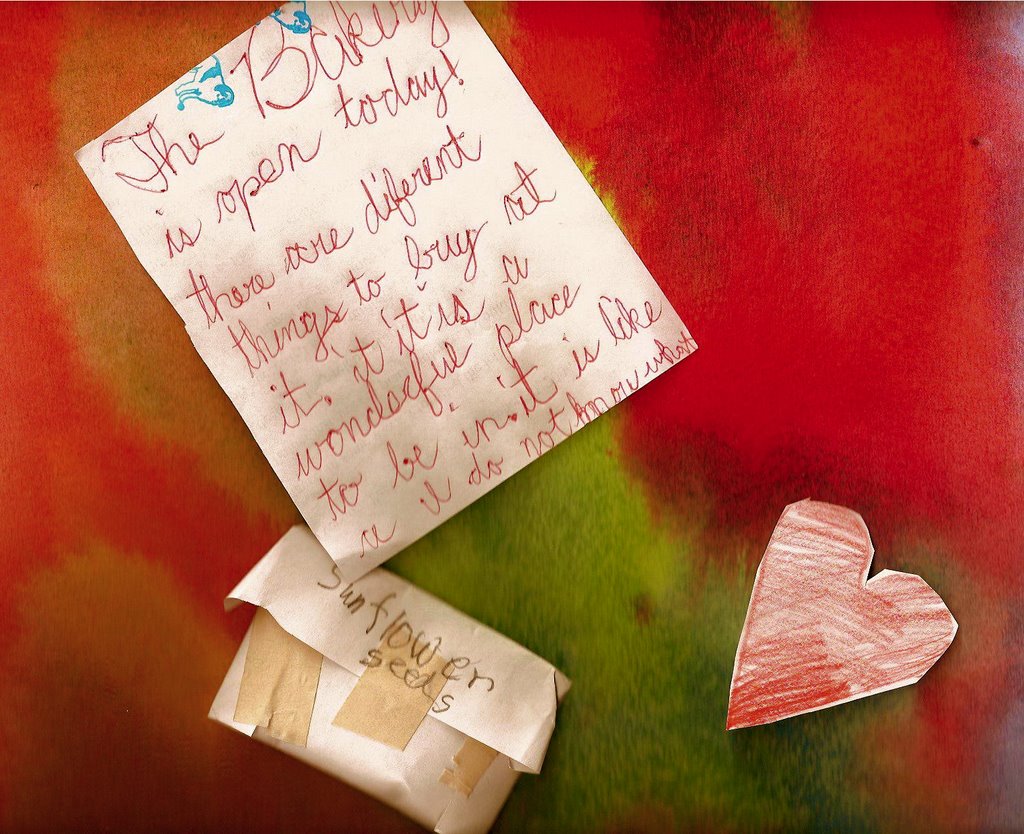
bakery notice, seeds for sale


As you see, I am not the only writer of the family. This reminds me to find last summer's saga, "The Gost and the Gril," a short story about a playful ghost and a fearful girl-- all written in multicolor pencil.

Oh, and the seed project: my children collected seeds from the pods of flowers of neighbors, constructed and labeled illustrated envelopes for the seeds, then proceded to sell the seeds back to the exact same neighbors. So far they have collected $4.80 and penciled in a few dozen meetings of The Seed Store onto their busy calendar. I got a complementary pack of sunflowers, after showing them how to rinse and dry tomato seeds.

Wednesday, June 07, 2006

the personal organizer

Kay is sleeping when I arrive, as she often is. When I call her name she doesn’t wake, but her snoring tells me she is fine. I peek in her door: her legs are folded Indian-style, or “criss-cross apple-sauce” as my daughter says these days. She is collapsed back onto a pile of pillows, looking both like a child and like someone on the threshold of the next world. She is so comfortable that she still doesn’t wake, so I haul out the box of files, set up my mug of coffee, and I dig into the stack of papers on her desk.

For a few hours a week, I am a personal organizer for Kay. It’s an excuse for us to spend time together, an excuse for her to pay me. Even recovering from a stroke, she is more organized than me, but she needs my eyesight and dexterity to sort through this mountain of mail. Her stroke occurred three years ago, and this stack measures the pace of her life since then, the halts and starts of medical procedures to keep her alive. In some ways, it is a record of her fight for independence, her fight to live on her own again, despite disabilities. There are bills and medical records from 2003 and from this year, and several of the years in-between. This is a first pass on these papers: I simply open envelopes and arrange all the Medicare files by month and stick them in the file folder. We will talk through these files later, deciding what to keep and what not to keep.

Postcards and photos and poems intermingle among these official papers, and I file them  in a small accordion file for “dear things.” Kay wakes, after another round of door-knocking and greeting on my part. She has an appointment in an hour, and waking is hard work for her. I read her a thank you note from a friend, and she softly brushes the thank you note against her face.

Kay is so fierce—these little glimpses of dearness slay me. If I falter at my task, fall into this sorrow, she may miss a necessary bill. If I slow down much, this pile will still greet me next week, too. How to be moved and not too moved, at the same time? If I were any more vulnerable at this work, I’m afraid I would cry all the time and be just useless. Compassion and work, side by side. She heads off to wash her face and swallow the medications she needs, the fresh thank you note tucked into her pocket.

Leaf by leaf, I sort. April 2003, twelve pages into this pile, June 2003, six pages into that file. Tucked in-between is a small stack of grid paper, torn out of a book. There are phone numbers and a name on the first page, in neat writing. This must be Kay’s handwriting before the stroke! I turn the page over to see where I ought to file this, and the page reads, “Today I will meet my daughter. She is twenty-three years old. I have not seen her for twenty-two and a half years. Her parents kept their promise and retained the name I gave her when she was born.” Four or five pages continue, but I have read something not mine, and it burns my eyes, my heart, my soul. Dear God, what else has this woman endured? I take off my glasses and cover my eyes.

“Are your eyes bothering you, dear?” she asks. She can see a little. I’m certain she cannot tell that I am holding pages from her diary. I quickly place the handwritten pages in the back of the file of dear things. From the first time I created this accordion file, I’ve not been certain she will ever really see these photos, postcards and notes again, whether she would recognize them if she did see them. They are kept “just in case.” In case she can see them. In case someone will read them to her, should she go completely blind. It’s clear that all the items in this folder are intimate—only a relative or close friend would be bold enough to read them for her. That person will know what to do, I surmise, whether to read these pages or not.

“My eyes are okay enough, Kay. I just need to refresh my coffee. I’ll finish this stack in a moment and then I’m ready to go.”

It’s a lie. My eyes are not okay. Kay’s daughter’s name was written clearly on that page and already my memory has blotted it out: not mine, not for me to know. It is one thing to read a story like that in a book. It is another to read it in handwriting, across the room from the writer of such a private truth. If it were my right to know such a story, I would talk with Kay about it, but it is clearly not my right. It’s likely I will never know how the story ends.

My eyes are waiting to rinse clear. My eyes know too much. She doesn’t need to know what I’ve seen.

I look Kay in the eye. “Ready?”

“I’m ready,” she answers. “Let’s go.”

Wednesday, November 30, 2005

intimate knowlege of...

I know way too much to be in this relationship. I have an intimacy problem: too much intimacy. Intimacy with organic produce.

Looking at my simple supper, the baby carrots are from Deep Roots Farm, in Vermont. I can similarly name the growers of the mostly gorgeous Boston lettuce, and the source of the Roma tomato. I know when they arrived at the organic grocery store where I work. I know the number of days I hauled them in and out of the walk-in cooler. I know why these vegetables were demoted to the “free” bin in the staff refrigerator. The chipotle ranch dressing gives a smoky kick at the end, which I love—that’s the one item I paid for in this dinner salad.

The stew is made with grass-fed beef and organic beef broth, both of which were pricey, but my employee discount comes in handy. The oregano, sea salt and thyme were practically free. Garlic and onions, well paid for, potatoes free. Red lentils thicken the broth, but they dissolve and no one knows of their presence but me. They cost pennies and impart a rich flavor.

Can I tell you a secret? I hate grocery stores—mine is a special exception. Prices of items go in one ear and out the other, or at least they did before. Now I know that the supermarket charges 75 cents more per pound for organic apples than my store, and I know because it’s my business to know, and because my store was short on apples when I needed to bake pies. I still hate the supermarket—that was my one trip since September. I love my little store, the sunlight streaming in the downtown windows and the funky music, depending on which staff person chooses it. I love the scent of the soaps near the cash register. I secretly love sweeping the amaranth grains off the floor with the big push broom.

Next secret? I detest dealing with produce. How can vegetables be so damned needy? I resent the rainbow chard for wilting and the bruises on the oranges, and the lettuces are like little neurotics, needing infinite care. Every item of produce is filed in its respective box overnight, me hauling it up and down, bundled in my sweaters in the big refrigerator. Every basket and bowl is washed, then the sinks and surfaces. And in the morning, wilty items are trimmed and soaked and primped, and it all starts again.

Now and then, though, some noxious produce chore makes me happy. Like today, when Kate tossed all the celery in the staff “free” bin, as it looked like it had been run over by a truck. I removed the outer layer of stalks of one bunch, intending to take it home, to find the celery hearts were quite sturdy and delicious, so I “redeemed” seven of the twelve pounds of formerly trashed celery. So no free celery today. I buy a bunch, instead, but take with it two free pounds of butter and some dated milk. And three chocolate-covered espresso beans that were “returned” by a customer.

I admit I have some reservations about bagging groceries, the one job I hoped to escape when I left my tiny hometown as an eighteen-year-old. I miss my work from last year, serving college students. I miss the prestige of a high hourly wage and I miss the way my schedule allowed me a few hours alone every day. That’s the downside.

But there is a third secret: it does not all even out in the end— even if I pay well for my food, I win, in every circumstance. It’s all such a gift, really good employers, really good meals made from really good ingredients at my intimately-known table. I toast my work life with a mug of hot cider, slightly past the “sell by” date and deliciously free.

Wednesday, August 24, 2005

for pay

Scribbled on the back of a bank deposit envelope, while waiting for the store’s deposit to be processed, a list of odd tasks from job descriptions in my life:

Unjam the bowling pin setter (wielding another pin like a bat).

Guide cave expeditions for large groups of small kids. Hide the bats from view.

Artfully rearrange a rotating display case for Parker Bros’ annual unveiling of new games, with a script timed to the second. Pay no attention to the woman behind the curtain with her hair on end!

Glaze and weatherproof old-fashioned pulley-weight windows.

Play victim for emergency cut-away rescue on a ropes course.

Give participants a helpful shove off a forty-foot high ropes course platform. Use a stepladder to remove participants from the forty-foot Tarzan swing.

Shake the”thunder sheet” to approximate a storm from backstage of a play.

Crush ten pounds of garlic with a French knife. “Smaller,” my student supervisors said. “Much smaller.”

Arrange a campus-wide discrimination of blue-eyed people for a racism simulation.

Write letters.

Pick apples on a high bluff, in the company of students from Namibia, Korea, Germany and Japan.

Sleep in the home of an elderly woman struggling to keep her independence.

Prevent children from sledding down the highly attractive lawn of a historic museum.

I have been a live-in tour guide for a historic home. I have nannied. I have sold books for a mail-order catalog, catered small-town events with my grandmother, served my favorite tabouli and pineapple-mint salsa to my supervisor’s dinner guests. I have temped. I have bussed tables and made milkshakes, and I have cleaned practically anything that needed to be cleaned. I have painted buildings. I have been guided to the top of the steeple of Mt. Lebanon Presbyterian, with an amazing view of downtown Pittsburgh, by a janitor whose graces I earned. I have dusted silverwork tooled by Paul Revere and paintings by John Singer Sargent. I worked as a telephone operator on one of those ancient plug-cord phone systems. I worked as a phone receptionist while recovering from dental surgery! I have played a lot of silly games and a few really good serious games. As a dorm director, I wandered the halls of my building, chatting with people. Library, post office, chapel, snack bar, yacht club, YMCA, bank, teacher of English as a Second Language, scrapbook design teacher, Sunday school educator, writing tutor.

And I am learning, now, how to use a cash register, how to use a pricing “gun,” how to straighten rows on shelves, how to multitask in public. Always, I am learning to listen with more sensitivity, to talk less. I’m learning not to start making birthday presents for childrens’ friends while running late for work. I’m learning how to “see for myself” what needs to be done to make the store just right. Secret: it’s pretty fun!

Saturday, August 06, 2005

reclaimed shelving

This is a piece I intend to send to the editorial page of the local paper, once I've passed it by my employers for an okay.

I am up to my elbows in this strange black grease. The posts for the kitchen shelves are marked inch by inch with a number, and the highest number is 84, so 84 times I press my rag-covered thumbnail into each groove while spinning the pole with my other hand. Eighty-four little globs of ancient grease evicted, eighty-four grooves disinfected. There are sixteen poles, for four sets of industrial wire shelving. There’s no need to do the math: each groove needs to be clean.

In a twist of irony, the expanding Common Crow store purchased kitchen shelving from what was once McT’s, so you get the picture: I am removing years of cooked-on airborne grease from hamburgers and onion rings, fishermen’s platters and French fries. I am reclaiming shelving from a carnivore haven in order to serve customers shopping for organic groceries, including (but not limited to) vegetarians and vegans. Now, I am a carnivore, in fact an omnivore if you get right down to it, but I certainly don’t want any remnants of my last burger at McT’s to contaminate my current groceries. So I clean. I believe in recycling. So I clean some more.

My mother created two cleaning aprons for my husband and me to organize our housecleaning efforts when we were first married. I sent her a picture of the apron I wanted, with pockets for my cleaning razor and my putty knife, with loops for my spray-bottles, with a pocket the size of a gallon bag for trash and, in this case, congealed brown bits. For a joke, she designed these aprons in a Mickey Mouse print, so we would have more fun, I suppose. I did not ask her for aprons because I love to clean—I asked her for aprons because it is the kind of practical project she would love, a practical way to serve us. Scott’s apron is gathering dust on the hanger, but I will need his when I wear out my scrubby sponge pocket.

My first full-time job was serving on the work crew of a summer camp in northern Indiana, and all of us got to try a hand at every kind of chore: chopping wood, raking the beach, digging postholes, and of course, cleaning. Lorraine was my beloved supervisor, and she taught me how to clean every kind of surface that could ever need to be cleaned. I did not love cleaning then, either, but I loved working with my crewmates, and the sooner the work was done, the sooner the staff went swimming in the camp’s lake. I did not want the staff to wait in the truck until I cleaned the oven again, more thoroughly, so I learned my job, well.

At that time, also, I did not like to do cleaning tasks on my own—it felt like being banished and missing the action I felt sure was happening somewhere. Now is different. I am the mother of two small children, and doing any task without interruption, until the project is completed… well, it is so rare that it practically sets me to reverie just thinking about it. I could think my own thoughts! I could sing, if I want to!

I can see Pat and Kate, the owners of the Common Crow, are concerned I will feel insulted by the nasty cleaning task, or perhaps desperate to be stuck off in the new store working endless hours alone with my cleaning fluids and putty knife, but I don’t mind. I couldn’t do this every day, but it’s good work, work that needs thoroughness and patience and elbow grease. It requires a ridiculous amount of time, and to be honest, there is no hourly wage that could pay enough to do this work. It takes a bit of love, a bit of singing, a putty knife. I have all three.

Eight hours pass and I have used two ragged bathtowels, two scrubby sponges, two microfiber cleaning cloths and two bottles of heavy-duty cleaner. The underneath sides of the shelves are the worst, hiding a black mold, as well as the other stuff. My cleaning razor definitely needs a new blade and the entire cleaning apron needs a good wash to be freed from the smell of old grease.

There are good shelves here, for vegetables untainted by cooking grease. Or organic meat. I go home to shower off the gooey globs and wash my hair with some organic lavender shampoo from the store’s sample basket. I emerge to find a long thank you message on the answering maching from Kate for my heroic cleaning effort. The new and expanded Common Crow will open in a few weeks, and I’ve given a good effort toward the move. I play the message three or four times and sit down to a nice dinner my husband has grilled for me: hamburgers, thick and juicy, dripping with fat, just the way I like them.