My mother was a sneak when making snacks, and as a mother, now, I see the beauty of this method. If you say, “would you like popcorn?” what you get is a chorus of alternatives that family members would prefer, and no one is satisfied. However, if the aroma and sound of popcorn is allowed to speak for itself, who can really resist?
White popcorn. That is the tender kind grown in Indiana, the kind in bags labeled “Cousin Willie’s,” that is my favorite. I also like red popcorn and black jewel, but I’d rather go hungry than eat yellow popcorn (too tough), and I avoid microwaved popcorn unless I am simply starving. What is that stuff in the bag? White popcorn. I have been known to buy twenty pounds of it for the trunk of my car, when traveling home from the Midwest, before the local stores carried Cousin Willie’s.
My father loves popcorn, and I wonder if we actually ate a giant bowl or two of popcorn every single night, as my memory tells it, in my growing up years, or if I have exaggerated the truth. Coca-cola, popcorn, salt, television. Followed by vanilla ice cream, with chocolate sauce, and more television. That’s the way I remember it.
My mom would disappear into the kitchen, and then emerge with a silvery aluminum bowl, edged as if with pinking shears, brimming with hot white popcorn. My father’s lap was the aluminum bowl’s home base, and the rest of us filled and refilled our smaller bowls from Dad’s. Butter was nice, but not necessary. Salt was critical, in huge quantities. My father often stood at the kitchen counter, the next morning, picking out the good kernels leftover in the emptying aluminum bowl, and licking his finger to pick up the grains of salt.
I’ve tried a number of popping methods over the years, but I’ve returned to the same method my mom employed: the big stockpot, coconut oil if I can afford it, and lots of shaking. I believe my older brother owns the aluminum popcorn serving bowl, but we, too, use the dad’s big bowl method, with a wooden bowl.
My children, though, have come to love a special little twist: I take half the big batch of popcorn into a separate bowl. I melt butter, off heat, in the hot stockpot, then toss the popcorn in the butter. When I pour the buttered corn into the bowl again, I sprinkle the popcorn with a mixture of cinnamon and sugar, and a touch of salt. Not as sweet as caramel corn, nor as sticky, nor as complicated. And we eat popcorn without the television, almost always. What matters is the quantity, and the good company gathered around the one big bowl.
The secret ingredients are cinnamon, of course, and sneak-erie. I’m eyeing the stockpot right now, but very quietly, quietly…
Wednesday, September 13, 2006


Tuesday, September 05, 2006
soot-coated skillet
I’m finding pieces I’ve written and “set aside” in my files. This is a report from a camping trip in mid-July, long past and fondly remembered, now that the threat of biting flies is long gone.
The humidity has broken, and I find myself listing the chores I couldn’t possibly tolerate, even yesterday. I pull the skillet and the griddle down from the rack. Though each pan journeyed through the dishwasher at least half a dozen times, the sticky campfire soot remains on the bottom. Just a week ago, this griddle sauted a mountain of red peppers for fajitas, topped by a mountain of sauted onions. The skillet bubbled the following night with Liz’ homemade red sauce, augmented by the leftover roasted peppers, onions, summer squash, and meatballs. One of my new favorite Boy Scout campers informed me that I ought to coat the pan bottoms with a bar of soap before cooking, so the soot would wash right off. But I was in a hurry, the bar of soap was far away in the toiletries bag, in another lean-to. His pans washed off beautifully, the first time.
“How did you DO that?” I asked.
“Just the way I told you,” replied the Boy Scout alumni. I blinked several times in a row at him, and I did not yell at him that he was such a smartass, the way I would yell at my brothers as a kid, when bested at a simple task. It takes me longer to scrub, now, than it would have taken to run to the other lean-to, and dig through my things to procure the bar of soap.
For much of my adult life, I have been The Competent One, regarding household anything. The Technological Guru (funny, given how little I actually know), The Cook, The Organizer of Everything. I’m the person who knows cleaning techniques, the contents of the pantry, and the person with a hundred kid-craft activities up her sleeve. I don’t often work in the garden, but I do know how. I am the person in charge of Where Things Go, Making Clothes Match, repairs to every kind of object.
So it’s a bit disconcerting to be out-competenced. At the end of our camping trip, I stood in a blazing hot flatbed of a truck to place each piece of equipment, jigsaw-like, into a good fit. I arrived back at the same spot fifteen minutes later to find that every single item had been moved to the opposite side of the truck. Why did I stand in the blazing sun, then, was my first unspoken question. So this is what that feels like, the next unspoken statement. This is what it feels like to have my own effort undone in the cause of someone else’s vision. “The Guys” moved everything, it turns out, to fit the canoe our group brought, and they did a perfect job.
It’s just a strange role for me, to be outdone, re-done, a little undone. The feeling amuses me, which is good, because I could name a dozen such instances over the course of three days of camping. Because I don’t often compete for anything, I had the luxury of thinking that I’m not really competitive, but now there are people in my league of problem-solving, and I need to bow in admiration. It’s fun to learn new tricks. And it’s weird to hear, “Let me show you another way of doing that.”
Both new friend Boy Scouts built me the perfect cooking fire for my dinner, the first night out, while involving children in the building of it. One Boy Scout assembled appetizers: water crackers topped with brie and pepper jelly. The other Boy Scout—and I am not kidding about this—pulled out a hatchet and a pile of huge nails, found a long flat plank and assembled a fireside cooking counter for my cutting boards and utensils! My favorite non-Boy Scout Man chopped vegetables like a professional, half a dozen peppers, the same number of onions, to grill for fajitas. I hauled two huge steaks and a few chicken breasts from the grill and sliced them, on the new plank counter in front of the fire, placing the slices onto warm tortillas, to be topped with salsa and lettuce and sour cream and cheese. I was very popular, but I was supported by a cast of five parents and a tribe of hungry, sweaty children with a taste for adventure—and fajitas. I just cooked it, that’s all. I wrapped up my fajita, full of steak, and the appetizer Boy Scout handed me a glass of wine. I like camping!
I actually like the two Boy Scout husbands of my two friends, also, and not just for their skills or the wine. They are such good people, and I suppose, when it gets right down to it, that I have a lot to learn from them. I have hiked four or five 14,000 foot peaks, can cook tasty meals on an open fire, and can assemble a tent I’ve never seen in ten minutes flat. But I’ve never been a Boy Scout, and if they know secrets about skillets, soot, and soap-- and they pack the wine and the appetizers-- they are invited on my camping trip, any day.
The humidity has broken, and I find myself listing the chores I couldn’t possibly tolerate, even yesterday. I pull the skillet and the griddle down from the rack. Though each pan journeyed through the dishwasher at least half a dozen times, the sticky campfire soot remains on the bottom. Just a week ago, this griddle sauted a mountain of red peppers for fajitas, topped by a mountain of sauted onions. The skillet bubbled the following night with Liz’ homemade red sauce, augmented by the leftover roasted peppers, onions, summer squash, and meatballs. One of my new favorite Boy Scout campers informed me that I ought to coat the pan bottoms with a bar of soap before cooking, so the soot would wash right off. But I was in a hurry, the bar of soap was far away in the toiletries bag, in another lean-to. His pans washed off beautifully, the first time.
“How did you DO that?” I asked.
“Just the way I told you,” replied the Boy Scout alumni. I blinked several times in a row at him, and I did not yell at him that he was such a smartass, the way I would yell at my brothers as a kid, when bested at a simple task. It takes me longer to scrub, now, than it would have taken to run to the other lean-to, and dig through my things to procure the bar of soap.
For much of my adult life, I have been The Competent One, regarding household anything. The Technological Guru (funny, given how little I actually know), The Cook, The Organizer of Everything. I’m the person who knows cleaning techniques, the contents of the pantry, and the person with a hundred kid-craft activities up her sleeve. I don’t often work in the garden, but I do know how. I am the person in charge of Where Things Go, Making Clothes Match, repairs to every kind of object.
So it’s a bit disconcerting to be out-competenced. At the end of our camping trip, I stood in a blazing hot flatbed of a truck to place each piece of equipment, jigsaw-like, into a good fit. I arrived back at the same spot fifteen minutes later to find that every single item had been moved to the opposite side of the truck. Why did I stand in the blazing sun, then, was my first unspoken question. So this is what that feels like, the next unspoken statement. This is what it feels like to have my own effort undone in the cause of someone else’s vision. “The Guys” moved everything, it turns out, to fit the canoe our group brought, and they did a perfect job.
It’s just a strange role for me, to be outdone, re-done, a little undone. The feeling amuses me, which is good, because I could name a dozen such instances over the course of three days of camping. Because I don’t often compete for anything, I had the luxury of thinking that I’m not really competitive, but now there are people in my league of problem-solving, and I need to bow in admiration. It’s fun to learn new tricks. And it’s weird to hear, “Let me show you another way of doing that.”
Both new friend Boy Scouts built me the perfect cooking fire for my dinner, the first night out, while involving children in the building of it. One Boy Scout assembled appetizers: water crackers topped with brie and pepper jelly. The other Boy Scout—and I am not kidding about this—pulled out a hatchet and a pile of huge nails, found a long flat plank and assembled a fireside cooking counter for my cutting boards and utensils! My favorite non-Boy Scout Man chopped vegetables like a professional, half a dozen peppers, the same number of onions, to grill for fajitas. I hauled two huge steaks and a few chicken breasts from the grill and sliced them, on the new plank counter in front of the fire, placing the slices onto warm tortillas, to be topped with salsa and lettuce and sour cream and cheese. I was very popular, but I was supported by a cast of five parents and a tribe of hungry, sweaty children with a taste for adventure—and fajitas. I just cooked it, that’s all. I wrapped up my fajita, full of steak, and the appetizer Boy Scout handed me a glass of wine. I like camping!
I actually like the two Boy Scout husbands of my two friends, also, and not just for their skills or the wine. They are such good people, and I suppose, when it gets right down to it, that I have a lot to learn from them. I have hiked four or five 14,000 foot peaks, can cook tasty meals on an open fire, and can assemble a tent I’ve never seen in ten minutes flat. But I’ve never been a Boy Scout, and if they know secrets about skillets, soot, and soap-- and they pack the wine and the appetizers-- they are invited on my camping trip, any day.
Monday, September 04, 2006
cafe viet nam
“Find a good place to wait,” he said on my cell phone. “I’ll be another half hour.”
“See you soon then.”
I peeled off the long-sleeve cotton over layer, a second layer of white linen, and folded the bright sarong I was using as a shawl. The inside of the bus was still too cold, as the passengers slowly gathered their bags and worked their way out into the night. The outside air seemed not to have cooled a bit since midday. How long before I sweat through all of my clothes and into the padding of my backpack, all over again?
The ticket was still in my skirt pocket: Lucky Star Express Bus, fifteen dollars. Keep your receipt! The tenth ride is free! Now there’s a thought. Only four hours to bullet down the highway from Boston to New York. I tucked the ticket back into my pocket and wondered how long before I lost track of it. I followed the line down the steps into the smell of heat and bus exhaust and garbage. I don’t like this kind of summer heat, and the smell is overwhelming—none-the-less I find a smile creeping up my face.
“Made it this far,” I whisper to myself."DC, tomorrow."
Like the Fung Wah bus, the Lucky Star drops on a corner of Chinatown. Both "Chinatown-to-Chinatown" bus lines use luxury charter buses. Both are, as they say in Boston, wicked fast. Unlike the Fung Wah, at least the Lucky Star stops on a side street, not on an exposed major intersection, and there is one lone street bench where the forty riders collect themselves and their baggage. A small tribe of elderly Asian women appear to be in charge of the tiny bus office and the luggage removal. The driver ducks into the office to pick up his next roster of passengers.
I’ve already traveled the circuit of heat sickness today, beginning with the walk to the two-thirty train—three blocks with no shade except the overpass and my straw sun hat, me carrying my book bag, my messenger bag, and a tote bag. They seemed light when I packed them. They don’t seem light as I carry them. Then the Boston subway system, then the bus terminal at South Station and the shift from too, too hot, to too, too cold. Now too hot again.
A surprise wind scatters papers and leaves, and a flash of lightning illuminates the small park across the street. Hundreds of people sit in the heat of the night. I cross the street to see what’s up. I see, then, the recessed playground where children scramble, while adults and teenagers chat without excess movement. I imagine hot apartments where children have been cooped up all day to avoid the heat, waiting for “the cool of the night,” but there is still no cool, here.
I peek around a building and see another green space filled with hundreds of people sitting near a fountain, chatting in small groups. Just past them is a beautiful view of that stone archway, and now I know I’m close to the river that separates Manhattan and Brooklyn. It’s the only landmark I know in all of Chinatown, and even then, I don’t know its name. I scan the block— I have just barely avoided heat-sickness, and I know I need to eat, though I have no real appetite. There are no outdoor vendors. No signs in English. And another lightning flash and thunderclap nearby fails to move anyone. I turn back to the street corner with the street bench/bus office—and I see a brightly-lit storefront right around the corner. Café VietNam! Once again, I feel a smile pulling at the corners of my mouth. Is there anything I’d like more?
Café VietNam is not air conditioned, but a strong fan blows directly onto the empty table by the window. The proprietor seems like an old friend I’ve never met, someone from another time. He fills an old-fashioned plastic glass with ice water and hands me a menu.
“Do you have spring rolls?” I ask.
“Yes, but that will take a half an hour to fry. We make everything fresh—you are waiting for your ride?”
“Wait—What I’m looking for is cold. What do you call cold wrapped rolls?”
“Oh! Summer rolls—you want summer rolls? That is a good choice tonight.” I look at the menu again. Three dollars and fifty cents!
“Yes. Summer rolls. That is exactly what I want.”
“I make the peanut sauce, myself,” says the proprietor.
We watch another lightening flash, and he turns to the kitchen as a downpour erupts in the street, the hundreds of people scattering, back to their homes, perhaps. Some people don’t hurry—the muscled dark-skinned man with a roll of copper tubing over his shoulder carries his burden as lightly as a handbag. An elderly Chinese woman laughs as she wheels a hand-truck filled with boxes of cabbage. I worry about the bicyclers— helmetless on this dreadful-hot night, and now in a downpour. Two groups of teenagers stumble in the door, laughing, and without asking, the proprietor brings them cold glasses of some sort of milky-looking drink from the cooler, like the waitresses back home would automatically bring some customers icy bottles of Coke. I open the hard cover book from my messenger bag.
He arrives next with two of the most beautiful summer rolls I have ever seen—three large pink shrimp show against the green of lettuces, cilantro and mint, chilled rice noodles, held together with translucent rice paper. Sprigs of lemon grass adorn the rolls. And the peanut sauce is amazing. I pay at the counter, explaining my ride might arrive any minute, and he nods, and comes to fill my water glass again. My ride calls—he is lost somewhere in Manhattan, driving in lightning and a rainstorm. It will be awhile.
I settle in with my book, and the proprietor refills my glass with ice water and assurances. “You stay. You stay as long as you need.” I’m so relieved I don’t notice the hour that passes, the customers dwindling, the young man with the mop. “It’s nine-forty-five, miss. We are closing.” I pack up, apologetically, leaving a generous tip for a four dollar meal whose taste I will remember affectionately for the rest of my life. I make my way into the steamy, still wet streets, finding the next place to wait for my ride.
“See you soon then.”
I peeled off the long-sleeve cotton over layer, a second layer of white linen, and folded the bright sarong I was using as a shawl. The inside of the bus was still too cold, as the passengers slowly gathered their bags and worked their way out into the night. The outside air seemed not to have cooled a bit since midday. How long before I sweat through all of my clothes and into the padding of my backpack, all over again?
The ticket was still in my skirt pocket: Lucky Star Express Bus, fifteen dollars. Keep your receipt! The tenth ride is free! Now there’s a thought. Only four hours to bullet down the highway from Boston to New York. I tucked the ticket back into my pocket and wondered how long before I lost track of it. I followed the line down the steps into the smell of heat and bus exhaust and garbage. I don’t like this kind of summer heat, and the smell is overwhelming—none-the-less I find a smile creeping up my face.
“Made it this far,” I whisper to myself."DC, tomorrow."
Like the Fung Wah bus, the Lucky Star drops on a corner of Chinatown. Both "Chinatown-to-Chinatown" bus lines use luxury charter buses. Both are, as they say in Boston, wicked fast. Unlike the Fung Wah, at least the Lucky Star stops on a side street, not on an exposed major intersection, and there is one lone street bench where the forty riders collect themselves and their baggage. A small tribe of elderly Asian women appear to be in charge of the tiny bus office and the luggage removal. The driver ducks into the office to pick up his next roster of passengers.
I’ve already traveled the circuit of heat sickness today, beginning with the walk to the two-thirty train—three blocks with no shade except the overpass and my straw sun hat, me carrying my book bag, my messenger bag, and a tote bag. They seemed light when I packed them. They don’t seem light as I carry them. Then the Boston subway system, then the bus terminal at South Station and the shift from too, too hot, to too, too cold. Now too hot again.
A surprise wind scatters papers and leaves, and a flash of lightning illuminates the small park across the street. Hundreds of people sit in the heat of the night. I cross the street to see what’s up. I see, then, the recessed playground where children scramble, while adults and teenagers chat without excess movement. I imagine hot apartments where children have been cooped up all day to avoid the heat, waiting for “the cool of the night,” but there is still no cool, here.
I peek around a building and see another green space filled with hundreds of people sitting near a fountain, chatting in small groups. Just past them is a beautiful view of that stone archway, and now I know I’m close to the river that separates Manhattan and Brooklyn. It’s the only landmark I know in all of Chinatown, and even then, I don’t know its name. I scan the block— I have just barely avoided heat-sickness, and I know I need to eat, though I have no real appetite. There are no outdoor vendors. No signs in English. And another lightning flash and thunderclap nearby fails to move anyone. I turn back to the street corner with the street bench/bus office—and I see a brightly-lit storefront right around the corner. Café VietNam! Once again, I feel a smile pulling at the corners of my mouth. Is there anything I’d like more?
Café VietNam is not air conditioned, but a strong fan blows directly onto the empty table by the window. The proprietor seems like an old friend I’ve never met, someone from another time. He fills an old-fashioned plastic glass with ice water and hands me a menu.
“Do you have spring rolls?” I ask.
“Yes, but that will take a half an hour to fry. We make everything fresh—you are waiting for your ride?”
“Wait—What I’m looking for is cold. What do you call cold wrapped rolls?”
“Oh! Summer rolls—you want summer rolls? That is a good choice tonight.” I look at the menu again. Three dollars and fifty cents!
“Yes. Summer rolls. That is exactly what I want.”
“I make the peanut sauce, myself,” says the proprietor.
We watch another lightening flash, and he turns to the kitchen as a downpour erupts in the street, the hundreds of people scattering, back to their homes, perhaps. Some people don’t hurry—the muscled dark-skinned man with a roll of copper tubing over his shoulder carries his burden as lightly as a handbag. An elderly Chinese woman laughs as she wheels a hand-truck filled with boxes of cabbage. I worry about the bicyclers— helmetless on this dreadful-hot night, and now in a downpour. Two groups of teenagers stumble in the door, laughing, and without asking, the proprietor brings them cold glasses of some sort of milky-looking drink from the cooler, like the waitresses back home would automatically bring some customers icy bottles of Coke. I open the hard cover book from my messenger bag.
He arrives next with two of the most beautiful summer rolls I have ever seen—three large pink shrimp show against the green of lettuces, cilantro and mint, chilled rice noodles, held together with translucent rice paper. Sprigs of lemon grass adorn the rolls. And the peanut sauce is amazing. I pay at the counter, explaining my ride might arrive any minute, and he nods, and comes to fill my water glass again. My ride calls—he is lost somewhere in Manhattan, driving in lightning and a rainstorm. It will be awhile.
I settle in with my book, and the proprietor refills my glass with ice water and assurances. “You stay. You stay as long as you need.” I’m so relieved I don’t notice the hour that passes, the customers dwindling, the young man with the mop. “It’s nine-forty-five, miss. We are closing.” I pack up, apologetically, leaving a generous tip for a four dollar meal whose taste I will remember affectionately for the rest of my life. I make my way into the steamy, still wet streets, finding the next place to wait for my ride.
Saturday, August 19, 2006
below the whisker-lines, under the bowsprit
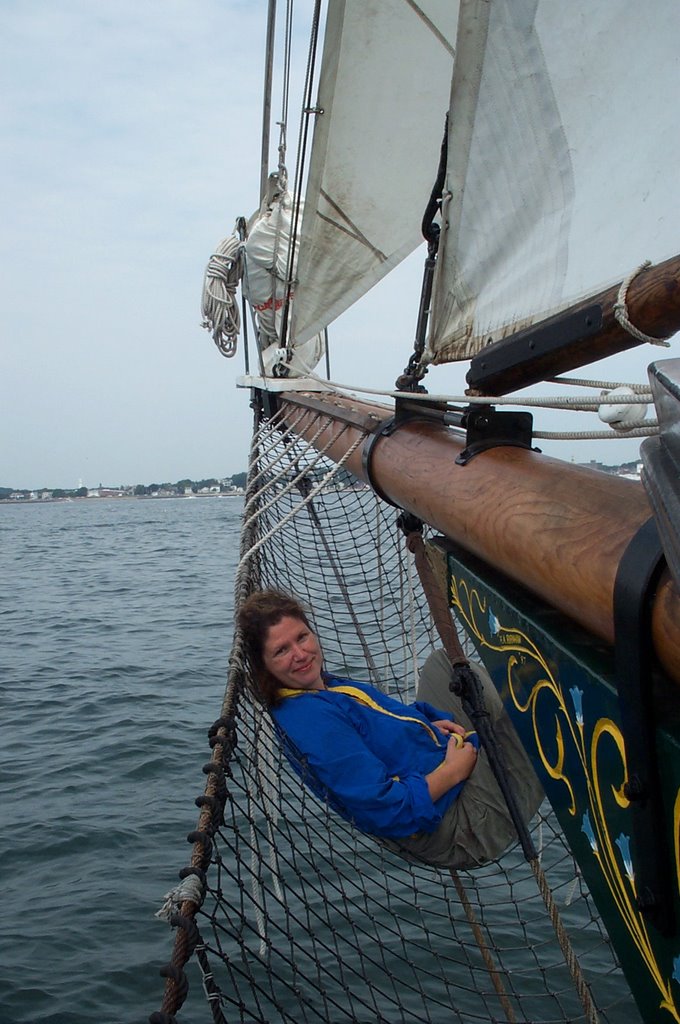
More than once in my life, I have staged photos to make me appear to be in a more precarious place than I actually am. This photo? This photo looks a fraction of how precariously I am hanging above the Atlantic-- perhaps fifteen feet above the surface of the water, speeding along on the breeze... First time on a sailboat in twenty years or so. I convinced the captain I'm a good climber. Good thing he didn't ask if I'm a good swimmer-- because I am a bad liar. He let me ride in this net for the last half-hour of the sail, rocking and swaying in my comfortable "hammock."
"The winds of grace blow all the time. All we need do is set our sails." The quote is attributed to Ramakrishna. I know nothing about sails. But I know how to climb. Wind and grace are ever connected in my mind.
This ride was an anniversary gift from our neighbor, who sings the sea chanties while folks hoist the sails onto the masts.
Monday, August 07, 2006
it's the skirt, isn't it?
My friend still hadn’t arrived, so I set up shop on the rainy corner of Chinatown, a few blocks from the Manhattan Bridge: my backpack leaned against the wall, my tote between my feet, I pulled out my glasses and the new hard-cover I’m devouring. My clothes were sweat-through and nearly dripping all over again when two college age young men cycled right up to me. They were cute and hip Anglo’s just as out-of-place as me, and the one with the great glasses began to ask me detailed questions—it took me a moment to realize he was asking me for directions!
“Wait a minute! You’re telling me I don’t look utterly disoriented and like a probable victim for tourist-mugging? I have no idea where I am! It’s not written all over me?”
The two guys looked at each other, then back at me in apparent admiration. The one with the curls spoke next, “No—no, not at all. You look exactly like you own this block.”
We’re suddenly co-conspirators, guards let down as we realized we are equally clueless in a city and neighborhood where cluelessness could be dangerous. “Tell me, so I can know: it’s the skirt, isn’t it?”
“No,” said the curly-haired one, “it’s the book. But then, it’s everything. You look quite comfortable.”
“Definitely the book,” the first one laughed. He whispered, in a congratulatory tone “You project complete confidence.”
“It’s whistling in the dark, you know, false courage when you’ve run out of options.”
“It works. A wall of courage. Your ride comin’ soon?”
“Anytime. He’s within a few blocks.” I shook my head and continued reading as they cycled off into the night.
“Wait a minute! You’re telling me I don’t look utterly disoriented and like a probable victim for tourist-mugging? I have no idea where I am! It’s not written all over me?”
The two guys looked at each other, then back at me in apparent admiration. The one with the curls spoke next, “No—no, not at all. You look exactly like you own this block.”
We’re suddenly co-conspirators, guards let down as we realized we are equally clueless in a city and neighborhood where cluelessness could be dangerous. “Tell me, so I can know: it’s the skirt, isn’t it?”
“No,” said the curly-haired one, “it’s the book. But then, it’s everything. You look quite comfortable.”
“Definitely the book,” the first one laughed. He whispered, in a congratulatory tone “You project complete confidence.”
“It’s whistling in the dark, you know, false courage when you’ve run out of options.”
“It works. A wall of courage. Your ride comin’ soon?”
“Anytime. He’s within a few blocks.” I shook my head and continued reading as they cycled off into the night.
Friday, August 04, 2006
tenderheaded
Handfuls of hair collect near the drain each time I wash my hair. It startles me, as if I haven’t been losing two fists worth of hair every single wash for the past several months. There’s no need to be alarmed: my hair could cloak three heads, at least, and perhaps I will notice a difference in quantity after another few months of this. Still, the sight is a strange one, something rinsing away from me. It was just a part of me, a minute ago.
My hair has always been like a fussy pet. It won’t tolerate conditions other people consider normal: normal haircuts shape my hair like a Christmas tree, or worse, like a square. A normal blow-dryer can destroy my hair until the next wash, and a curling iron or flat-iron is simply no match for my hair’s deep desire to go it’s own way. Treated just right, though, it’s become my one lasting vanity—it dresses up well, it dresses down well. As long as I treat it with care.
Bits of my hair crackled off when I lived in the pine barrens of eastern Washington for a few years—I woke each morning to find desiccated pieces of dark hair on my pillow, would buy any moisturizing product my hairdressers recommended, in hopes moisture would sink in. On those rare weekends I traveled across the Cascade Mountains toward Seattle, I could almost hear my hair (and my skin, for that matter) sigh with relief as I entered the damp curtain of humidity. For a few days, my hair would remember how to be happy again, before I returned to the desert.
Now I live by the sea, where the weather is always damp and suited to my dense curls. I pull it up and away from my face, almost every day of summer. Ponytail, braids, French twist—there are so many options. I’m good to my pet, feeding it bottles of Frizz-Ease (Extra Strength), covering it with a big straw hat at the beach.
I began a combination of supplements, a few months ago, to alleviate headaches, and the headaches left almost immediately. The doctor thought my mood would lift, and it lifted sooner than we expected. She told me I would gain weight for a few months. She mentioned I might be uncomfortable. She did not tell me the texture of my skin would change. She did not tell me I would lose hair. I’ll go back and read all of the fine print from the pharmacy and see what I learn.
Until then, I wash my exotic pet hair with the reminder to myself: I have plenty, plenty. It only looks scary, washing away like that. I wonder if each strand was connected to a headache I will not suffer, as I watch it go. I imagine all the terrible reasons people lose hair, in cancer treatments, for surgery. This is not so bad. No one sees it go, no one but me. No one sees a single hair of difference in me. No one is upset. But me.
Addendum: I wrote this a month ago—the hair loss has slowed considerably. Now I hope that little weight-gain thing also “subsides,” as the good doctor described it would.
My hair has always been like a fussy pet. It won’t tolerate conditions other people consider normal: normal haircuts shape my hair like a Christmas tree, or worse, like a square. A normal blow-dryer can destroy my hair until the next wash, and a curling iron or flat-iron is simply no match for my hair’s deep desire to go it’s own way. Treated just right, though, it’s become my one lasting vanity—it dresses up well, it dresses down well. As long as I treat it with care.
Bits of my hair crackled off when I lived in the pine barrens of eastern Washington for a few years—I woke each morning to find desiccated pieces of dark hair on my pillow, would buy any moisturizing product my hairdressers recommended, in hopes moisture would sink in. On those rare weekends I traveled across the Cascade Mountains toward Seattle, I could almost hear my hair (and my skin, for that matter) sigh with relief as I entered the damp curtain of humidity. For a few days, my hair would remember how to be happy again, before I returned to the desert.
Now I live by the sea, where the weather is always damp and suited to my dense curls. I pull it up and away from my face, almost every day of summer. Ponytail, braids, French twist—there are so many options. I’m good to my pet, feeding it bottles of Frizz-Ease (Extra Strength), covering it with a big straw hat at the beach.
I began a combination of supplements, a few months ago, to alleviate headaches, and the headaches left almost immediately. The doctor thought my mood would lift, and it lifted sooner than we expected. She told me I would gain weight for a few months. She mentioned I might be uncomfortable. She did not tell me the texture of my skin would change. She did not tell me I would lose hair. I’ll go back and read all of the fine print from the pharmacy and see what I learn.
Until then, I wash my exotic pet hair with the reminder to myself: I have plenty, plenty. It only looks scary, washing away like that. I wonder if each strand was connected to a headache I will not suffer, as I watch it go. I imagine all the terrible reasons people lose hair, in cancer treatments, for surgery. This is not so bad. No one sees it go, no one but me. No one sees a single hair of difference in me. No one is upset. But me.
Addendum: I wrote this a month ago—the hair loss has slowed considerably. Now I hope that little weight-gain thing also “subsides,” as the good doctor described it would.
Subscribe to:
Posts (Atom)