written on a sweltering Sunday two weeks ago-- church school started last week.
I sit by the window this hot, hot morning in church, glad I dressed in lightweight layers—a pink camisole I don’t wear often, covered with a tunic of sheer silk, the floral skirt and plain sandals. I take these summer church services as a personal retreat into who I once was, a worshipper undistracted. In my pew by myself, I forget anyone else exists for stretches at a time. I sing “like a charismatic,” as one Episcopal friend puts it, head thrown back and happily lost to all but my one great love.
I come alone to church in summer, just for this.
During the fall, winter and spring, I teach church school for ages nine to twelve. I do my best to do justice to the children and the material, and I fail sometimes, but they know I love them. When I finish church school, I rant a little to anyone in the kitchen as I get a glass of water and I try to shake off the tensions, the frustrations and the power struggles. Afterwards I arrive in the sanctuary late, rattled, thinking what I will do differently next week—I do not arrive in a meditative state. During the worship service, I’m aware of my oldest child and all the other children from my church school classroom: are they paying attention to the sermon? Are they antsy and needing assistance?
When the schedule shifts in summer months, then, my husband attends the eight a.m. worship service and I attend the ten a.m. service, while the kids stretch out on the floor at home and toodle with toys, and skip church entirely. Parents “tag team;” children lounge. Our congregation offers no church school, no childcare for children over seven in the summer. I know I could easily “make” children attend worship, but then I would lose my retreat.
Will I pay later for this choice? Am I passing along the wrong message? I LOVE GOD. More than anyone or anything else. It’s not a message to anyone, against anyone. In summer I experience God, truly for me. Quite honestly it’s the most selfish thing I do all week, go to church. I walk in slowly, sit down slowly. I pack my journal and noodle around a bit before things start. I sing with gusto. I cry inexplicably.
And toward the end of the service on this hot, hot day, I sit with my back against the arm of the pew, kick my sandals off and place my shoeless feet on the pew to sit and listen to the postlude. I close my eyes and pretend it’s just me. Something tickles my foot and I jump—I look up to find a white-haired friend from the pew behind me, with his finger curled a few inches away from my foot, laughing merrily. “I couldn’t resist!” he whispered. “You remind me so much of my daughter.” His wife slaps him in the shoulder, but he is busy being bemused, obviously thinking his actions worth the cost. I laugh at him and shake my head, then close my eyes again and return to the lovely fugue.
When the organ solo ends, Charlie’s wife quickly exits, scandalized. Charlie shrugs and apologizes, still smiling at his church mischief. I brush off the apology and ask him how he is, how is his wife, how are their children. I’m an easy target for flirting, in my summery clothes, radiating happiness. I know Charlie enough to know he is harmless and kind-hearted and there is nothing at stake except his wife’s pride. Nowhere else do I get this treatment but my church, and at times it’s given me as much life as it gives my favorite old men. I am not the same kind of pretty I once was. I weigh too much, and my forehead sports a grid of deep creases. Everyone here knows my husband, my children, my reputation as a teacher and my happy summer arrangement. I am harmless, too. My regular flirt, Dan, is out sailing today, his own summer schedule, and perhaps Charlie thought I’d be lonely. No matter. I hope his wife will forgive his indulgence, but he couldn’t care less, just now, wrapped in his own merry orneriness.
We are both worship hedonists, today, then, me and Charlie. I’m coming back next Sunday, too, my last hedonist Sunday before church school begins. I only wink at my man Dan, but I’ll smile at Charlie if I see him, and I’ll make it a point to talk with his wife about kids and houses and weather, to make sure she knows I’m not embarrassed or put off by Charlie’s impishness. Not at all. I wish him joy, while summer lasts.
Showing posts with label spirituals. Show all posts
Showing posts with label spirituals. Show all posts
Wednesday, September 19, 2007


Friday, April 20, 2007
a different start to the same story
Months ago, I posted A Fluke Within a Mistake, an essay for a scholarship. Though I finished the essay, the different starts and pieces are still around, waiting find new homes. This is one.
The reading was about heartburn. I was a terrible cook, then, but a good eater, and I felt a keen urge to bake cookies, and to read that cookbook from cover to cover. Both urges were fulfilled in short order. I wonder how many of life’s best moments happen through mistakes and miscalculations, and the tiny seeds sown in strange places, in good faith.
So many events change us so profoundly, and the first that came to mind is the image of a snake, shedding its skin, coupled with the experience of leaving home. Then I listed all the leavings of home, and there were so many: leaving my small town for college, leaving the Midwest for so many places, each time shedding a skin but looking not terribly different from the person I was before. The adult leavings, too: leaving a profession I loved, leaving the easy ways of singlehood for marriage, leaving a good job to be closer to family, and the remarkable shedding of skin involved in childbirth and what follows. Shedding that skin left me so exposed I’m just beginning to recover after ten years.
The better question, for me, is to ask not about the myriad of leavings, but to ask when I began to come home—to come home to myself, and make a home in this world, for me and for others. This reading of a cookbook, in this odd lecture, begins that story.
The moment someone introduced me to the God who delights in the creation like a chef cooking for her best friends, I recognized that God immediately. There is a place for theology, but there is a richer and wiser place for loving the entirety of the created order, lock stock and barrel, with a touch of rosemary and finished off with butter. That’s the same place where composting turns vegetable scraps into the most delicious-smelling black gold, and also the place where color combinations raise the spirit of the handspinner of wool to new heights. There is a place to sing along with Aretha Franklin. The world—this world is full to brimming with entrancing joys.
The reading was about heartburn. I was a terrible cook, then, but a good eater, and I felt a keen urge to bake cookies, and to read that cookbook from cover to cover. Both urges were fulfilled in short order. I wonder how many of life’s best moments happen through mistakes and miscalculations, and the tiny seeds sown in strange places, in good faith.
So many events change us so profoundly, and the first that came to mind is the image of a snake, shedding its skin, coupled with the experience of leaving home. Then I listed all the leavings of home, and there were so many: leaving my small town for college, leaving the Midwest for so many places, each time shedding a skin but looking not terribly different from the person I was before. The adult leavings, too: leaving a profession I loved, leaving the easy ways of singlehood for marriage, leaving a good job to be closer to family, and the remarkable shedding of skin involved in childbirth and what follows. Shedding that skin left me so exposed I’m just beginning to recover after ten years.
The better question, for me, is to ask not about the myriad of leavings, but to ask when I began to come home—to come home to myself, and make a home in this world, for me and for others. This reading of a cookbook, in this odd lecture, begins that story.
The moment someone introduced me to the God who delights in the creation like a chef cooking for her best friends, I recognized that God immediately. There is a place for theology, but there is a richer and wiser place for loving the entirety of the created order, lock stock and barrel, with a touch of rosemary and finished off with butter. That’s the same place where composting turns vegetable scraps into the most delicious-smelling black gold, and also the place where color combinations raise the spirit of the handspinner of wool to new heights. There is a place to sing along with Aretha Franklin. The world—this world is full to brimming with entrancing joys.
Tuesday, March 13, 2007
forgetfulness
I am still working at that short Lenten meditation for my church newsletter...
Forgetfulness is such a deeply-imbedded part of my nature that I forget others do not suffer the same. Forgetfulness is a good trait in a reader—I can pick up the same novel after just a few years, and I recall characters, but nothing of the plot.
Perhaps it’s my forgetfulness that draws me to stories of time travel and time loops. I love the movies Back to the Future and Groundhog’s Day, and my daughter Madeleine is named for the author of A Swiftly Tilting Planet. In time loops, the protagonist must reach recall a future event, at the very time he is absorbed in the present moment: he lives in two different times. He must remember to change a few small things—and then all of human civilization will be saved, or at least a romance will be saved. But everything will be different.
And perhaps my fear of forgetfulness makes Memento the most crushing movie. The protagonist cannot remember how reality fits together, nor his place in it. He can’t remember who is on his side and what version of the story to trust. It’s both a terrifying story and a terrifying metaphor, to be lost in a story that can’t be deciphered.
The cycle of the liturgical year provides its own time loop—because I grew up in non-liturgical traditions, sometimes the cycle’s turning catches me off-guard. Wasn’t it just Christmas? How can it possibly be time for Holy Week again? I forgot it was coming, and then Lent simply appeared after Ash Wednesday.
Liturgy is a string tied around a finger, a reminder to “remember into” that strange future and out of that strange past, remember who we are and where we are in this story. God offers the same grace in each telling of the story: God creates, God redeems the creation because of great love. At least, that’s how the Book reads. In this story, however, it is we who must remember to change one small, important thing: we must be mindful, to listen for what we need to hear this time around. We don’t know how, but the Christian story says we will be joined with God in the end of this long, long season of ashes, where we live absorbed in the present. We don’t really forget that Jesus did the work for us—but on the other hand, don’t we all forget? We forget every day. We get absorbed.
Ash Wednesday and Lent and Holy Week are our opportunity to remember that it is God who made us and not we ourselves. We are dust, to be certain. Some days I feel more dusty than others. And somehow we are also the dear children of God, made to be so by the resurrection of Christ.
Remember who you are, and don’t forget. Listen carefully. Don’t forget.
Forgetfulness is such a deeply-imbedded part of my nature that I forget others do not suffer the same. Forgetfulness is a good trait in a reader—I can pick up the same novel after just a few years, and I recall characters, but nothing of the plot.
Perhaps it’s my forgetfulness that draws me to stories of time travel and time loops. I love the movies Back to the Future and Groundhog’s Day, and my daughter Madeleine is named for the author of A Swiftly Tilting Planet. In time loops, the protagonist must reach recall a future event, at the very time he is absorbed in the present moment: he lives in two different times. He must remember to change a few small things—and then all of human civilization will be saved, or at least a romance will be saved. But everything will be different.
And perhaps my fear of forgetfulness makes Memento the most crushing movie. The protagonist cannot remember how reality fits together, nor his place in it. He can’t remember who is on his side and what version of the story to trust. It’s both a terrifying story and a terrifying metaphor, to be lost in a story that can’t be deciphered.
The cycle of the liturgical year provides its own time loop—because I grew up in non-liturgical traditions, sometimes the cycle’s turning catches me off-guard. Wasn’t it just Christmas? How can it possibly be time for Holy Week again? I forgot it was coming, and then Lent simply appeared after Ash Wednesday.
Liturgy is a string tied around a finger, a reminder to “remember into” that strange future and out of that strange past, remember who we are and where we are in this story. God offers the same grace in each telling of the story: God creates, God redeems the creation because of great love. At least, that’s how the Book reads. In this story, however, it is we who must remember to change one small, important thing: we must be mindful, to listen for what we need to hear this time around. We don’t know how, but the Christian story says we will be joined with God in the end of this long, long season of ashes, where we live absorbed in the present. We don’t really forget that Jesus did the work for us—but on the other hand, don’t we all forget? We forget every day. We get absorbed.
Ash Wednesday and Lent and Holy Week are our opportunity to remember that it is God who made us and not we ourselves. We are dust, to be certain. Some days I feel more dusty than others. And somehow we are also the dear children of God, made to be so by the resurrection of Christ.
Remember who you are, and don’t forget. Listen carefully. Don’t forget.
Sunday, December 24, 2006
the people in darkness have seen a great light
This elf is "done" earlier than I've ever been, on Christmas eve. I could finish a few more projects, but this little nagging sore throat has me worried. Scott just left for the midnight service. I'm wrestling to upload the photo of my son's spectacular art project/meditation on Isaiah 9 ... it will have to wait.
Meanwhile, when they are awake, and can be coaxed away from tasteless renditions of Jingle Bells (they don't even know who Batman is, or what a Batmobile is, but that doesn't stop them from trying...) in magical moments, they sing this...
People, look east. The time is near
Of the crowning of the year.
Make your house fair as you are able,
Trim the hearth and set the table.
People, look east and sing today:
Love, the guest, is on the way.
Furrows, be glad. Though earth is bare,
One more seed is planted there:
Give up your strength the seed to nourish,
That in course the flower may flourish.
People, look east and sing today:
Love, the rose, is on the way.
Birds, though you long have ceased to build,
Guard the nest that must be filled.
Even the hour when wings are frozen
God for fledging time has chosen.
People, look east and sing today:
Love, the bird, is on the way.
Stars, keep the watch. When night is dim
One more light the bowl shall brim,
Shining beyond the frosty weather,
Bright as sun and moon together.
People, look east and sing today:
Love, the star, is on the way.
Angels, announce with shouts of mirth
Christ who brings new life to earth.
Set every peak and valley humming
With the word, the Lord is coming.
People, look east and sing today:
Love, the Lord, is on the way.
"People, Look East" was written by Eleanor Farjeon (1881-1965) and was first published as "Carol of Advent" in Part 3 of "Modern Texts Written for or Adapted to Traditional Tunes" in The Oxford Book of Carols, 1928.
Blessed Christmas to you. Thank you for reading.
Meanwhile, when they are awake, and can be coaxed away from tasteless renditions of Jingle Bells (they don't even know who Batman is, or what a Batmobile is, but that doesn't stop them from trying...) in magical moments, they sing this...
People, look east. The time is near
Of the crowning of the year.
Make your house fair as you are able,
Trim the hearth and set the table.
People, look east and sing today:
Love, the guest, is on the way.
Furrows, be glad. Though earth is bare,
One more seed is planted there:
Give up your strength the seed to nourish,
That in course the flower may flourish.
People, look east and sing today:
Love, the rose, is on the way.
Birds, though you long have ceased to build,
Guard the nest that must be filled.
Even the hour when wings are frozen
God for fledging time has chosen.
People, look east and sing today:
Love, the bird, is on the way.
Stars, keep the watch. When night is dim
One more light the bowl shall brim,
Shining beyond the frosty weather,
Bright as sun and moon together.
People, look east and sing today:
Love, the star, is on the way.
Angels, announce with shouts of mirth
Christ who brings new life to earth.
Set every peak and valley humming
With the word, the Lord is coming.
People, look east and sing today:
Love, the Lord, is on the way.
"People, Look East" was written by Eleanor Farjeon (1881-1965) and was first published as "Carol of Advent" in Part 3 of "Modern Texts Written for or Adapted to Traditional Tunes" in The Oxford Book of Carols, 1928.
Blessed Christmas to you. Thank you for reading.
Saturday, November 11, 2006
reaping in the sunny field by the sea
This boy loves to clean—he does not love to tidy up or to do basic maintenance cleaning, but he loves a big messy project. He’s looking for the kind of project that allows him to eradicate massive quantities of yuck. I understand. I was the same as a child. And I have seen the future, for all of us: there are not enough cleaners and menders and fixers and repairers in the world, not enough for all the breakage and entropy crumbling all things around the edges. His heart is true. Though it would be significantly less work if I did the cleaning myself, I find him a project.
“Sweep floor,” reads the list of chores for Saturday, written in red magic marker on a sheet of paper at the table. Brendan has Madeleine read him the items, and his eyes light up. “Can I mop the floor, Mama?” What’s a mom to say? The floor is disgusting. It needs to be mopped.
“We have to start from the top and go down to the floor, if you want to do that. Otherwise we make more work for ourselves, later. Will you help me with the other parts, first?” As I make sure he is serious, he has already begun to move the dining chairs to the living room, to haul out the broom and dustpan, to clean the sticky spots on the dining table.
“Bring me the cleaning cloths from the bathroom, my putty knife, too.” I instruct. I do the first sweep. I am thinking, the floor is extra dusty because the dryer is located next to the refrigerator, and the tubing to the dryer vent disconnected itself weeks ago, so bits of dusty lint adhered themselves to the wall behind the frig, the items above the laundry area. I can’t start this project, I think, recalling the last time I replaced the dryer vent tubing, how it fell off immediately three times in a row before I got it right. I don’t mind the warmth and damp air blowing in, but it drives Scott crazy. I take a few of those cleaning wipes from the container and lay them over the unidentifiable stains to soften them.
And Brendan moves more of the furniture out of the kitchen, while I dust the walls and the refrigerator free of the lint. I will fix it. It needs to be done. When the dusting is progressed as far as I can go, I wiggle the dryer free from the wall, an inch on the left, an inch on the right, until it is free from its space entirely.
“Cool!” he shouts, immediately placing himself in the dusty square of floor space. “This is like a house, except small,” he exclaims. “Unless you are a mouse, of course, and then it is big.”
“Hmmm. Proportion—yes, that’s a good way to look at things.” I know what is coming. It’s okay to set myself up, sometimes.
“What’s pro-por-shun?” he says, my good straight man.
“Proportion means that what is small to you is what’s big to a mouse, just like you said.”
“Oh,” he says brightly, fishing behind the refrigerator with the whisk broom for more yucky stuff. He picks up the silvery tube and looks inside. “Cool! What does this do?”
“See if you can tell me where it attaches to the dryer.” This is so much better than a thousand “educational” plastic Legos. “Can you find me the duct tape?”
“What’s this silver thing called, Mama?”
“It’s a duct. And the stuff we use to seal it to the dryer is called duct tape.” I set myself up again, of course.
“You mean it’s not Duck Tape?”
“I don’t think it’s used for ducks at all, do you?”
Peals of laughter follow. We sweep and sweep, then begin repairing with the tape. I explain that we do the dryer project before mopping so we don’t ruin our mopping later with lots of dust. We broke our mop handle a few years back, so the mop shares a handle with the broom, which requires unscrewing the broom “head” and replacing it with the “mop” head. Since the broom and mop are never used at the same time, the process works—but Brendan the Over Eager keeps getting ahead of himself, and I find the mop head on my broom again. I give him a mock scolding look.
“Oh, yeah! We still need the broom to be the broom!”
Madeleine begins singing from her bedroom, where she has begun to vacuum. While not so eager as Brendan, she is just back from a field trip to a farm, and she has grown accustomed to work and chores in a new way. She is singing a farm song over the vacuum, so her words are loud and clear.
“I will go with my father a-plowing, to the green field by the sea,
And the rooks and the crows and seagulls will come flocking after me.
I will sing to the patient horses, with the lark in the light of the air,
And my father will sing the plow song that blesses the cleaving share.
Brendan knows the words too, from his first grade circle, and he sings along, now using my putty knife in rhythm, to remove sticky spots from the floor. The duct repaired, I inch the dryer back into place and do a final sweep to remove the last bits of lint. I quickly brush the counters and the stove top to remove the last crumbs before the broom becomes a mop. Both children finish their tasks and beg for who will have what turn with the mop. I fill the sink with hot water and mild soap, and the cloth covers for the flat mop.
“First we must move the dining table. Then Madeleine will clean the cracks between the table leaves with the putty knife,” she grins and nods, “while Brendan takes the first turn mopping. Mop it all, then Madeleine can mop it all with the second mop cloth, while Brendan cleans the bathroom floor.” Each begins a task, singing.
“I will go with my father a-sowing to the red field by the sea,
And the rooks and the gulls and starlings will come flocking after me.
I will sing to the striving sowers with the finch on the flowering sloe,
And my father will sing the seed song that only the wise men know.
I go back and forth, keeping the mop-cloths hot enough to clean, supervising the furniture and floors in the cleaning process, asking for the lyrics of that beautiful song to an old Irish tune.
I will go with my father a-reaping to the brown field by the sea,
And the geese and the crows and children will come flocking after me
I will sing to the weary reapers with the wren in the heat of the sun
And my father will sing the scythe song that joys for the harvest done.”
Neither the father nor the mother at this house knew this song as children, neither the plow song nor the seed song nor the scythe song. Neither the father nor the mother plow, at least not enough to brag about. The father is not sowing or reaping anything this weekend, but he is vacationing a bit, after sowing and reaping young readers at his school. We barely know the wren from the geese. The only weary reaper is the little farmer girl, herself, who slept twelve hours straight last night, so happy to be in her own bed.
Our father in heaven sings the scythe song to the weary reapers, though, on this sunny morning in the house, as we reap a clean floor and a repaired dryer and a trio of uplifted spirits. We barely have time to replace the dining table and chairs when neighbor kids’ voices ring out. The children run outside, calling an impromptu meeting of their seed-saving club. It is payday, they tell me. They run back with $2.10 each for their little banks.
He is such a hard worker. She is such good company to have back home. Scott will come home with energy like a Mexican Jumping Bean, after his visit to the Baseball Hall of Fame’s special educator day. I am gathering myself for the next leg of my journey to becoming published—I pursue magazine publication, beginning this week, and as far as I can see there is nothing to stop me from learning the ins and outs of the writing business. And now there are two nagging tasks done, as well.
Joys for the harvest, done. Time for lunch.
“Sweep floor,” reads the list of chores for Saturday, written in red magic marker on a sheet of paper at the table. Brendan has Madeleine read him the items, and his eyes light up. “Can I mop the floor, Mama?” What’s a mom to say? The floor is disgusting. It needs to be mopped.
“We have to start from the top and go down to the floor, if you want to do that. Otherwise we make more work for ourselves, later. Will you help me with the other parts, first?” As I make sure he is serious, he has already begun to move the dining chairs to the living room, to haul out the broom and dustpan, to clean the sticky spots on the dining table.
“Bring me the cleaning cloths from the bathroom, my putty knife, too.” I instruct. I do the first sweep. I am thinking, the floor is extra dusty because the dryer is located next to the refrigerator, and the tubing to the dryer vent disconnected itself weeks ago, so bits of dusty lint adhered themselves to the wall behind the frig, the items above the laundry area. I can’t start this project, I think, recalling the last time I replaced the dryer vent tubing, how it fell off immediately three times in a row before I got it right. I don’t mind the warmth and damp air blowing in, but it drives Scott crazy. I take a few of those cleaning wipes from the container and lay them over the unidentifiable stains to soften them.
And Brendan moves more of the furniture out of the kitchen, while I dust the walls and the refrigerator free of the lint. I will fix it. It needs to be done. When the dusting is progressed as far as I can go, I wiggle the dryer free from the wall, an inch on the left, an inch on the right, until it is free from its space entirely.
“Cool!” he shouts, immediately placing himself in the dusty square of floor space. “This is like a house, except small,” he exclaims. “Unless you are a mouse, of course, and then it is big.”
“Hmmm. Proportion—yes, that’s a good way to look at things.” I know what is coming. It’s okay to set myself up, sometimes.
“What’s pro-por-shun?” he says, my good straight man.
“Proportion means that what is small to you is what’s big to a mouse, just like you said.”
“Oh,” he says brightly, fishing behind the refrigerator with the whisk broom for more yucky stuff. He picks up the silvery tube and looks inside. “Cool! What does this do?”
“See if you can tell me where it attaches to the dryer.” This is so much better than a thousand “educational” plastic Legos. “Can you find me the duct tape?”
“What’s this silver thing called, Mama?”
“It’s a duct. And the stuff we use to seal it to the dryer is called duct tape.” I set myself up again, of course.
“You mean it’s not Duck Tape?”
“I don’t think it’s used for ducks at all, do you?”
Peals of laughter follow. We sweep and sweep, then begin repairing with the tape. I explain that we do the dryer project before mopping so we don’t ruin our mopping later with lots of dust. We broke our mop handle a few years back, so the mop shares a handle with the broom, which requires unscrewing the broom “head” and replacing it with the “mop” head. Since the broom and mop are never used at the same time, the process works—but Brendan the Over Eager keeps getting ahead of himself, and I find the mop head on my broom again. I give him a mock scolding look.
“Oh, yeah! We still need the broom to be the broom!”
Madeleine begins singing from her bedroom, where she has begun to vacuum. While not so eager as Brendan, she is just back from a field trip to a farm, and she has grown accustomed to work and chores in a new way. She is singing a farm song over the vacuum, so her words are loud and clear.
“I will go with my father a-plowing, to the green field by the sea,
And the rooks and the crows and seagulls will come flocking after me.
I will sing to the patient horses, with the lark in the light of the air,
And my father will sing the plow song that blesses the cleaving share.
Brendan knows the words too, from his first grade circle, and he sings along, now using my putty knife in rhythm, to remove sticky spots from the floor. The duct repaired, I inch the dryer back into place and do a final sweep to remove the last bits of lint. I quickly brush the counters and the stove top to remove the last crumbs before the broom becomes a mop. Both children finish their tasks and beg for who will have what turn with the mop. I fill the sink with hot water and mild soap, and the cloth covers for the flat mop.
“First we must move the dining table. Then Madeleine will clean the cracks between the table leaves with the putty knife,” she grins and nods, “while Brendan takes the first turn mopping. Mop it all, then Madeleine can mop it all with the second mop cloth, while Brendan cleans the bathroom floor.” Each begins a task, singing.
“I will go with my father a-sowing to the red field by the sea,
And the rooks and the gulls and starlings will come flocking after me.
I will sing to the striving sowers with the finch on the flowering sloe,
And my father will sing the seed song that only the wise men know.
I go back and forth, keeping the mop-cloths hot enough to clean, supervising the furniture and floors in the cleaning process, asking for the lyrics of that beautiful song to an old Irish tune.
I will go with my father a-reaping to the brown field by the sea,
And the geese and the crows and children will come flocking after me
I will sing to the weary reapers with the wren in the heat of the sun
And my father will sing the scythe song that joys for the harvest done.”
Neither the father nor the mother at this house knew this song as children, neither the plow song nor the seed song nor the scythe song. Neither the father nor the mother plow, at least not enough to brag about. The father is not sowing or reaping anything this weekend, but he is vacationing a bit, after sowing and reaping young readers at his school. We barely know the wren from the geese. The only weary reaper is the little farmer girl, herself, who slept twelve hours straight last night, so happy to be in her own bed.
Our father in heaven sings the scythe song to the weary reapers, though, on this sunny morning in the house, as we reap a clean floor and a repaired dryer and a trio of uplifted spirits. We barely have time to replace the dining table and chairs when neighbor kids’ voices ring out. The children run outside, calling an impromptu meeting of their seed-saving club. It is payday, they tell me. They run back with $2.10 each for their little banks.
He is such a hard worker. She is such good company to have back home. Scott will come home with energy like a Mexican Jumping Bean, after his visit to the Baseball Hall of Fame’s special educator day. I am gathering myself for the next leg of my journey to becoming published—I pursue magazine publication, beginning this week, and as far as I can see there is nothing to stop me from learning the ins and outs of the writing business. And now there are two nagging tasks done, as well.
Joys for the harvest, done. Time for lunch.
Sunday, June 25, 2006
usherette
Late for church, I grab my umbrella from the passenger seat and run up the steps to the sanctuary, and just as I suspected, Dan is ushering. He comes to church only when it is too rainy to sail.
“My girl!” he tries to maintain a whisper, but I haven’t seen him in a month of sunny Sundays. The congregation is in the middle of the first hymn, eyes to the front, so Dan throws his arms open for an embrace. When I whisper, “I miss you!” he lifts me up off my feet and shakes me. I worry when he picks me up off the ground—Dan is eighty this year, and I may actually weigh more than him. I step back and scruff up his beard, then mosey on over to the very back pew.
I haven’t sat in the back since last summer—I’m normally in the second pew on the right, where my children can see the organist and I can enjoy the breeze from the little window, where Scott is usually waiting for me. But summer is different. With no children’s programs, Scott and I each attend a worship service solo: he takes the eight a.m. and I take the ten a.m. The children enjoy the break, and they’ll be begging for church by September.
My priest told me once that my face looks different when I come to worship alone, and this doesn’t surprise me. “Reverie” is the word that comes to mind: my spirit ranges far and wide, and I can sing happily, unencumbered. It’s not like I don’t pay attention: I pay attention to what I need. I listen carefully to the sermon, while knitting a new pair of socks for my son. I listen better with my hands engaged, ears and heart flying. I curl up in the pew and lose myself.
I first attended Episcopal worship in a cathedral, and one day a friend visited with me. The place was big enough that one wrong turn after communion sent her wandering all over the building, trying to find her way back. When the dean of the cathedral asked her what she thought of the service, shaking hands at the door, she replied, sheepishly, “I got lost!”
“That’s the beauty of worship with the prayer book,” he said. “When you come back, you’ll know where to find us.” He was speaking profoundly. She nodded and didn’t have the heart to tell him she was not speaking metaphorically, but was actually physically lost. Nonetheless, the most refreshing way for me to approach worship, these days, is to lose myself. When I come back, I know where to find myself, it’s just as true as he said.
I realize, these summer Sundays, how much I anticipate and fill my family’s needs, how I am always fending off the next disaster with an activity, a hankie, a snack, a stick of gum—any preventative measure that might allow me quiet in my pew. Worship in summer, in contrast, is like breathing, like yoga, like a good walk, clearing all the clutter for one hour of listening, singing, prayer.
With the next hymn, I stand up and walk over to sing with Dan—his eyesight is dwindling. He can no longer read the hymnal, and it frustrates him. I know I remember words better with someone singing next to me. It's not mere generosity: he has a beautiful baritone, and he sings harmony. He chuckles at my dancing lilt—I can hardly stand still singing my favorites.
“Can you help me?” he asks.
“Just name it.” I say.
“Usher with me? It’s a two person job.”
Now, I teach church school, and I occasionally read scriptures in the service. I have sung solos, played guitar in worship. I have made truly obnoxious announcements. One day ten years ago, I arrived to serve as a reader and chalice bearer, and ended up carrying the processional cross, too—I joked that I would not give the sermon without prior notice, though I have done that, too. But I have never, ever been a church usher.
I think briefly of the huge Presbyterian church I once attended, with its phalanx of ushers in matching suits and ties, a precision drill team of ushers, and I swallow nervously. But this is just our little Episcopal church in a sleepy tourist town, on a rainy day. “Okay,” I answer. “You got it. Just tell me what to do.”
I see my mistake accepting this role when Dan tugs on my sleeve to pass the offering plates—wait, where is my mind? If I’m going to be an usher, I will have to switch on that sense of what-comes-next, that need-o-meter. Minutes later, we walk up the aisle with the bread and wine, and I slow when he slows—then I realize he is slowing to allow me to pass through the handrails first, rather than to squeeze us both awkwardly through. So I have to start up again. Do I reverence the altar, or not? I am watching, watching. This is no fun.
And then comes the next blow: I realize that the usher’s job is to be unobtrusive, to allow others to remain quietly attentive to God’s voice. But wait! Obtrusive affection is practically my job at this church! Unobtrusive means I can’t wink at the teenagers from my Sunday school class, or thread my arm through the arm of my octogenarian friends. I can’t reach over and mess up Lourdes’ choir music, as I’ve probably done every Sunday for a year. “Watch for trippers,” says Dan as I stand at the bottom of the steps, and I’m watching. Olive smiles at me when I climb up and help her, but everyone else avoids eye contact as if I might label them as “tottering.” Decorum, phooey!
I survive until the end of the service and then go douse my frustration in two cups of coffee and one three-month-old baby, borrowed from a young woman who needs to give her arms a break. The baby boy’s head is tucked under my chin, where I can’t see him, and everyone tells me he is smiling. I walk him around to show my octogenarians, one by one, to kiss them on the cheeks lest they think I’ve turned cold. I go flirt with Dan and harass my teenagers, and introduce a two-year-old named Noah to every adult in the room, merely so he will stop removing all the bibles from the bookshelves. I stay for an hour to talk with Althea—she came back from brunch just to catch up with me. My priest reminds me that we all speak very loudly after a conversation with Althea, whose hearing is a challenge. I confess to her, quietly this time, that I will never be an usher again. She just smiles and nods, “I was a little surprised to see you back there. I guess that means I don’t have to scold you and tell you and Dan to be a little quieter next time.”
I guess I’m not so good at being unobtrusive, which is fine with me: who wants unobtrusive? There are so many good ways to be involved in the church, but for me, ushering is definitely off the list. I make a plan for next Sunday: I will come early, sit in a place where no one expects or needs me, and be a different kind of unobtrusive, a disappearing kind of unobtrusive, until all the volunteer roles are filled. Then I'm going to get really, really lost.
“My girl!” he tries to maintain a whisper, but I haven’t seen him in a month of sunny Sundays. The congregation is in the middle of the first hymn, eyes to the front, so Dan throws his arms open for an embrace. When I whisper, “I miss you!” he lifts me up off my feet and shakes me. I worry when he picks me up off the ground—Dan is eighty this year, and I may actually weigh more than him. I step back and scruff up his beard, then mosey on over to the very back pew.
I haven’t sat in the back since last summer—I’m normally in the second pew on the right, where my children can see the organist and I can enjoy the breeze from the little window, where Scott is usually waiting for me. But summer is different. With no children’s programs, Scott and I each attend a worship service solo: he takes the eight a.m. and I take the ten a.m. The children enjoy the break, and they’ll be begging for church by September.
My priest told me once that my face looks different when I come to worship alone, and this doesn’t surprise me. “Reverie” is the word that comes to mind: my spirit ranges far and wide, and I can sing happily, unencumbered. It’s not like I don’t pay attention: I pay attention to what I need. I listen carefully to the sermon, while knitting a new pair of socks for my son. I listen better with my hands engaged, ears and heart flying. I curl up in the pew and lose myself.
I first attended Episcopal worship in a cathedral, and one day a friend visited with me. The place was big enough that one wrong turn after communion sent her wandering all over the building, trying to find her way back. When the dean of the cathedral asked her what she thought of the service, shaking hands at the door, she replied, sheepishly, “I got lost!”
“That’s the beauty of worship with the prayer book,” he said. “When you come back, you’ll know where to find us.” He was speaking profoundly. She nodded and didn’t have the heart to tell him she was not speaking metaphorically, but was actually physically lost. Nonetheless, the most refreshing way for me to approach worship, these days, is to lose myself. When I come back, I know where to find myself, it’s just as true as he said.
I realize, these summer Sundays, how much I anticipate and fill my family’s needs, how I am always fending off the next disaster with an activity, a hankie, a snack, a stick of gum—any preventative measure that might allow me quiet in my pew. Worship in summer, in contrast, is like breathing, like yoga, like a good walk, clearing all the clutter for one hour of listening, singing, prayer.
With the next hymn, I stand up and walk over to sing with Dan—his eyesight is dwindling. He can no longer read the hymnal, and it frustrates him. I know I remember words better with someone singing next to me. It's not mere generosity: he has a beautiful baritone, and he sings harmony. He chuckles at my dancing lilt—I can hardly stand still singing my favorites.
“Can you help me?” he asks.
“Just name it.” I say.
“Usher with me? It’s a two person job.”
Now, I teach church school, and I occasionally read scriptures in the service. I have sung solos, played guitar in worship. I have made truly obnoxious announcements. One day ten years ago, I arrived to serve as a reader and chalice bearer, and ended up carrying the processional cross, too—I joked that I would not give the sermon without prior notice, though I have done that, too. But I have never, ever been a church usher.
I think briefly of the huge Presbyterian church I once attended, with its phalanx of ushers in matching suits and ties, a precision drill team of ushers, and I swallow nervously. But this is just our little Episcopal church in a sleepy tourist town, on a rainy day. “Okay,” I answer. “You got it. Just tell me what to do.”
I see my mistake accepting this role when Dan tugs on my sleeve to pass the offering plates—wait, where is my mind? If I’m going to be an usher, I will have to switch on that sense of what-comes-next, that need-o-meter. Minutes later, we walk up the aisle with the bread and wine, and I slow when he slows—then I realize he is slowing to allow me to pass through the handrails first, rather than to squeeze us both awkwardly through. So I have to start up again. Do I reverence the altar, or not? I am watching, watching. This is no fun.
And then comes the next blow: I realize that the usher’s job is to be unobtrusive, to allow others to remain quietly attentive to God’s voice. But wait! Obtrusive affection is practically my job at this church! Unobtrusive means I can’t wink at the teenagers from my Sunday school class, or thread my arm through the arm of my octogenarian friends. I can’t reach over and mess up Lourdes’ choir music, as I’ve probably done every Sunday for a year. “Watch for trippers,” says Dan as I stand at the bottom of the steps, and I’m watching. Olive smiles at me when I climb up and help her, but everyone else avoids eye contact as if I might label them as “tottering.” Decorum, phooey!
I survive until the end of the service and then go douse my frustration in two cups of coffee and one three-month-old baby, borrowed from a young woman who needs to give her arms a break. The baby boy’s head is tucked under my chin, where I can’t see him, and everyone tells me he is smiling. I walk him around to show my octogenarians, one by one, to kiss them on the cheeks lest they think I’ve turned cold. I go flirt with Dan and harass my teenagers, and introduce a two-year-old named Noah to every adult in the room, merely so he will stop removing all the bibles from the bookshelves. I stay for an hour to talk with Althea—she came back from brunch just to catch up with me. My priest reminds me that we all speak very loudly after a conversation with Althea, whose hearing is a challenge. I confess to her, quietly this time, that I will never be an usher again. She just smiles and nods, “I was a little surprised to see you back there. I guess that means I don’t have to scold you and tell you and Dan to be a little quieter next time.”
I guess I’m not so good at being unobtrusive, which is fine with me: who wants unobtrusive? There are so many good ways to be involved in the church, but for me, ushering is definitely off the list. I make a plan for next Sunday: I will come early, sit in a place where no one expects or needs me, and be a different kind of unobtrusive, a disappearing kind of unobtrusive, until all the volunteer roles are filled. Then I'm going to get really, really lost.
Sunday, June 04, 2006
serenade
A year ago, for my birthday, my friend Valerie treated me to a fancy dinner at a wonderful restaurant, and her family made cards for me. Two of her children, Rachel and Josh, are in my Sunday school class, and they passed along “gift certificates”—Josh’s was for “an hour of guitar-playing.” Somehow I never took him up on it, which was a shame. He’s an awfully, awfully good kid, and he lights up when my family appears at his basketball or football games. From time to time, he gets surly with his parents about attending Sunday school, because no other kid he knows is “forced” to attend church, let alone an extra hour of teaching. But he always talks about this openly, apologetically. “No offence to you, Denise. You are great. Really great. I just shouldn’t have to, you know?”
I just look at him and smile, and remind him he has great parents. One day he was offered a chance to get out of church, to provide child care for the service, instead, and he refused. “Why are you refusing? I thought you liked to get out of church?” I asked.
“Not today,” he said. “Today I get to sit with my dad. There is nothing better than sitting with my dad in church.” Other days, Josh has been training his younger brother John to be an acolyte, and the two of them look so proud to be standing together. Josh treats John as though they are in on this grand joke together, and their affection for each other shows. I am not speaking too much about Rachel, here, but she enjoys the sermons and is very much like an adult. We hear she has surly teenage moments, but none of those is apparent in our class or in church—in fact, those reports are just hard to believe.
So yesterday, Valerie and I ate our annual Denise’s Birthday Dinner, always belated enough that I’ve long forgotten I had a birthday. We drank good wine and dined at a little Italian bistro, on a cold rainy night. After a quick dessert at Valerie’s house (homemade fudge sauce on ice cream, yum!), I thought we were winding down, when Josh came through the door.
“Hey, that’s Denise’s fish bag purse! Denise, you here?”
I nodded, and Valerie asked him to bring down the guitars. He shook his head, insisted he was hungry. I talked a little while longer with Valerie and her husband when Josh walked in grinning sheepishly, with two guitars. Eric picked up the acoustic, and Josh the electric, and after a teenage-boy-sized fudgy sundae, the two started noodling their way through their catalog: Chicago tunes, Green Day, Jimi Hendrix, the Stones, and some of their own songs, as well. Josh’s ears turned red when his mom asked him to please sing, but he just couldn’t go that far. Still, an impromptu post-birthday guitar jam is a good enough present for anyone, really. My heart was almost too full to be in a room with a boy whose ears are blushing for him, so I didn’t stare too much at my performers, hoping I wouldn’t get teary.
About eleven-thirty, Josh apologized that he wouldn’t be in Sunday school today—he’d be at his new job at the chowder house. He’s saving money for a new guitar, and he was smart enough to find a job before all the good ones were taken for the summer. I tell him that’s okay, and thanks for telling me. And I tell him I will miss him tomorrow. The next time we talk, I will no longer be his Sunday school teacher, just a friend, and his mom’s friend, though I don’t think he’ll consider it much until fall, when the summer ends. I’ve considered it for months now. I manage well until I get to the car and settle in for the ride home, when no one else will be made to blush, and then just as I suspect, it hits me when I turn on the radio, some nice guitar music, and how I will miss this particular role in this particular boy’s life. There will be another role. But it won’t be this one.
I just look at him and smile, and remind him he has great parents. One day he was offered a chance to get out of church, to provide child care for the service, instead, and he refused. “Why are you refusing? I thought you liked to get out of church?” I asked.
“Not today,” he said. “Today I get to sit with my dad. There is nothing better than sitting with my dad in church.” Other days, Josh has been training his younger brother John to be an acolyte, and the two of them look so proud to be standing together. Josh treats John as though they are in on this grand joke together, and their affection for each other shows. I am not speaking too much about Rachel, here, but she enjoys the sermons and is very much like an adult. We hear she has surly teenage moments, but none of those is apparent in our class or in church—in fact, those reports are just hard to believe.
So yesterday, Valerie and I ate our annual Denise’s Birthday Dinner, always belated enough that I’ve long forgotten I had a birthday. We drank good wine and dined at a little Italian bistro, on a cold rainy night. After a quick dessert at Valerie’s house (homemade fudge sauce on ice cream, yum!), I thought we were winding down, when Josh came through the door.
“Hey, that’s Denise’s fish bag purse! Denise, you here?”
I nodded, and Valerie asked him to bring down the guitars. He shook his head, insisted he was hungry. I talked a little while longer with Valerie and her husband when Josh walked in grinning sheepishly, with two guitars. Eric picked up the acoustic, and Josh the electric, and after a teenage-boy-sized fudgy sundae, the two started noodling their way through their catalog: Chicago tunes, Green Day, Jimi Hendrix, the Stones, and some of their own songs, as well. Josh’s ears turned red when his mom asked him to please sing, but he just couldn’t go that far. Still, an impromptu post-birthday guitar jam is a good enough present for anyone, really. My heart was almost too full to be in a room with a boy whose ears are blushing for him, so I didn’t stare too much at my performers, hoping I wouldn’t get teary.
About eleven-thirty, Josh apologized that he wouldn’t be in Sunday school today—he’d be at his new job at the chowder house. He’s saving money for a new guitar, and he was smart enough to find a job before all the good ones were taken for the summer. I tell him that’s okay, and thanks for telling me. And I tell him I will miss him tomorrow. The next time we talk, I will no longer be his Sunday school teacher, just a friend, and his mom’s friend, though I don’t think he’ll consider it much until fall, when the summer ends. I’ve considered it for months now. I manage well until I get to the car and settle in for the ride home, when no one else will be made to blush, and then just as I suspect, it hits me when I turn on the radio, some nice guitar music, and how I will miss this particular role in this particular boy’s life. There will be another role. But it won’t be this one.
Wednesday, April 26, 2006
brendan's station
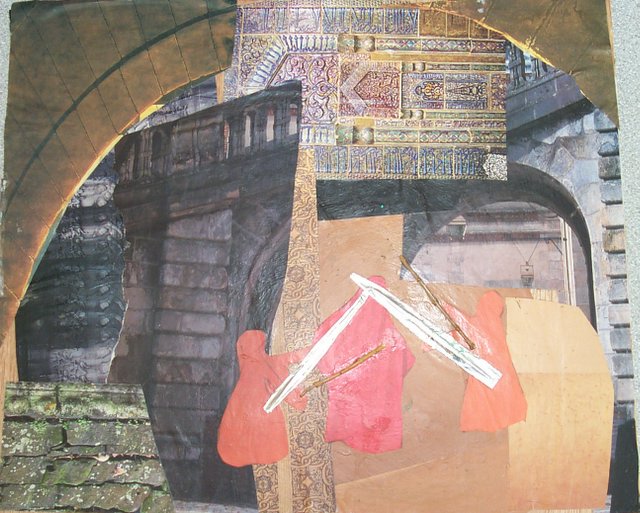 This is Brendan's collage to represent Jesus' "scourged and mocked," for the Stations of the Cross at our church. See the story below, Mean Old World.
Sunday, April 23, 2006
two small children and the mean old world
My entryway into the Bible was Good News Club—a lovely grandmotherly lady down the street offered Bible stories (with cutout paper figures placed on a flannel board, the technology of the mid-sixties), followed by chocolate cupcakes. During winter months, children would arrive at her sunporch, to find a fire crackling in the fireplace, and those cupcakes waiting in the kitchen. She would read the text from the King James and move paper figures around the board, and we would sing Bible songs. Somehow I learned those stories well enough that I remembered basic plotlines and characters a decade later, in college Bible courses. Of course I also remembered the characters as clean, pale-skinned and well-shaven, but that’s another story.
A few years back, remembering my affection for those stories, I found a tastefully-done video of Old Testament stories to watch with my children. I started with Joseph and His Brothers, but my poor Madeleine wailed “Turn it off!” just when the brothers began to toss Joseph in a pit. “How can people be so mean, Mama?” I was wishing for those chocolate cupcakes to distract her. And I had to agree with her. I decided not to tell her that the world can be very mean, sometimes. She will learn that soon enough—but not yet. Montessori education says, “follow the child,” to see what she can handle, and I see that my children may be more delicate than most.
So what is the developmentally appropriate time to introduce delicate kids to the story of the cross? I haven’t spent a lot of time wondering—I simply put off making a decision.
Each Lenten season, my favorite Montessori-trained teacher Jane leads extraordinary art workshops: children produce The Stations of the Cross over the course of six weeks, then they lead congregants through that worship service during Holy Week. Each year Jane chooses a different medium. Like my childhood Good News Club, there are great snacks and great times together. But the Stations of the Cross? That’s walking step by step through the worst that humanity has to offer. That’s the mean old world, at it’s meanest.
Last year Madeleine was old enough, but I kept her back—if she thought Joseph’s brothers’ meanness would drive her to tears, what would she do with the story of the cross?
This year, Brendan turned six, and he caught wind of Jane’s Lenten art project, and was immediately determined he and Madeleine should “do the Art.” Is a parent going to say “no” to that? I spoke with Jane about their readiness, my hesitance. They studied in church school how the Good Shepherd lays down his life for his sheep. They studied how the grain of wheat must die to bring new life. She had prepared them, she said. Of course, we say each week in the liturgy, Christ has died, Christ is risen, Christ will come again. They know about the cross—they just don’t know in any harrowing, bloody detail. I trust Jane, so I took a deep breath and I dropped them off the first week to sketch out their collages.
Brendan arrived home very excited. “What does ‘scourge’ mean again? What does ‘mock’ mean? What does a spear look like?”
I tipped my head skyward to blink back tears, and I answered his questions with definitions and sketches. “Did Jane read through the whole story, Brendan?”
“Yes. I am making a collage of that word, scourge.”
“Tell me what else happens in the story. How does it end?”
“Jesus gets dead. People are mean and hurt him. Then he gets alive again and no one knows how.” He pauses, but only for a moment. “What’s a spear made of?”
I whisper a prayer of praise for Jane, the blessed teacher. He crossed a threshold. It is time. Madeleine chooses Jesus entering the gates of Jerusalem for her collage, complete with palms, and chooses also to portray Simon of Cyrene lifting Jesus’ cross in a second collage. She has crossed a threshold, too.
Perhaps twenty people arrived for the Stations of the Cross, and each was greeted by Brendan, who proudly hand-delivered a church bulletin. A six-year-old boy who cannot read, he solemnly stood by each station as a candle was lit, and listened to the other children read verses from the Bible. He fidgeted a little, got a little distracted as older people meditated more slowly than he would like, but he stayed remarkably serious. Madeleine firmly planted her feet and read clearly, and talked with people ten times her age about how she developed her design.
Though he is two years younger than any of the other your artists, somehow Brendan’s portrayal of the scourging of Jesus is the most moving. The background is a collage of stone walls (cut from National Geographics). And in the foreground, left of center, two red-cloaked figures raise flashing silver swords and sticks over a third red-cloaked figure, arms slightly raised. There are no faces, and the only details are the swords, which are Brendan’s interpretation of spears and bludgeons, no doubt. That’s what scourge means, though. He may not understand the story enough to cry, like me, and I cry nearly every time I read through this story-- but he understands it.
Was it just last year that I lamented Easter translated to bunnies and eggs, for my children? (http://dvivid.blogspot.com/2006/02/ashes-and-glitter-glue-2005-rumination.html )Each year I hold this tension, between one culturally-embraced Easter story and the central, life-altering Easter story. Unlike the years before parenting, I cannot claim any purity of lifestyle in the Easter holiday department. This year I crafted and sold bunnies and eggs for my store—not because I like their connection to the Easter holiday, but because I have a knack for beauty, and I confess to a weakness in the area of well-crafted cute things. My children and I decorated eggs, too, with Ukrainian tools and dyes, talking about the love of good work as we spent hours with the wax and candles. They laughed when I told them the lovely prophecy about the end of time, when the cowbells and pots and pans will be inscribed Holy to the Lord. “And even the eggs, too!” says Brendan, so diligently etching and dipping his egg in the dye.
There’s a lot to be said for beauty, for the turning of the seasons, for new life in blossoms and in chicks. But at last my somewhat delicate children and I begin this conversation about the true story of Easter, of Jesus’ death and resurrection, and life in this mean old world, which is not often sweet and certainly not often cute, or new like grass. Sometime I will tell them that we ourselves are sometimes “the mean old world,” when they are older and can understand a bit more. It’s going to be a long conversation, inbetween lots of silliness and kid stuff—they are six and eight years old, after all. I get the feeling we will etch a lot of eggs and eat a lot of chocolate cupcakes in the meantime, but I’m waiting for the story to unfurl a little further, when they are ready, and when I am, too.
A few years back, remembering my affection for those stories, I found a tastefully-done video of Old Testament stories to watch with my children. I started with Joseph and His Brothers, but my poor Madeleine wailed “Turn it off!” just when the brothers began to toss Joseph in a pit. “How can people be so mean, Mama?” I was wishing for those chocolate cupcakes to distract her. And I had to agree with her. I decided not to tell her that the world can be very mean, sometimes. She will learn that soon enough—but not yet. Montessori education says, “follow the child,” to see what she can handle, and I see that my children may be more delicate than most.
So what is the developmentally appropriate time to introduce delicate kids to the story of the cross? I haven’t spent a lot of time wondering—I simply put off making a decision.
Each Lenten season, my favorite Montessori-trained teacher Jane leads extraordinary art workshops: children produce The Stations of the Cross over the course of six weeks, then they lead congregants through that worship service during Holy Week. Each year Jane chooses a different medium. Like my childhood Good News Club, there are great snacks and great times together. But the Stations of the Cross? That’s walking step by step through the worst that humanity has to offer. That’s the mean old world, at it’s meanest.
Last year Madeleine was old enough, but I kept her back—if she thought Joseph’s brothers’ meanness would drive her to tears, what would she do with the story of the cross?
This year, Brendan turned six, and he caught wind of Jane’s Lenten art project, and was immediately determined he and Madeleine should “do the Art.” Is a parent going to say “no” to that? I spoke with Jane about their readiness, my hesitance. They studied in church school how the Good Shepherd lays down his life for his sheep. They studied how the grain of wheat must die to bring new life. She had prepared them, she said. Of course, we say each week in the liturgy, Christ has died, Christ is risen, Christ will come again. They know about the cross—they just don’t know in any harrowing, bloody detail. I trust Jane, so I took a deep breath and I dropped them off the first week to sketch out their collages.
Brendan arrived home very excited. “What does ‘scourge’ mean again? What does ‘mock’ mean? What does a spear look like?”
I tipped my head skyward to blink back tears, and I answered his questions with definitions and sketches. “Did Jane read through the whole story, Brendan?”
“Yes. I am making a collage of that word, scourge.”
“Tell me what else happens in the story. How does it end?”
“Jesus gets dead. People are mean and hurt him. Then he gets alive again and no one knows how.” He pauses, but only for a moment. “What’s a spear made of?”
I whisper a prayer of praise for Jane, the blessed teacher. He crossed a threshold. It is time. Madeleine chooses Jesus entering the gates of Jerusalem for her collage, complete with palms, and chooses also to portray Simon of Cyrene lifting Jesus’ cross in a second collage. She has crossed a threshold, too.
Perhaps twenty people arrived for the Stations of the Cross, and each was greeted by Brendan, who proudly hand-delivered a church bulletin. A six-year-old boy who cannot read, he solemnly stood by each station as a candle was lit, and listened to the other children read verses from the Bible. He fidgeted a little, got a little distracted as older people meditated more slowly than he would like, but he stayed remarkably serious. Madeleine firmly planted her feet and read clearly, and talked with people ten times her age about how she developed her design.
Though he is two years younger than any of the other your artists, somehow Brendan’s portrayal of the scourging of Jesus is the most moving. The background is a collage of stone walls (cut from National Geographics). And in the foreground, left of center, two red-cloaked figures raise flashing silver swords and sticks over a third red-cloaked figure, arms slightly raised. There are no faces, and the only details are the swords, which are Brendan’s interpretation of spears and bludgeons, no doubt. That’s what scourge means, though. He may not understand the story enough to cry, like me, and I cry nearly every time I read through this story-- but he understands it.
Was it just last year that I lamented Easter translated to bunnies and eggs, for my children? (http://dvivid.blogspot.com/2006/02/ashes-and-glitter-glue-2005-rumination.html )Each year I hold this tension, between one culturally-embraced Easter story and the central, life-altering Easter story. Unlike the years before parenting, I cannot claim any purity of lifestyle in the Easter holiday department. This year I crafted and sold bunnies and eggs for my store—not because I like their connection to the Easter holiday, but because I have a knack for beauty, and I confess to a weakness in the area of well-crafted cute things. My children and I decorated eggs, too, with Ukrainian tools and dyes, talking about the love of good work as we spent hours with the wax and candles. They laughed when I told them the lovely prophecy about the end of time, when the cowbells and pots and pans will be inscribed Holy to the Lord. “And even the eggs, too!” says Brendan, so diligently etching and dipping his egg in the dye.
There’s a lot to be said for beauty, for the turning of the seasons, for new life in blossoms and in chicks. But at last my somewhat delicate children and I begin this conversation about the true story of Easter, of Jesus’ death and resurrection, and life in this mean old world, which is not often sweet and certainly not often cute, or new like grass. Sometime I will tell them that we ourselves are sometimes “the mean old world,” when they are older and can understand a bit more. It’s going to be a long conversation, inbetween lots of silliness and kid stuff—they are six and eight years old, after all. I get the feeling we will etch a lot of eggs and eat a lot of chocolate cupcakes in the meantime, but I’m waiting for the story to unfurl a little further, when they are ready, and when I am, too.
Thursday, March 02, 2006
serendipity
It’s Tuesday afternoon, and I find myself unexpectedly with an open hour, close enough to my children’s school that it makes no sense to go home. I consider my options: it’s too cold to merely sit in a parking lot and wait the time out. And then it comes to me: my favorite Starbucks is merely five minutes away! Should I spend the money? Should I consume more caffeine? I remembered tomorrow is Ash Wednesday, and my husband and I are giving up sugar and dairy products for two weeks, to begin the Lenten season. And that seals it: yes, caffeine, with milk and sugar.
I fully recognize that Starbucks can be completely annoying, and this Starbucks, especially, can be completely annoying. But it has saved my life a few times, too, a living room that is not my living room, with no one needing me. Last week, I read a book there, cover to cover, without moving except for my friendly barrister putting up the chairs around me near closing time.
“Do I need to move?” I asked.
“Nah, not til you get to the last page,” he answered. “How close are you?”
“Three pages,” I answered.
“No problem. Read on.” This is the guy I see here on his day off, too, working his way through graduate school at the seminary down the road. We’ve discussed Kierkegaard—we are like old pals, now.
This Starbucks can be a little strange, as it is often populated with seminary students. It is not unusual to overhear students preparing sermons, holding a Bible study, praying out loud in that earnest evangelical way. It’s endearing and somewhat homey to me, as I have some seminary coursework and spiritual focus in my background. And it’s a little weird, when contrasted with most conversations at most Starbucks, which I think are unlikely to be centered on subjects of theology, nine days out of ten.
So I walk in, and miraculously, there are seats available. I order a giant caramel macchiato in a mug, and just as the barrister calls my name, the cushy seats by the fireplace open up. And just as I sit down with my steaming mug, and pull out my journal to note some notes, Aretha Franklin begins playing on the sound system, “You’re a no-good heart-breaker,” All this and Aretha, too? If God was pleading with us to return to him, he would sound like Aretha, like we are no-good heart-breakers that he cannot bear to lose. That’s my kind of theology, the kind I feel in my bones.
Did they know I was coming? Did they know I needed respite, power, caffeine and the breath of the Holy Spirit? “Kiss me once again my darlin’, don’t you never, never say that we’re through, I ain’t never… never… never loved a man the way that I, I love you.”
I put away my journal, my pen, my reading glasses and prop my feet up by the fire. I close my eyes and skip all pretense of doing anything constructive, and sip my coffee slowly and deliberately, meditating on one pleasure after another, sweetness, darkness, bitterness, warmth, gifts, and my favorite thing about Starbucks: the feeling that I am utterly unnecessary to the functioning of the world, for a few lovely moments. My only work is not to sing along at the top of my lungs, for the sake of other customers.
“You really know this song,” the barrister-Kierkegaard fella says.
“Aretha,” I say, shaking my head.
“It’s a soul mix,” he says. So it is, for me, too.
I fully recognize that Starbucks can be completely annoying, and this Starbucks, especially, can be completely annoying. But it has saved my life a few times, too, a living room that is not my living room, with no one needing me. Last week, I read a book there, cover to cover, without moving except for my friendly barrister putting up the chairs around me near closing time.
“Do I need to move?” I asked.
“Nah, not til you get to the last page,” he answered. “How close are you?”
“Three pages,” I answered.
“No problem. Read on.” This is the guy I see here on his day off, too, working his way through graduate school at the seminary down the road. We’ve discussed Kierkegaard—we are like old pals, now.
This Starbucks can be a little strange, as it is often populated with seminary students. It is not unusual to overhear students preparing sermons, holding a Bible study, praying out loud in that earnest evangelical way. It’s endearing and somewhat homey to me, as I have some seminary coursework and spiritual focus in my background. And it’s a little weird, when contrasted with most conversations at most Starbucks, which I think are unlikely to be centered on subjects of theology, nine days out of ten.
So I walk in, and miraculously, there are seats available. I order a giant caramel macchiato in a mug, and just as the barrister calls my name, the cushy seats by the fireplace open up. And just as I sit down with my steaming mug, and pull out my journal to note some notes, Aretha Franklin begins playing on the sound system, “You’re a no-good heart-breaker,” All this and Aretha, too? If God was pleading with us to return to him, he would sound like Aretha, like we are no-good heart-breakers that he cannot bear to lose. That’s my kind of theology, the kind I feel in my bones.
Did they know I was coming? Did they know I needed respite, power, caffeine and the breath of the Holy Spirit? “Kiss me once again my darlin’, don’t you never, never say that we’re through, I ain’t never… never… never loved a man the way that I, I love you.”
I put away my journal, my pen, my reading glasses and prop my feet up by the fire. I close my eyes and skip all pretense of doing anything constructive, and sip my coffee slowly and deliberately, meditating on one pleasure after another, sweetness, darkness, bitterness, warmth, gifts, and my favorite thing about Starbucks: the feeling that I am utterly unnecessary to the functioning of the world, for a few lovely moments. My only work is not to sing along at the top of my lungs, for the sake of other customers.
“You really know this song,” the barrister-Kierkegaard fella says.
“Aretha,” I say, shaking my head.
“It’s a soul mix,” he says. So it is, for me, too.
Tuesday, December 27, 2005
Sunday, December 18, 2005
church newsletter magi
My priest asked me to write an “advent reflection” for the church newsletter, and this is what I submitted, after forgetting at least twice, after a deadline was extended for me.
I am thinking about those Magi.
Advent is the season of waiting and preparation, two activities for which I am ill-suited, if my day-to-day life is any indication. I can barely keep the laundry up-to-date and the pantry full enough to feed my small family, and I often lose track of the chores on my list, and then I lose the list, too. So when I ask how to prepare for the Christ child to arrive in my life, anew, and how to prepare for the Parousia, that future coming of God to complete the work of creation, the people who capture my imagination are those mysterious magi, about whom we know so little.
What kind of people watch the sky so closely that they know nearly two years in advance when the paths of several stars will meet? What kind of people are so learned that they can read the meaning of such things? What kind of people know a good thing is coming, know it so deeply they will sell whatever it takes to gather money and resources to make a journey so risky, halfway around the known world? These are wise men, we are told, wise enough to know they might lose their lives in the process, in a foreign land at the hands of strangers. What does it mean to be so hopeful and so ready?
The Magi invested their whole lives, their minds and hearts, watching for something life-changing. Years later, perhaps after these students of the sky were long dead, Jesus spoke the parable of The Pearl of Great Price, about a nutty guy who gave up everything he owned—and one would assume his livelihood as a pearl merchant, too-- to obtain a pearl he never intended to trade, just for the beauty and perfection of the thing. I wonder if Jesus was remembering a story his mother told him about sky-watching travelers from the East, who knew about Jesus’ coming birth even before Mary was told by an angel. They packed frankincense and myrrh, which are beautiful, and about as useful as a pearl to a baby whose parents are on the run.
When I think of the dumbfounded shepherds in the fields around Bethlehem, I see someone more like myself, but both the unprepared shepherds and the brilliant Magi yearned for the world to make some sort of sense, yearned for God to show us more clearly what life is about.
Perhaps I do have a gift for Advent: I am yearning for the fullness of God’s kingdom to take hold of us all and sweep us into that place where there are no more tears. In the words of a popular song, I am yearning for that place where the streets have no name. Tell me what you are yearning for, and perhaps we can get ready for that place and time, together. What if we were preparing for a long journey, one that could take years, and we wanted to bring the best of ourselves that we could offer? What if this journey required commitment, sacrifice, cunning? What if this trip might be the very best moment of our lives?
A blessed Advent to you.
I am thinking about those Magi.
Advent is the season of waiting and preparation, two activities for which I am ill-suited, if my day-to-day life is any indication. I can barely keep the laundry up-to-date and the pantry full enough to feed my small family, and I often lose track of the chores on my list, and then I lose the list, too. So when I ask how to prepare for the Christ child to arrive in my life, anew, and how to prepare for the Parousia, that future coming of God to complete the work of creation, the people who capture my imagination are those mysterious magi, about whom we know so little.
What kind of people watch the sky so closely that they know nearly two years in advance when the paths of several stars will meet? What kind of people are so learned that they can read the meaning of such things? What kind of people know a good thing is coming, know it so deeply they will sell whatever it takes to gather money and resources to make a journey so risky, halfway around the known world? These are wise men, we are told, wise enough to know they might lose their lives in the process, in a foreign land at the hands of strangers. What does it mean to be so hopeful and so ready?
The Magi invested their whole lives, their minds and hearts, watching for something life-changing. Years later, perhaps after these students of the sky were long dead, Jesus spoke the parable of The Pearl of Great Price, about a nutty guy who gave up everything he owned—and one would assume his livelihood as a pearl merchant, too-- to obtain a pearl he never intended to trade, just for the beauty and perfection of the thing. I wonder if Jesus was remembering a story his mother told him about sky-watching travelers from the East, who knew about Jesus’ coming birth even before Mary was told by an angel. They packed frankincense and myrrh, which are beautiful, and about as useful as a pearl to a baby whose parents are on the run.
When I think of the dumbfounded shepherds in the fields around Bethlehem, I see someone more like myself, but both the unprepared shepherds and the brilliant Magi yearned for the world to make some sort of sense, yearned for God to show us more clearly what life is about.
Perhaps I do have a gift for Advent: I am yearning for the fullness of God’s kingdom to take hold of us all and sweep us into that place where there are no more tears. In the words of a popular song, I am yearning for that place where the streets have no name. Tell me what you are yearning for, and perhaps we can get ready for that place and time, together. What if we were preparing for a long journey, one that could take years, and we wanted to bring the best of ourselves that we could offer? What if this journey required commitment, sacrifice, cunning? What if this trip might be the very best moment of our lives?
A blessed Advent to you.
Friday, October 21, 2005
the real story
She would come early to church, or late as the case would be, and while she was well-dressed, sixty-something, she looked for all the world like a stray cat, too skinny, hungry and big-eyed, more fragile than a person ought to be. I loved the way Elaine climbed into a pew, slipped off her shoes and hugged her knees to herself, staring off into the rafters regardless of what she had walked in on. It seemed as if perhaps she had never been in a church before, though that is hardly possible. Her posture reminded me of Mary and Martha, the sisters of Lazarus, Mary sitting at Jesus’ feet and drinking him in.
That church was in the center of town, and my husband and I called it The Church of the Broken People. Our congregation attracted the newly divorced, a good indicator for a place that claims healing is possible. Elaine wasn’t the first to discover the miracle of it, the warmth of that church at that time, but she embodied the experience of being left behind, forlorn, bereft, like no one else. Starved for goodness, she responded with gratitude to any drop of goodness that could be found, and she found it in the architecture, in the way the light streamed in the window, in the smallest hello.
Prior to the weekly worship service, St. John’s Adult Forum was truly a forum—what we lacked in racial diversity was made up in theological and class diversity, and what congregants believed covered a remarkably broad range. One Sunday, I lead a discussion titled “What is the Bible,” which I introduced with a group cheer:
WHAT is the Bible,
what IS the Bible,
what is THE Bible,
what is the BIBLE—
WHAT, IS, THE, BIBLE?
I made them shout this just to make a ruckus and to loosen up our tongues for the tough questions and differences ahead. I began with a blank flipchart and asked people to tell me what was the biggest, gnarliest question each held in regards to the Bible and modern life. Elaine practically stood out of her seat, shaking with her question when I nodded to her to speak: she blinked as if she might cry and whispered,
“What if… what if it’s real?”
I felt chills as she said it, blood rising to my face in a great rush, and I paused at length to let the question sink in. “Now that,” I nodded, “that is the best question of all, isn’t it? What if this story is true, what if the ending is really good, what if God really cares about us the way this book says, from creation until the end. You win, Elaine! Write that one down.” We proceeded to have the kind of rich, wild discussion one would expect in an Episcopal church where not everyone believes the same thing about the Bible. And every time I saw Elaine after that, I thought of that moment, of magic and vulnerability and grand insight. Every time I saw her I wanted to congratulate her.
Years later I worked in a college office building where Elaine also worked, whole and generous-hearted and capable, not a stray cat at all. And I mentioned Elaine to Gretchen, another member of that community, from that time.
“Now, Elaine, she is a case isn’t she? She never seemed to concentrate on a single word said in church, lost in her own little world. I remember one day she asked in Adult Forum what if the Bible was real, and I wanted to shake her and say, if you’d just pay attention, maybe you’d find out!”
And now it was time for me to be astonished, again, blood rising to my face again, but this time in bewilderment.
“Did you see her face when she said it? You didn’t feel how deep this question was, for her?”
“Deep? The opposite of deep. I just gave up on her. How can a person like that learn anything?”
Now I was discouraged. How could anyone see Elaine that way?
I know my experience. I was present in the room in that Adult Forum, wondering if the Holy Spirit would whisk us all away on a big wind—so was Gretchen, present in the room and permanently discouraged, writing off Elaine as too far gone. You are reading my story, not Gretchen’s, so you will think my side more likely. Which is true?
I am intrigued. It’s perception, interpretation. It’s what we are ready to see. It’s where we have been, along the way, and Gretchen has certainly been some places along the way to see suffering. She is not shallow, not blind at all. I remain convinced of the fire inside the question, convinced I have something to learn from Elaine, to be Mary at the feet of Jesus. But the other perception? I need to know that, too, that mine are not the only eyes in the world, mine not the only view.
Perhaps the lesson for me, once again, and again and again, that others see things differently, feel things differently, even when the Real Version is as plain as the nose on my face, to me. The disparity is unsettling, discordant. And as a writer exploring my own past, this disparity is important. Is my version true? Has my memory embellished it?
In the case of Elaine, she seems vibrant, now, and thrilled when I bring her a yellow tulip for her office. As for me, I laugh and shake my head. Regardless, I like my version better, and I’m sticking to my story.
What if it’s real? Isn’t that the best question of all! What if.
Tuesday, July 26, 2005
growth spurt
My son and my daughter are having a summer growth spurt, and sporting their sun-blonde locks and lanky tan legs. They have recently begun sleeping late for the first time in their desperate parents’ memory, and when I wander in to wake them, I pause for a glorious moment to memorize them anew. When the boy sleeps curled up in fetal position I can see the day he was born, the moment we first locked eyes. His head was strong, and he held my gaze in his first minute of life. He stretches in his sleep and a transformation occurs: his legs are hanging over the end of the bed, for heaven’s sake! In our neighbor boy’s hand-me-down boxer shorts, he suddenly flops at a considerable length and I see him as a teenager, struggling to consciousness, fighting for another hour of sleep.
The girl, too, so long and brown, her sleeping face a definition of serenity, shape-shifting from the baby in the crook of my neck to the girl who refuses a teddy bear, who trots along in Birkenstocks. Her favorite stripy two-piece bathing suit is by no means skimpy, but it foreshadows some time long from now when she will be off to the beach with friends, and without me. Her confidence and social life are practically that big, already.
Summer is a part of the long season called The Season after Pentecost, in both Jewish and Christian traditions. In the Christian church, we dress the sanctuary in green for the long growing season. My favorite parable is practically a one-liner, “The kingdom of God is like seed thrown on a field by a farmer who then goes to bed and forgets about it. The seed sprouts and grows—the farmer doesn’t know how it happens. The earth does it all without his help: first a green stem of grass, then a bud, then the ripened grain. One day he wakes and the fields are ready, and he reaps the harvest!” Mark 4:26-29. There is no mistake to be made in this parable about the quality of the farmer’s actions or motivations forcing the result. It’s more like, that’s just the way the kingdom of God is, or that’s just the way the universe works from the beginning of time. Throw some hope in, and see what happens.
Not every day feels so blessed and lucky as a summer day with two lovely children sleeping in. But today feels that way. From seeds to sprouts and beyond, they grow like stalks in the sun. Throw some hope in—such good results.
The girl, too, so long and brown, her sleeping face a definition of serenity, shape-shifting from the baby in the crook of my neck to the girl who refuses a teddy bear, who trots along in Birkenstocks. Her favorite stripy two-piece bathing suit is by no means skimpy, but it foreshadows some time long from now when she will be off to the beach with friends, and without me. Her confidence and social life are practically that big, already.
Summer is a part of the long season called The Season after Pentecost, in both Jewish and Christian traditions. In the Christian church, we dress the sanctuary in green for the long growing season. My favorite parable is practically a one-liner, “The kingdom of God is like seed thrown on a field by a farmer who then goes to bed and forgets about it. The seed sprouts and grows—the farmer doesn’t know how it happens. The earth does it all without his help: first a green stem of grass, then a bud, then the ripened grain. One day he wakes and the fields are ready, and he reaps the harvest!” Mark 4:26-29. There is no mistake to be made in this parable about the quality of the farmer’s actions or motivations forcing the result. It’s more like, that’s just the way the kingdom of God is, or that’s just the way the universe works from the beginning of time. Throw some hope in, and see what happens.
Not every day feels so blessed and lucky as a summer day with two lovely children sleeping in. But today feels that way. From seeds to sprouts and beyond, they grow like stalks in the sun. Throw some hope in—such good results.
Subscribe to:
Posts (Atom)