Each moment I stay in my house, the workman blocks off another vital pathway to my desk, my purse, my kitchen, and with the aroma of industrial flooring glue, I finally grab my sweater, my book bag, and thread my way through the maze to my door. Neither the workman nor I know exactly what the day holds, but we are each doing our best. Perhaps tomorrow most of the new floor will be installed—that is the hope. Perhaps by the end of this week, I’ll be ready to turn in my next round of homework. I head for my borrowed studio on a stormy Tuesday, on the Atlantic.
A road detour winds me through back streets, but right past my favorite independent coffee shop. Dorothy, the owner, waves to me as she pokes her head out of the drive-up window to assess the line of cars waiting. When it’s my turn, we chat only long enough for her to pour my coffee—the wind promises rain, any minute.
And then I have a hot cup of coffee in my hand, and the road detour threads me past my favorite beach for watching surfers. Just as I’m hoping no one is crazy enough to be surfing in this tempest, I see the flashes of bright blue and green, swooping and jerking—two kite-surfers! Twenty cars line the beach-side of the narrow road, spectators alongside the parked cars of the wet-suited athletes. Usually, the surfers walk calmly by to their cars, but today the men scamper like children to tell tales to one another, faces alight and hands gesturing, like boys describing a soccer game. The two closest men are my age—one balding and one who looks like a handsome college professor I remember. I wonder at men so in love with the sea and the weather.
After I study the joy on their faces, they haul boards across the footbridge, and I turn to the kite-boarders again. As far as I can tell, the rider wears the kite’s harness around his waist and rides a board that attaches to his feet. One kite-surfer rides the shallow edge of Good Harbor Beach back toward me as far as he can come, then cuts wave after wave in the opposite direction down the mile of shoreline. At several points the surfer flies in the air—more than twenty feet into the air—then “lands” again on a wave and rides. He is leaning back hard on his kite-lines and nearly touching the water with his back. I can’t imagine the training necessary to evoke this confidence. I drink my coffee until I see one kite surfer walking onto the beach, wrestling his kite to the ground and folding it. The other rider walks ashore, too, and the first runs to help the second fold his kite. I imagine their faces radiant, like the men who just passed me on the footbridge, and their hands and storytelling as they pack their cars and maneuver the heavy wetsuits. Will they be going to office jobs, next? It’s only nine o’clock in the morning. Perhaps they will sit at a desk by ten.
The road detour takes me along the rocky Atlantic coast for another mile. Drivers rubberneck to see the grey-green curls of wave, veering toward my half of the two-lane road. I drive carefully through the sea spray until I find Edgemoor Road. I take a right once again and familiarize myself with the house numbers. The owner of a boutique in town told me he’d introduce me to the new residents of T. S. Eliot’s childhood summer home. The boutique owner is charming and lonely to talk books and reading, but also he is lonely to tell me how atrociously Americans use the rules of grammar, how shallowly American literature compares to European. This makes me self-conscious of the looseness of my childhood education, the Midwestern drawl and rhythm that won’t be parsed into sentence diagrams. I have little desire to defend my literary loves, but he is an interesting character. I’ll offer him a cup of coffee some winter morning when I can be patient. I believe it’s 3 Edgemoor or 5 Edgemoor Road. I consider pulling into St. Anthony’s By-the-Sea—surely someone there would know the answer to this question, and perhaps hold insight as to why Eliot named his road Edgeware instead of Edgemoor in his poem. Edge-Where? Edge-More? The crest of homes does overlook what could be called a moor, I suppose. I decide not to pursue this question today, either. I need to write.
I make a left onto Eastern Point Boulevard and within five minutes I open the car door to the sea howl and the foghorn. The lock gives way without a struggle this time. I climb to the third floor with my book bag (Eliot’s thin volume is in there, along with a Cowley Brothers book of meditations on Eliot) and laptop, find a blanket and settle into the eaves. I begin writing at nine-thirty in the morning in a stormy paradise.
The kite-surfers have me wondering—perhaps writing is like that, though with less muscle. The surfer rides one ocean with his feet, one weather system with his arms, one unpredictable self inbetween and from the looks of the faces after, I can only imagine how fully engaged he is. The call to writing, as I am learning, is to become more vulnerable, more in touch with rawness of feeling, and more persistently in pursuit of truth. Harness the wind of a story, ride the undercurrent of the deep, be ever aware of all the unpredictabilities of weather and self. Watch for dangerous rocks. If you are not a writer you might think this description is self-indulgent—and it might be. I am sitting in a chair, after all, not feeling the wind and rain on my face.
But I’m playing just as hard as they are. I joined this writing program to change my writing, with no thought that my writing may change me. Like those surfers’ faces on the footbridge, perhaps I will be changed, if I do it well. Who could possibly encounter that tempest and still be the same?
Showing posts with label weather reports: how things are. Show all posts
Showing posts with label weather reports: how things are. Show all posts
Tuesday, November 06, 2007


Saturday, September 08, 2007
a saturday breath
Any minute now the door will swing open and my children will stumble from their bedroom. A friend tells me of a Polish mother’s proverb that says “one is none, but two is a million,” and mine will sound like, feel like, precisely one million, entering into my Saturday morning quiet.
But not yet. For now it’s me and the gull cries and the prowling cat, so pampered and pretty. The rainbow-throwers hanging on the window have Satchmo stalking, stalking those shimmers through the house. The white haze tells me the day will be hot. But not yet. For now, breakfast and coffee, in quiet, celebrated.
I slept last night—a mercy. I’ve experienced a strange bout of insomnia for the past six weeks, and find myself scrambling, cutting back caffeine, plotting nightly cups of tea laced with a calcium/magnesium brew, following the drowsy instinct whether it hits at eight-thirty or eleven, finding ways to invite sleep closer. My friend Katherine tells me I’ve successfully reinvented myself after age 40, and that I’m just beginning, and perhaps that is the tumult keeping me from sleeping. I don’t feel reinvented—“culmination” comes to mind, though that may seem presumptuous. I’m pulling all the threads together, into one life. I expected I’d uncover a storyline when I started writing. I didn’t expect such an unusual sense of power to it, though. Graduate study, pulling away from other’s needs to serve my own needs, travel, running at freelance opportunities as fast as I can… okay, I’m reinventing my life, while tending the same children, home and husband, in the same tiny condo by-the-sea. Neighbors ask me “what’s new” and I start to laugh maniacally, considering how to respond, how to translate seismic shifts into a “hi, how are you” conversation. “I’m still here. Everything else is new.”
One pajama boy emerges from the bedroom, but one is none. He asks for Daddy and sneaks across the hall for a sleep-in. The coffee is still warm and my stack of books can stay right here on the living room floor. I hope the two of them will find a way to be, together in the next room. The boy can be exceptionally demanding.
One pajama girl emerges, greets Satchmo and she heads to the bathroom. I overhear Brendan asking Scott “why” and “how” questions about baseball technicalities, which means both are happy. Scott’s voice moves steadily and patiently through definitions and fine points of distinction. “Does that make sense?” he asks after each concept. “Uh-huh,” Brendan answers, satisfied, and the questions end for awhile in the quiet of the morning.
Madeleine settles into the couch behind me, with a new book about girls and bodies—her friends are growing rapidly, though she will be a late bloomer like me. There is treasure in waiting, even in being “last,” but I felt left out of so many things as a child, not wanting to change to be like the boy-chasing girls, as I saw them. Madeleine’s childhood is completely different—she is a happy and social girl who makes friends easily, and she is quite comfortable with boys, unlike me at that age. This book is nothing like the book my mother handed me, which covered anatomy and anatomical processes. Madeleine’s growing-up book has colorful illustrations and talks about friendships, differences from one girl to the next, clothing choices, and the anatomical details are tucked in, just like normal conversation. It’s nothing we haven’t talked about already, but as an American Girls title, the book holds some weight of authority. Unlike the book handed to me, this book makes growing up seem quite normal and not catastrophic.
Brendan emerges with a copy of our school’s yearbook, and sits quietly on the other end of the couch. His mouth shows evidence of last night’s dessert and his nails need trimming, both topics to pursue—but not yet. The quiet is all. My back is propped on the same couch, at my laptop. All is good.
One question I hear, in good writing, is the question, “what is at stake?” I understand that some stories are powerful, and I know a powerful story when it is happening to me. Often, though, I want to write and write when nothing is at stake, nothing at all. It’s a strange impulse, I know, but I feel sure it will serve me.
Like this moment serves me, the gulls, two children who are not yet a million, a sleeping husband in the next room over. This day is unlike any other. Nothing is happening. We are just here, contented and the world is open on a quiet Saturday. My friend Kellie tells me, “All I have is this breath.” As soon as I say it, I breathe deeper and taller, hear the whir of the rainbow-thrower and the gulls overhead. I breathe in the scent of pinon coffee from Valerie, the scent of pulled pork simmering in the crockpot for later, and sea salt. (The pork is leftovers, raised to glory—don’t tell my family, okay?) I do not ignore the scent of the compost that needs to be emptied, and I am relishing all scents before the cat is fed, the worst scent of the day.
As a Christian, I have so much more than this breath, the whole created order and all of history… and this breath, right now. Make it a good one, I remind myself, make it good.
Scott lumbers out and moves the laundry along, and the questions about what to do and how we will do it, begin. I don’t say the spell is broken—this breath is all I have, still, though conversations fly and breakfasts need to be addressed, the dryer tosses its contents and Satchmo begs loudly for his fishy-smelling stuff. The million emerge from the no-longer quiet.
And that's alright. I have this breath, and I am ready.
But not yet. For now it’s me and the gull cries and the prowling cat, so pampered and pretty. The rainbow-throwers hanging on the window have Satchmo stalking, stalking those shimmers through the house. The white haze tells me the day will be hot. But not yet. For now, breakfast and coffee, in quiet, celebrated.
I slept last night—a mercy. I’ve experienced a strange bout of insomnia for the past six weeks, and find myself scrambling, cutting back caffeine, plotting nightly cups of tea laced with a calcium/magnesium brew, following the drowsy instinct whether it hits at eight-thirty or eleven, finding ways to invite sleep closer. My friend Katherine tells me I’ve successfully reinvented myself after age 40, and that I’m just beginning, and perhaps that is the tumult keeping me from sleeping. I don’t feel reinvented—“culmination” comes to mind, though that may seem presumptuous. I’m pulling all the threads together, into one life. I expected I’d uncover a storyline when I started writing. I didn’t expect such an unusual sense of power to it, though. Graduate study, pulling away from other’s needs to serve my own needs, travel, running at freelance opportunities as fast as I can… okay, I’m reinventing my life, while tending the same children, home and husband, in the same tiny condo by-the-sea. Neighbors ask me “what’s new” and I start to laugh maniacally, considering how to respond, how to translate seismic shifts into a “hi, how are you” conversation. “I’m still here. Everything else is new.”
One pajama boy emerges from the bedroom, but one is none. He asks for Daddy and sneaks across the hall for a sleep-in. The coffee is still warm and my stack of books can stay right here on the living room floor. I hope the two of them will find a way to be, together in the next room. The boy can be exceptionally demanding.
One pajama girl emerges, greets Satchmo and she heads to the bathroom. I overhear Brendan asking Scott “why” and “how” questions about baseball technicalities, which means both are happy. Scott’s voice moves steadily and patiently through definitions and fine points of distinction. “Does that make sense?” he asks after each concept. “Uh-huh,” Brendan answers, satisfied, and the questions end for awhile in the quiet of the morning.
Madeleine settles into the couch behind me, with a new book about girls and bodies—her friends are growing rapidly, though she will be a late bloomer like me. There is treasure in waiting, even in being “last,” but I felt left out of so many things as a child, not wanting to change to be like the boy-chasing girls, as I saw them. Madeleine’s childhood is completely different—she is a happy and social girl who makes friends easily, and she is quite comfortable with boys, unlike me at that age. This book is nothing like the book my mother handed me, which covered anatomy and anatomical processes. Madeleine’s growing-up book has colorful illustrations and talks about friendships, differences from one girl to the next, clothing choices, and the anatomical details are tucked in, just like normal conversation. It’s nothing we haven’t talked about already, but as an American Girls title, the book holds some weight of authority. Unlike the book handed to me, this book makes growing up seem quite normal and not catastrophic.
Brendan emerges with a copy of our school’s yearbook, and sits quietly on the other end of the couch. His mouth shows evidence of last night’s dessert and his nails need trimming, both topics to pursue—but not yet. The quiet is all. My back is propped on the same couch, at my laptop. All is good.
One question I hear, in good writing, is the question, “what is at stake?” I understand that some stories are powerful, and I know a powerful story when it is happening to me. Often, though, I want to write and write when nothing is at stake, nothing at all. It’s a strange impulse, I know, but I feel sure it will serve me.
Like this moment serves me, the gulls, two children who are not yet a million, a sleeping husband in the next room over. This day is unlike any other. Nothing is happening. We are just here, contented and the world is open on a quiet Saturday. My friend Kellie tells me, “All I have is this breath.” As soon as I say it, I breathe deeper and taller, hear the whir of the rainbow-thrower and the gulls overhead. I breathe in the scent of pinon coffee from Valerie, the scent of pulled pork simmering in the crockpot for later, and sea salt. (The pork is leftovers, raised to glory—don’t tell my family, okay?) I do not ignore the scent of the compost that needs to be emptied, and I am relishing all scents before the cat is fed, the worst scent of the day.
As a Christian, I have so much more than this breath, the whole created order and all of history… and this breath, right now. Make it a good one, I remind myself, make it good.
Scott lumbers out and moves the laundry along, and the questions about what to do and how we will do it, begin. I don’t say the spell is broken—this breath is all I have, still, though conversations fly and breakfasts need to be addressed, the dryer tosses its contents and Satchmo begs loudly for his fishy-smelling stuff. The million emerge from the no-longer quiet.
And that's alright. I have this breath, and I am ready.
Thursday, July 19, 2007
cleaning under the influence
At ten-thirty in the morning I suddenly come to my senses. One chair sits by the refrigerator, and the box labeled "charity" sits on the seat. Another chair indicates someone has been climbing in the children's closet. Below the attic entry is a stack of bagged items: two handmade decorative pillows that no longer match my bedroom, though they are crafted with great love. One quilted by me, the other smocked by my mother. They can wait in the attic for the someday when we need them. A wooden pirate ship and its inhabitants are bagged and ready, as is the hobby-horse who is actually a hobby-giraffe, a wooden ring-toss game and a "balancing moon" game. Sweaters stacked on the table (which one will make the best laptop sleeve? Which one will make the nicest cardigan for my kids?)
I believe I started cleaning like a drunk woman in order to clear my desktop. Some technological shift requires me to move our telephone from The Place It's Always Been to my desktop. It will save us money, but I don't have to like it. The phone belongs near the calendar, in the kitchen, clearly. If anyone leaves a single ANYTHING on my desk… it won't be pretty. I need a place to stash the phone book out of sight, grrrr. Meanwhile I need yet another power strip to plug in a new vast array of power cords to routers and modems and answering machines…
As I'm trying to figure out a way around the nests of wires as my new decorating scheme, I recall my dad's desktop organizer, in the upper shelves of my closet. I believe Dad's father made it, or that's what I heard. This wooden set of "pigeonholes" was indispensable in college, filled with envelopes and stamps and index cards. Luckily, the items stacked atop the organizer slide right into place when I move it, dust flying. Thus the chair left by the opening of my own closet. And the dust needs removed, along with some ancient scotch tape. To the sink, to find the Murphy's Wood Oil Soap. Thus the cabinet door open. To discover the gunk spilled under the sink. Only a minor delay to clean the gunk, then to use the cleverly-placed chair in front of the frig to locate the shelf-lining paper I'd just seen up there…
At some point I repeat the cautionary mantra: wait, I'm cleaning like a drunk woman! WHY? Oh, yeah, I didn't have breakfast before I took kids to camp for the day, and I am out of my right mind. My "blood-sugar low" looks a lot like an alcohol-induced ADD. My house looks a lot like an alcohol-induced ADD, emphasis on the "disorder" part of the attention-deficit disorder. It takes some mighty will to pull away from all the projects and start some eggs and toast. I polish the wooden pigeon-holes with Murphy's while the eggs cook.
After my late breakfast, I roll the shelf-liner into place under the sink, and replace the roll in its home above the frig. I return all the stuff under the sink, leaving the grubby floor for later. I'm done in my closet, so I close it and return one dining chair to its home. The clean pigeon-hole organizer moves atop my desk, where the router fits in one slot, the phone whatcha-ma-who in another, the modem in another. I relocate the kids' board game collection to the top of their closet, making room for all the sets of plastic gizmos they claim important. I take the box of miscellaneous stuff from the top shelf and sure enough, nothing inside the box has been requested for three months—retired to the attic. Two chairs returned to the dining table.
I finish a quick visual sweep of the living room, looking for anything else I can shuttle to the attic without its being missed.
It's the last full day of camp for my children, and a good day to pick up what is scattered—my last day as "fiber artist in residence" was yesterday. Last week's paper-making supplies are tucked away, along with flosses for friendship bracelets and kumihimo braiding— in a moments generosity, Madeleine offered to wind bright flosses onto bobbins to make the project easier the next time. I still have quantities of loose wool and recycled sweater material to stash away, from wet-felting and hand-sewn treasure bag design. At camp yesterday, each group of kids lagged a little longer than the allotted time, trying to stay longer and sew more. I talked, while they worked, about setting up their own small sewing kits and finding recyclable sweaters for new projects. Some children told me they'd already sent their moms digging into closets for wool yarn, tapestry needles and shrunken sweaters. Consider these campers empowered.
The heddle loom remains on the windowsill, in case my kids and I are inspired to finish an Art Harbor banner begun by campers, for tomorrow's end-of-camp celebration.
Lest you think me possessed, I am leaving the "earthen scum" (Thank you, Louise Erdrich, see below) on the kitchen floor, and the celery (or whatever it is) rotting in the frig. The neglected baskets of clean laundry remain behind the couch. I still need to find a home for the small spinning wheel and the two bags of unprocessed wool fleece. I think I'll move it where my larger heddle loom is now, while I move my heddle loom to…
Before I find myself cleaning under the influence of drunken inspiration again, I go back to my desk, where I started, and pull out my laptop, which I need to get used to, and type a long memo for my blog. While eating breakfast, earlier, I began writing a story in my journal, with a pen, about cleaning like my mother who would always start in one place and end up with half the house disassembled, putting things away in the middle of the night...
All the chairs are returned to the dining table except the chair I'm sitting on, all the climbing done for today, I think, except for the climb up the attic stairs and the climb down three flights to the trash bin.
Summer is dreamy and good this year. Children are beautiful and happy. Weather is still unseasonably cool, which makes me happy. Scott uttered the words he hasn't said in years, "we sent the kids off the zipline today at school," which makes him happy. I'm tossing things into the wheeled duffle bag for my trip to Santa Fe, one week from today. So many things left to do and to arrange, and a few stories to write for a few magazines, too. But things are good, in the too-small treehouse condo by the sea. All the rest of life's hassles will work out over time, but the raspberries are thriving and a rogue watermelon vine sprung up from the compost we gave our downstairs neighbor—a huge melon ripens slowly on the front walkway. It's a good sign, fruitfulness from nothing, like the greenness and today's foggy mist.
Time to stop cleaning, and stop typing, and make a cool drink and some lunch, next, before I forget myself and begin to randomly clean anything I lay eyes on. I'm keeping the chairs at the table, where maybe they'll stick to the earthen floor while I go for a walk, before I pick up another thing to put away.
I believe I started cleaning like a drunk woman in order to clear my desktop. Some technological shift requires me to move our telephone from The Place It's Always Been to my desktop. It will save us money, but I don't have to like it. The phone belongs near the calendar, in the kitchen, clearly. If anyone leaves a single ANYTHING on my desk… it won't be pretty. I need a place to stash the phone book out of sight, grrrr. Meanwhile I need yet another power strip to plug in a new vast array of power cords to routers and modems and answering machines…
As I'm trying to figure out a way around the nests of wires as my new decorating scheme, I recall my dad's desktop organizer, in the upper shelves of my closet. I believe Dad's father made it, or that's what I heard. This wooden set of "pigeonholes" was indispensable in college, filled with envelopes and stamps and index cards. Luckily, the items stacked atop the organizer slide right into place when I move it, dust flying. Thus the chair left by the opening of my own closet. And the dust needs removed, along with some ancient scotch tape. To the sink, to find the Murphy's Wood Oil Soap. Thus the cabinet door open. To discover the gunk spilled under the sink. Only a minor delay to clean the gunk, then to use the cleverly-placed chair in front of the frig to locate the shelf-lining paper I'd just seen up there…
At some point I repeat the cautionary mantra: wait, I'm cleaning like a drunk woman! WHY? Oh, yeah, I didn't have breakfast before I took kids to camp for the day, and I am out of my right mind. My "blood-sugar low" looks a lot like an alcohol-induced ADD. My house looks a lot like an alcohol-induced ADD, emphasis on the "disorder" part of the attention-deficit disorder. It takes some mighty will to pull away from all the projects and start some eggs and toast. I polish the wooden pigeon-holes with Murphy's while the eggs cook.
After my late breakfast, I roll the shelf-liner into place under the sink, and replace the roll in its home above the frig. I return all the stuff under the sink, leaving the grubby floor for later. I'm done in my closet, so I close it and return one dining chair to its home. The clean pigeon-hole organizer moves atop my desk, where the router fits in one slot, the phone whatcha-ma-who in another, the modem in another. I relocate the kids' board game collection to the top of their closet, making room for all the sets of plastic gizmos they claim important. I take the box of miscellaneous stuff from the top shelf and sure enough, nothing inside the box has been requested for three months—retired to the attic. Two chairs returned to the dining table.
I finish a quick visual sweep of the living room, looking for anything else I can shuttle to the attic without its being missed.
It's the last full day of camp for my children, and a good day to pick up what is scattered—my last day as "fiber artist in residence" was yesterday. Last week's paper-making supplies are tucked away, along with flosses for friendship bracelets and kumihimo braiding— in a moments generosity, Madeleine offered to wind bright flosses onto bobbins to make the project easier the next time. I still have quantities of loose wool and recycled sweater material to stash away, from wet-felting and hand-sewn treasure bag design. At camp yesterday, each group of kids lagged a little longer than the allotted time, trying to stay longer and sew more. I talked, while they worked, about setting up their own small sewing kits and finding recyclable sweaters for new projects. Some children told me they'd already sent their moms digging into closets for wool yarn, tapestry needles and shrunken sweaters. Consider these campers empowered.
The heddle loom remains on the windowsill, in case my kids and I are inspired to finish an Art Harbor banner begun by campers, for tomorrow's end-of-camp celebration.
Lest you think me possessed, I am leaving the "earthen scum" (Thank you, Louise Erdrich, see below) on the kitchen floor, and the celery (or whatever it is) rotting in the frig. The neglected baskets of clean laundry remain behind the couch. I still need to find a home for the small spinning wheel and the two bags of unprocessed wool fleece. I think I'll move it where my larger heddle loom is now, while I move my heddle loom to…
Before I find myself cleaning under the influence of drunken inspiration again, I go back to my desk, where I started, and pull out my laptop, which I need to get used to, and type a long memo for my blog. While eating breakfast, earlier, I began writing a story in my journal, with a pen, about cleaning like my mother who would always start in one place and end up with half the house disassembled, putting things away in the middle of the night...
All the chairs are returned to the dining table except the chair I'm sitting on, all the climbing done for today, I think, except for the climb up the attic stairs and the climb down three flights to the trash bin.
Summer is dreamy and good this year. Children are beautiful and happy. Weather is still unseasonably cool, which makes me happy. Scott uttered the words he hasn't said in years, "we sent the kids off the zipline today at school," which makes him happy. I'm tossing things into the wheeled duffle bag for my trip to Santa Fe, one week from today. So many things left to do and to arrange, and a few stories to write for a few magazines, too. But things are good, in the too-small treehouse condo by the sea. All the rest of life's hassles will work out over time, but the raspberries are thriving and a rogue watermelon vine sprung up from the compost we gave our downstairs neighbor—a huge melon ripens slowly on the front walkway. It's a good sign, fruitfulness from nothing, like the greenness and today's foggy mist.
Time to stop cleaning, and stop typing, and make a cool drink and some lunch, next, before I forget myself and begin to randomly clean anything I lay eyes on. I'm keeping the chairs at the table, where maybe they'll stick to the earthen floor while I go for a walk, before I pick up another thing to put away.
Monday, July 02, 2007
a scalloped edged coverlet of violet and green

My family steps out the door without me—without me!—and for the first time in two weeks I have a stretch of afternoon and evening to myself. Already I’ve entertained five different scenarios for the evening, playful options, necessary options. I dressed for gardening as they drew out the leaving process to an excruciating degree, spiraling louder and louder with the excitement of a minor league baseball game. I watered the plants in the backyard and on the porch, waiting for them to go and giving them distance. When they finally, finally leave, I tiptoe gingerly around the house for fifteen minutes or so, until I actually believe they will not return for something forgotten.
Then I exhale. It’s been a good beginning to break, with a five-day trip to Pennsylvania and numerous solo parenting days. Children have exhaled since school ended, sleeping late, lounging quietly over novels and baseball card collections, taking helmets to the parking lot for cycling and rollerblades. We’ve had a beach day and several beach evenings, plus several days too cold to consider being any closer to the icy Atlantic. I’ve done my online work for Ladies Home Journal in and around other activities. I’m preparing for grad school. They’ve let me do what I need to do for long stretches.
And now they need to go. Now.
I reach in the closet for my gardening shoes and look far into the top of the shelves: there sits my new floral coverlet, the one I hope to use as a bedspread. Except it’s too large, twice the size of my three-quarter width mattress on the Ginny Lind bedframe. I step back and consider for a moment. I don’t LIKE to sew. I know how, true, and that is why I bought a too-large coverlet on sale. The old-fashioned print of violet-colored roses and green leaves matches my vivid purple and white Signature Quilt, hanging on the sage green wall. I turn and look at the cheap shredded quilt on the bed—made in China of cotton so thin it will not hold up to four years of laundry, sigh. Underneath it is another heirloom quilt, too fragile for much more exposure to our kitty. Satchmo doesn’t claw the quilt on purpose—he just puts his claws out when he stretches, and that’s too much for the Star of David quilt my Grandma Mae crafted from scraps of favorite shirts and dresses.
I’d like the new bedspread I bought to actually fit the bed I bought it for. I step back in the closet and onto the step stool. It’s time to sew.
When the package is unzipped from it’s Liz Claiborne bag, I’m impressed once again with just how huge the Oversized King coverlet actually is. Measuring is easy—I place the right edge at the correct height from the floor, and smooth the coverlet over the bed. I fold it at the center wooden spindle of the footboard. The coverlet is edged with deep, wavy scallops. Three and a half scallops fall to the right of the center spindle, so I need seven scallops in all, across the foot of the bed. This leaves three scallop’s worth of fabric to be cut off one side—nearly a third of the blanket. I lift the coverlet from the bed and place it on the living room floor—the entire open space of the living room floor!—and fold it in half, at three and a half scallops.
Now comes the part where my mother would say to me, “you better go find a piece of chalk and mark that wavy cutting line before you pick up those sewing shears.” I glance left, and right, and my mother is nowhere to be seen. I could find the blue tailor’s chalk if I wanted to. I know where it is. Nah. I take a deep breath and plunge the scissors through the velvet bias tape at the edge of the blanket, and I begin cutting a large wavy line to match the opposite edge of the coverlet.
Does cut fabric have a scent? I swear it does, though I can’t imagine how it would. Is it simply the smell of something new, something that’s been sealed in a bag, in a store?
The wavy cut is completed and looks fine. Now for the tricky part—will the velvet bias tape tear free easily? Or will it shred when I remove the stitches with a seam ripper? I pull it apart a few stitches. It comes off the scrap of fabric perfectly, good. I will need it to cover the newly cut wavy edge of my blanket. I open every few inches with another snip and unfold the long strip of green velvet. It takes time. The time feels good.
An hour since the noisy crew left, I have the urge to lie down on the cut up pieces of blanket and listen to the quiet, smell the scent or non-scent of cut fabric. I think of my mother, the upholsterer, and all the practical skills I inherited, and how I miss her. I walk to the bedroom for my laptop—I’m getting accustomed to using it before my writing workshop in a few weeks—and bring the laptop onto my sewing project, on the floor. I type a few quick paragraphs, then tuck the computer away in its case again. The bias tape falls free. I admire the big strip of fabric left after all the cutting. My antique Signature Quilt is bold in color, and this fabric is so very subtle. They will compliment one another well. And there will be enough fabric for a few bolster pillows, a lucky bonus.
Back to the bedroom to unearth my mother’s old Singer sewing machine, and my daughter’s book of pins. For bias tape, the wrong side is sewn first, so I flip the coverlet to the all-white side, and begin to pin the velvet along the cut edge of scallops, overlapping the tape a bit on both ends. I switch on the lamp of the sewing machine knowing that smell will return me to my mother’s house once again. Lift the presser foot, position the fabric, just a moment’s hesitation to backstitch a half inch or so. Then push the foot pedal to the floor and follow the fabric’s edge. Done in a moment.
By now Garrison Keillor is hosting James Taylor at Tanglewood, on my radio, and I return to the floor to slowly pin the edge of green onto the right side of the coverlet. Somehow I’ve made no unforgivable mistakes in this process, and a song or two passes the time. One last set of backstitches and one more time remembering the “speeding tickets” I given to me in high school home ec class, rumbling along my dining table, also my mother’s, into the quiet night.
I finished the floral coverlet and quickly removed the tattered quilt and the Star of David quilt—one to the scrap pile and one to the cedar chest. Then I made the bed again, with the new delicate sprays of violet-colored roses and green leaves on a ground of white. From a distance no one can see the difference between my edge and the professional edge of the quilt. Up close, I still need to hand stitch two tiny sections of green velvet, so nothing can “catch” on each join and undo my work. Another day. I fold down the top hem of scallops and place a nest of pillows atop it, at the head of the bed. Nothing torn, now, and nothing too precious for the cat to rest on.
Back in the living room I fold up my scrap of quilt and tuck it away, then pour a glass of wine. The sun is still up, though the evening begins to cool. I sent them to the ballpark with jackets and socks, against their wills, but I’m sure they’ll return wearing the warm layers.
Just out of curiosity I walk back into the bedroom to find a project I planned two months ago, a handbag to be constructed of boiled wool from a retired sweater. The pieces are cut already, and the wide shoulder strap is embellished with a needle-felted vine of green leaves on the charcoal background. All that is left is to cut a lining from the block print pillowcase I bought just for this bag, and to sew. And my sewing machine is all set up, on the dining table, with no disruptions in sight. The light is on, the bobbins are wound…
I don’t like to sew, at least not as much as I like seeing the finished project in my hands. I like knowing how to sew, how to construct things, how to use what is easy, convenient, priced right to craft what is perfect, what fits, what pulls everything together. I’m a designer at heart.
With just enough know-how. And a beautiful bed, if I do say so myself.
Oh! The Signature Quilt was crafted to celebrate my great-grandparent’s fiftieth wedding anniversary. Signature quilts were still a popular gift for special occasions when I lived in Farmland—each participant pays one dollar and signs a square of fabric. Each signature is embroidered onto the square. The fabric is then “pieced” into a quilt pattern—mine is in eight-pointed stars, surrounded by rings of squares, more diamonds and a few triangles—and then the entire blanket is hand-quilted at eight to ten hand-stitches per inch. The quilt is then given, along with the money raised, to the honored recipients.

My mother identified each of the 255 names on the startling purple-and-white quilt, including her own family’s block, with the names of her parents, her brothers and sisters embroidered in white on one of the purple “stars.” I never knew my great-grandparents, but I know many of the people named on my quilt—they must’ve been children, like my mother was, when the quilt was made. When I sleep under the quilt, I think of “the great cloud of witnesses” named in the Bible, and I think of the teachers who’ve told me “we stand on the shoulders of giants.” What giant’s names appear on this quilt, I don’t know, but my grandfather willed this quilt to me, and nothing, not a scrap of fabric to anyone else in my family including my mother, whom he loved a great deal. I saw him perhaps twenty times in my life, but we were similar, and we wrote letters. I loved God from the time I could think a single thought, though no one in my family told me my grandfather did, too. Grandma Mae was not really my grandmother, but she handstitched the rest of my quilt collection herself—a quilt embroidered with fifty state birds, and the Star of David quilt. I slept under those birds from the time my mother could trust me to treat it properly, in the Ginny Lind bed with the hand-turned spindles, in my bedroom under the eaves.
I think these stories through, all the cinderblock walls of all the apartments covered by these quilts over all the years of my adulthood, while I strategize the pockets and flaps of the charcoal wool handbag. The shoulder strap and the front flap are lined, and a pen pocket sewn in place by the time I hear footsteps rushing up the steps to my door. I feel like telling them I’ve been to Indiana in my mind, been singing with James Taylor through my college summers in Colorado, too, been to every place I’ve ever lived.
Instead I listen to an extended tale of a ballgame from one child, while the older child, less interested in baseball, must be pulled from the heap where she collapses, just inside the door. Five minutes later I find her in a similar heap on my new coverlet, on my bed. I whisper her out of the bed and through brushing her teeth while Brendan continues to talk at the speed of light, at the top of his small lungs, in the dark of the night. I made their beds while they were gone and Madeleine falls directly into hers. I find her lying across her bed crossways with her feet under the dresser, and lift her into her bed properly. I walk Brendan to his bed with a smooch, after he admires my new bedspread, and he tucks his autographed ball from the pitcher onto his shelf of special things. I unplug the sewing machine and wrap up the cords, placing it under the lower shelf in my bedroom, where the dust will gather on it until the next occasion. My wool messenger bag needs to be stitched by hand from here, I think, with a green yarn to match the vines on the shoulder strap. Away go the pins, the sewing shears, the scraps and threads, the empty wine glass. Scott will need to tell me stories, too, after the children are soundly asleep.
“How was your night?” he asks as he walks through his nightly routine.
“Quiet—deliciously quiet. Did you know I’ve been mostly alone with these two kids for two weeks? Until this break tonight. I’ve forgotten what this is like, summer with children.”
“Hey where’d you get the new blanket?” he asked. Time for the stories of my own. And time for sleep, next to the great cloud of witnesses, tucked under the scalloped edges of green velvet in the Ginny Lind bed, on a chilly night in June.
Sunday, June 17, 2007
june
The queen of all lilac bushes lives a few steps away from my bedroom window, next to the brick patio. She is my pride and joy each April, her banner of scent announcing spring’s arrival. I tell time by her: how long until the blossoms open? How many branches can I give away, with plenty left for our multiple vases? A month has passed since blooming season and now I must deal with the undergrowth. Sprouts are pushing through the edge of the patio, through the stone retaining wall, too. I know nothing about duty—my landscaping neighbor Wayne tries to embarrass me into being a better gardener by pointing out my weeds. I have such an affection for him that I allow him to harass me—I know the names of those wildflowers, and I tucked them into the perennial bed on purpose. If Wayne knew I wrote anything about gardening he would laugh himself silly. So it’s just between you and me.
My daughter agreed to come outside if I’d help her make a tent from jumpropes and a flannel blanket. My mother crafted a baby sling when this child was born, from the same red tartan. We clip the corners onto a fence and a tree and the corner of the porch, and she lays down a red gingham quilt my grandmother Fern made for me, so she can read her next volume of the Oz books by Frank Baum, in the shade. We needed to leave Scott and Brendan to their naps—it’s been a big week for all of us, but the last week of teaching nearly did Scott in, and the last weeks of school have found Brendan in a heightened state of excitement. Our end-of-year parties lasted until the no-see-ums threatened to eat us alive, yesterday, so this nap is a good beginning to summer break, for both of them.
Madeleine tells me she is bored and threatens to return inside. I ask if she will bring us cold water. When she returns, we crush mint leaves into our glasses. I ask her what plant she’d like to learn about today, and she looks at me, amazed at the idea.
“I don’t know, mama. Which one would be good?”
“These columbine have very interesting seed pods—would you like to take them apart and see where the seeds live? That’s how scientists learn about things, you know, they look carefully to see what they can learn from the insides.”
Madeleine eagerly sat at the patio table with a pair of scissors, a magnifying glass, and half a dozen seed pods, while I went to find the blue shovel.
The lilac starts are remarkably stubborn. Each one tosses soil onto my face and head when I finally pluck it from the ground. This is probably because I don’t root them out often—I think I didn’t even bother to trim this bush last year, feeling blissfully free of gardening duty. This year, though, I’m the sole person responsible for this tiny patch of backyard. The two other abutting owners tiptoe around when they see me mowing and weeding, but I don’t mind. I don’t have much know-how, just enough to be dangerous, so I take the small shovel to the base of the lilac bush after a few false starts, and find one line of sproutlings to chop from the taproot. I start with the outermost lilac starts and dig up each one, working closer to the mother bush. The small ones I throw into the bin for weeds, and the larger ones I save for Cora’s backyard after they spray me with dirt from head to toe. I’ve already started rows of smaller bushes along the ugly stone wall to the back of our terraced yard. I own as many as I can sustain.
Madeleine brings me another round of water, and asks if she can take the small bushes to Cora’s house. I know what will happen, and I think about my two nappers. This is as good a time as any for her visit, so I say yes, and I know she’ll be un-bored for a few hours at Cora and Lila’s house.
I keep at the task of freeing my favorite lilac bush. She is so like me. She needs a haircut, a manicure, a little attention. She seems to believe that she can take up this whole corner of the yard, that there ought to be no end to her, in exchange for the goodness of those prolific spring blossoms. She pays no attention to limits, adding shoots and green leaves in any direction that seems good. I trim some of the smaller shoots from the center of the bush, and I dig as close as I can to the patio stones. I haul out the visible balls of roots, too, to make way for shade plants that will thrive under this small canopy.
As soon as I finish I take the scissors to my favorite forget-me-nots, “trimming back to the mound” as they say in the gardening books, so they might continue blooming. I eye the forsythia, huge and in complete disarray, just as much as the lilac bush. One forsythia threatens to bar my way to the compost bin! The pussy willow is far too large. Not today, my friends. Soon, but not today. I’ll have to borrow the hedge trimmers to get to the top of each of these shrubs, but I’ve done enough. The queen of lilacs looks open and airy. She is my first priority.
Scott emerges from his nap to tell me he’s going for a long bike ride, on this his first real day off of summer. I listen for Brendan waking, just as I listened when he was a baby, as I clean up the tools, the mower, the tent, the clippings. I take off my dusty Keens at the door, when I set down Madeleine’s orange bandana, her book, her blankets. When I look into the bathroom mirror, long fronds of forget-me-nots stick to my curls and a fine mist of soil covers my hair and face with grit. All that’s missing is a vine of green and a halo of leaves.
A quick shower with the lavender soap and I am ready for my little nap, too. But first a bowl of strawberries from the garden—small but delicious—and another glass of water with a sprig of mint.
Happy June. School is out. May you have a day off, to trim or nap, as you please.
My daughter agreed to come outside if I’d help her make a tent from jumpropes and a flannel blanket. My mother crafted a baby sling when this child was born, from the same red tartan. We clip the corners onto a fence and a tree and the corner of the porch, and she lays down a red gingham quilt my grandmother Fern made for me, so she can read her next volume of the Oz books by Frank Baum, in the shade. We needed to leave Scott and Brendan to their naps—it’s been a big week for all of us, but the last week of teaching nearly did Scott in, and the last weeks of school have found Brendan in a heightened state of excitement. Our end-of-year parties lasted until the no-see-ums threatened to eat us alive, yesterday, so this nap is a good beginning to summer break, for both of them.
Madeleine tells me she is bored and threatens to return inside. I ask if she will bring us cold water. When she returns, we crush mint leaves into our glasses. I ask her what plant she’d like to learn about today, and she looks at me, amazed at the idea.
“I don’t know, mama. Which one would be good?”
“These columbine have very interesting seed pods—would you like to take them apart and see where the seeds live? That’s how scientists learn about things, you know, they look carefully to see what they can learn from the insides.”
Madeleine eagerly sat at the patio table with a pair of scissors, a magnifying glass, and half a dozen seed pods, while I went to find the blue shovel.
The lilac starts are remarkably stubborn. Each one tosses soil onto my face and head when I finally pluck it from the ground. This is probably because I don’t root them out often—I think I didn’t even bother to trim this bush last year, feeling blissfully free of gardening duty. This year, though, I’m the sole person responsible for this tiny patch of backyard. The two other abutting owners tiptoe around when they see me mowing and weeding, but I don’t mind. I don’t have much know-how, just enough to be dangerous, so I take the small shovel to the base of the lilac bush after a few false starts, and find one line of sproutlings to chop from the taproot. I start with the outermost lilac starts and dig up each one, working closer to the mother bush. The small ones I throw into the bin for weeds, and the larger ones I save for Cora’s backyard after they spray me with dirt from head to toe. I’ve already started rows of smaller bushes along the ugly stone wall to the back of our terraced yard. I own as many as I can sustain.
Madeleine brings me another round of water, and asks if she can take the small bushes to Cora’s house. I know what will happen, and I think about my two nappers. This is as good a time as any for her visit, so I say yes, and I know she’ll be un-bored for a few hours at Cora and Lila’s house.
I keep at the task of freeing my favorite lilac bush. She is so like me. She needs a haircut, a manicure, a little attention. She seems to believe that she can take up this whole corner of the yard, that there ought to be no end to her, in exchange for the goodness of those prolific spring blossoms. She pays no attention to limits, adding shoots and green leaves in any direction that seems good. I trim some of the smaller shoots from the center of the bush, and I dig as close as I can to the patio stones. I haul out the visible balls of roots, too, to make way for shade plants that will thrive under this small canopy.
As soon as I finish I take the scissors to my favorite forget-me-nots, “trimming back to the mound” as they say in the gardening books, so they might continue blooming. I eye the forsythia, huge and in complete disarray, just as much as the lilac bush. One forsythia threatens to bar my way to the compost bin! The pussy willow is far too large. Not today, my friends. Soon, but not today. I’ll have to borrow the hedge trimmers to get to the top of each of these shrubs, but I’ve done enough. The queen of lilacs looks open and airy. She is my first priority.
Scott emerges from his nap to tell me he’s going for a long bike ride, on this his first real day off of summer. I listen for Brendan waking, just as I listened when he was a baby, as I clean up the tools, the mower, the tent, the clippings. I take off my dusty Keens at the door, when I set down Madeleine’s orange bandana, her book, her blankets. When I look into the bathroom mirror, long fronds of forget-me-nots stick to my curls and a fine mist of soil covers my hair and face with grit. All that’s missing is a vine of green and a halo of leaves.
A quick shower with the lavender soap and I am ready for my little nap, too. But first a bowl of strawberries from the garden—small but delicious—and another glass of water with a sprig of mint.
Happy June. School is out. May you have a day off, to trim or nap, as you please.
Wednesday, June 06, 2007
early June weather report
Early June, at the end of a long and cold spring, and the smell of freshly-mown grass is still a delicious novelty. An icy fog just settled over Cape Ann, taunting the little weather predictor on my computer screen. Forecast: seventy-two degrees, actual temperature fifty-nine.
My daughter will be muttering to her cold self that her mother sent her to school without a sweater. I see her in my mind, sitting at her desk with her corduroy hat pulled tightly over her ears, her spring-green dress tucked tightly around her legs. She’ll insist on wearing her purple fleece poncho during class—she’s been wearing the poncho since she was three years old, and it will be hard to give it up. She hid beneath it yesterday as her beloved teacher described how Madeleine was a ring-leader hassling the substitute teacher, the day before. “I believe that she is genuinely sorry,” said her teacher, who is honest and fair, so it must be so, though the sorry-ness has passed by the end of the day.
The temperature is cold, then, and I mowed the lawn this morning, while calculating the hours left in the school year. With graduation on Friday and an assembly the following Friday, there are five regular school days. It’s alarming—I love vacation, but I get no time to myself, if I’m not careful. Today I give my attention to annoying chores that need concentration, now, knowing that concentration will be in short supply in a little more than one week.
After a quick bowl of oatmeal, I checked in on my new jobsite (it’s online), then drove the minivan (aka The Party Barge) to my favorite mechanic’s place, on the other side of downtown. I smiled and left Bill with the keys. I walked with brisk efficiency until I stepped into City Hall, into the line at the Parking Clerk’s office. I knit a few rows on my son’s sock, to keep from tapping my toe impatiently. Demeanor is everything, when begging. Behind the counter is a genial round man with a white beard and half-glasses. He’s a sucker for women, as everyone in town knows, and he forgets people after a few months. This is a good feature in a parking officer—he doesn’t remember the last, say, seven parking tickets he’s forgiven me. I step to the window. It’s my husband’s parking ticket. I don’t overdo it, just explain sympathetically as he writes “void” over the dreaded orange thing. The people behind me in line are happy, knowing there is hope for them, too.
Without thinking, I find myself happily meandering downtown. There are a frightful number of beautiful storefronts empty—the world’s greatest toy store closed, and my favorite clothing store in the world, too. Perhaps a third of the businesses are empty, not a good sign. I step into a coffee shop, full of moms with small children, and chat with the owner for entirely too long. I step into the organic grocery and am careful not to do the same. Then into the vintage thrift shop that specializes in cowboy boots and outrageous clothing. I need to go home, I think. Then the second thought: how long has it been since I was not “in a hurry?” I make a conscious decision to dawdle, to not hurry until I am done. I chat with the UPS man, and stroll leisurely home. I’ve covered a mile and a half in two happy hours.
I cook a late breakfast for my lunchtime, a favorite practice this school year, and I resist the urge to eat my eggs and toast at the keyboard. I have only a week of predictable quiet left. I eat slowly and enjoy each bite as if it matters greatly. It's the best set of eggs I've ever cooked, I decide.
And then I pull out the baskets of mail and paper to be sorted, things to be filed and put back in their homes, while children are still in school. I still have a few hours to concentrate, to make the house ready for the vacation-chaos.
I love my reprieve from “hurry,” this morning. But now it’s time to move some stacks, while there is still quiet and a cool breeze and the smell of mown grass, and I can choose my favorite radio station with no argument. Perhaps the mechanic will call soon and tell me to hurry on back, but not yet, and that’s the important thing.
My daughter will be muttering to her cold self that her mother sent her to school without a sweater. I see her in my mind, sitting at her desk with her corduroy hat pulled tightly over her ears, her spring-green dress tucked tightly around her legs. She’ll insist on wearing her purple fleece poncho during class—she’s been wearing the poncho since she was three years old, and it will be hard to give it up. She hid beneath it yesterday as her beloved teacher described how Madeleine was a ring-leader hassling the substitute teacher, the day before. “I believe that she is genuinely sorry,” said her teacher, who is honest and fair, so it must be so, though the sorry-ness has passed by the end of the day.
The temperature is cold, then, and I mowed the lawn this morning, while calculating the hours left in the school year. With graduation on Friday and an assembly the following Friday, there are five regular school days. It’s alarming—I love vacation, but I get no time to myself, if I’m not careful. Today I give my attention to annoying chores that need concentration, now, knowing that concentration will be in short supply in a little more than one week.
After a quick bowl of oatmeal, I checked in on my new jobsite (it’s online), then drove the minivan (aka The Party Barge) to my favorite mechanic’s place, on the other side of downtown. I smiled and left Bill with the keys. I walked with brisk efficiency until I stepped into City Hall, into the line at the Parking Clerk’s office. I knit a few rows on my son’s sock, to keep from tapping my toe impatiently. Demeanor is everything, when begging. Behind the counter is a genial round man with a white beard and half-glasses. He’s a sucker for women, as everyone in town knows, and he forgets people after a few months. This is a good feature in a parking officer—he doesn’t remember the last, say, seven parking tickets he’s forgiven me. I step to the window. It’s my husband’s parking ticket. I don’t overdo it, just explain sympathetically as he writes “void” over the dreaded orange thing. The people behind me in line are happy, knowing there is hope for them, too.
Without thinking, I find myself happily meandering downtown. There are a frightful number of beautiful storefronts empty—the world’s greatest toy store closed, and my favorite clothing store in the world, too. Perhaps a third of the businesses are empty, not a good sign. I step into a coffee shop, full of moms with small children, and chat with the owner for entirely too long. I step into the organic grocery and am careful not to do the same. Then into the vintage thrift shop that specializes in cowboy boots and outrageous clothing. I need to go home, I think. Then the second thought: how long has it been since I was not “in a hurry?” I make a conscious decision to dawdle, to not hurry until I am done. I chat with the UPS man, and stroll leisurely home. I’ve covered a mile and a half in two happy hours.
I cook a late breakfast for my lunchtime, a favorite practice this school year, and I resist the urge to eat my eggs and toast at the keyboard. I have only a week of predictable quiet left. I eat slowly and enjoy each bite as if it matters greatly. It's the best set of eggs I've ever cooked, I decide.
And then I pull out the baskets of mail and paper to be sorted, things to be filed and put back in their homes, while children are still in school. I still have a few hours to concentrate, to make the house ready for the vacation-chaos.
I love my reprieve from “hurry,” this morning. But now it’s time to move some stacks, while there is still quiet and a cool breeze and the smell of mown grass, and I can choose my favorite radio station with no argument. Perhaps the mechanic will call soon and tell me to hurry on back, but not yet, and that’s the important thing.
Saturday, May 12, 2007
saturday work
I stepped out of bed in the quiet and slipped on the new leather clogs I am breaking in. Already they’ve begun to loosen to just the right size. I could write about the need for a pair of red shoes, but that’s happy work for another day—I have a project. I’ve had this project in mind for months. Flipped the switch on the coffee maker, located a calligraphy pen and a pencil, and I tore open the 100-pack of 3 x 5 cards.
The title of the piece goes in the upper left corner. Clear categories, like The Farmland Stories or Comfort Foods are abbreviated next to the title. I need to be careful because I’ve renamed pieces along the way, and I need to know how to locate each story quickly. Has it been edited for publication already? I make a box for a checkmark, next to the word “edited?” And a list of possible publication categories in the upper right corner. I’ve written for religious publications, fiber art publications, and now women’s magazines will be listed. Literary journals for the best work. Parenting magazines—but they need to be alternative-parenting-friendly publications, because I’m an honest and imperfect parent, and I focus on foibles. Travel magazines? Food magazines? What categories am I missing?
Long, long ago and far, far away, writers organized their thoughts on 3 x 5 cards. Unlike an Excel spread sheet, cards can be dealt into stacks and columns on the floor, then recategorized and stacked again. Cards can be bundled with a rubber band and carried around in a messenger bag for strategizing, for holding alongside a book titled The Successful Writer’s Guide to Publishing Magazine Articles (borrowed). Unlike a computerized anything, cards have corners for marking codes, and the possibilities for use of color pencils are endless. This is not a perfect system—I may need to add the Excel spread sheet later, but for now I need to get a handle on what pieces need a second edit, which ones need a complete overhaul to express the central idea, which stories are worthy to sell to whom, right now.
While using the ancient form of 3 x 5 cards, I’m still working at my computer desk, still using my computer files to tell me the names of all my written pieces from the past three years. A favorite Saturday morning music show provides a backdrop, shuffling Dylan songs and remakes of Dylan songs. I only need the music as the children begin to stir their grouchy morning selves. Satchmo begs for his food and I try to pass off the turkey-giblets flavor one more time. It doesn’t work this time, either, and he comes back to meow at me and press against my new red clogs.
Ninety minutes pass when I hear the mulch truck arrive—it’s neighborhood mulching day, and I promised to finish preparing the last third of my yard before the mulch is brought up, one recycling bin and one bucket at a time, from the parking lot. I talk some child into feeding the kitty again, help a girl dress in clothes that don’t make her look like a street urchin (the sweats under the purple dress, topped by the sweatshirt and finished with bulky red socks and crocs and hair looking like a bird’s nest—the whole look wasn’t working for me. I have some standards.) I tighten bike helmets and trade smooches and say goodbye as they make their way down Main Street to pick up donuts and Some Secret Mothers Day Something.
Eighty cards are carefully labeled and stacked, with two on top that are ready to edit for two publications I’ve targeted. I’ve just scratched the surface—another four packs of cards waits for labels. I know I have at least 300 pieces to write cards for, and a few loose paragraphs lying around that are worth building. It’s fun to pat each of these stories on the head, like the kitty, and recall the work poured into them.
But now I need to put the red clogs in the closet and pull out the work boots and yesterday’s grubby pants, and the garden gloves. The writer needs breakfast and to move away from the computer entirely.
I’ll leave the desk open, though, with my computer dialed to WUMB’s “Highway 61 Revisited,” which is playing a cover version of The Chimes of Freedom. (I wrote that it was The Byrds, but just heard it's a Canadian band called Starry-Eyed and Laughing.) Breakfast. Boots. Weeds. Mulch. Thinking about my stack of cards, and about the next time I’ll have available to write cards and write stories, perhaps wearing my red clogs to break them in just a little bit more.
The title of the piece goes in the upper left corner. Clear categories, like The Farmland Stories or Comfort Foods are abbreviated next to the title. I need to be careful because I’ve renamed pieces along the way, and I need to know how to locate each story quickly. Has it been edited for publication already? I make a box for a checkmark, next to the word “edited?” And a list of possible publication categories in the upper right corner. I’ve written for religious publications, fiber art publications, and now women’s magazines will be listed. Literary journals for the best work. Parenting magazines—but they need to be alternative-parenting-friendly publications, because I’m an honest and imperfect parent, and I focus on foibles. Travel magazines? Food magazines? What categories am I missing?
Long, long ago and far, far away, writers organized their thoughts on 3 x 5 cards. Unlike an Excel spread sheet, cards can be dealt into stacks and columns on the floor, then recategorized and stacked again. Cards can be bundled with a rubber band and carried around in a messenger bag for strategizing, for holding alongside a book titled The Successful Writer’s Guide to Publishing Magazine Articles (borrowed). Unlike a computerized anything, cards have corners for marking codes, and the possibilities for use of color pencils are endless. This is not a perfect system—I may need to add the Excel spread sheet later, but for now I need to get a handle on what pieces need a second edit, which ones need a complete overhaul to express the central idea, which stories are worthy to sell to whom, right now.
While using the ancient form of 3 x 5 cards, I’m still working at my computer desk, still using my computer files to tell me the names of all my written pieces from the past three years. A favorite Saturday morning music show provides a backdrop, shuffling Dylan songs and remakes of Dylan songs. I only need the music as the children begin to stir their grouchy morning selves. Satchmo begs for his food and I try to pass off the turkey-giblets flavor one more time. It doesn’t work this time, either, and he comes back to meow at me and press against my new red clogs.
Ninety minutes pass when I hear the mulch truck arrive—it’s neighborhood mulching day, and I promised to finish preparing the last third of my yard before the mulch is brought up, one recycling bin and one bucket at a time, from the parking lot. I talk some child into feeding the kitty again, help a girl dress in clothes that don’t make her look like a street urchin (the sweats under the purple dress, topped by the sweatshirt and finished with bulky red socks and crocs and hair looking like a bird’s nest—the whole look wasn’t working for me. I have some standards.) I tighten bike helmets and trade smooches and say goodbye as they make their way down Main Street to pick up donuts and Some Secret Mothers Day Something.
Eighty cards are carefully labeled and stacked, with two on top that are ready to edit for two publications I’ve targeted. I’ve just scratched the surface—another four packs of cards waits for labels. I know I have at least 300 pieces to write cards for, and a few loose paragraphs lying around that are worth building. It’s fun to pat each of these stories on the head, like the kitty, and recall the work poured into them.
But now I need to put the red clogs in the closet and pull out the work boots and yesterday’s grubby pants, and the garden gloves. The writer needs breakfast and to move away from the computer entirely.
I’ll leave the desk open, though, with my computer dialed to WUMB’s “Highway 61 Revisited,” which is playing a cover version of The Chimes of Freedom. (I wrote that it was The Byrds, but just heard it's a Canadian band called Starry-Eyed and Laughing.) Breakfast. Boots. Weeds. Mulch. Thinking about my stack of cards, and about the next time I’ll have available to write cards and write stories, perhaps wearing my red clogs to break them in just a little bit more.
Monday, May 07, 2007
monday coffee and keyboard
It’s Monday morning in a writer’s life—my second cup of coffee downed, breakfast dishes stowed in the dishwasher an hour ago as the kids headed to school, and Satchmo the Wonder Cat romping and stomping around for his post-breakfast adventure. In a few hours I get to go find out what happens to Almanzo’s pet pig as I read Farmer Boy to very eager third graders.
At home though, every action is akin to pacing with impatience. I’m waiting for word from a scholarship committee, and I desperately need this scholarship to materialize NOW, so I can plan for summer. I mailed a query letter to Mothering magazine, set up a phone appointment for a new start-up magazine called Living Craft, and I need to find the appropriate editor to query for The Boston Globe Magazine. The Interweave Press article is “in the can,” so to speak, just waiting for print, and an online literary magazine features a story of mine—this one doesn’t pay, but it’s not a fibercraft publication, and it’s not a faith-related publication, so IT’S JUST ABOUT THE QUALITY OF MY WRITING, so this is a milestone.
I’m itching to register for classes (Santa Fe! Santa Fe in July!), but I need to wait until the money situation is clearer.
Last week Brendan was home with a fever and I didn’t feel too well, either—my family postponed my birthday celebration until eating seemed like a good idea, and then when eating seemed like a good idea Cape Ann experienced a bout of seriously good weather, and no one wanted to be indoors for any reason other than sleep. We celebrated an early dinner at our favorite Mexican restaurant, last night, with the staff bringing me a candle-bedecked flan and a whopping sombrero to top off our meals. Scott reminded me that last year at this time, I was applying for a completely different kind of masters degree program, ending a job in an unhappy way, and I had not taken my writing as seriously as I need to. But I was glad for the upcoming summer, just as I am now.
In a few weeks I’ll begin a job with a blog for a major women’s magazine, so if you see that my writing has turned to subjects like hair, clothing accessories and other girl-stuff—stuff I’m practically embarrassed to focus on—it’s an experiment, and I hope you’ll stick with me. Can I write about girl-stuff as a self-respecting forty-five year old? Can I finally admit in public that I wear make-up on a daily basis, even though I appear quite low-maintenance? I miss, miss, miss my life climbing in trees with teenagers, and touring caves for summer camp. But I don’t live a climbing-helmet life these days: I live a hair-product life, a life in which cool-looking shoes need to be noted if they are also insanely comfortable, a how-do-I-lose-some-weight life. And I’ll be telecommuting in just a few weeks, while my kids play at daycamp. It ain’t perfect, but I get paid to write and play with ideas. It’s perfect enough.
Now my writer’s life needs to move to the practical showering and dressing stage, then I need to clear out my bag for the coming week and make my way to a beach walk before my third grade reading group.
It’s coming along, though, this writer’s life. Two years ago I was falling apart. A year ago I was so sad and frustrated. Just now I see a clear path to work on my book and to make money along the way, and my work is a joy. My family seems to be in a good-enough place. My cars are repaired. The weather is beautiful and the gulls are singing for their breakfasts outside in the boatyard.
Now if that scholarship will just come through…
At home though, every action is akin to pacing with impatience. I’m waiting for word from a scholarship committee, and I desperately need this scholarship to materialize NOW, so I can plan for summer. I mailed a query letter to Mothering magazine, set up a phone appointment for a new start-up magazine called Living Craft, and I need to find the appropriate editor to query for The Boston Globe Magazine. The Interweave Press article is “in the can,” so to speak, just waiting for print, and an online literary magazine features a story of mine—this one doesn’t pay, but it’s not a fibercraft publication, and it’s not a faith-related publication, so IT’S JUST ABOUT THE QUALITY OF MY WRITING, so this is a milestone.
I’m itching to register for classes (Santa Fe! Santa Fe in July!), but I need to wait until the money situation is clearer.
Last week Brendan was home with a fever and I didn’t feel too well, either—my family postponed my birthday celebration until eating seemed like a good idea, and then when eating seemed like a good idea Cape Ann experienced a bout of seriously good weather, and no one wanted to be indoors for any reason other than sleep. We celebrated an early dinner at our favorite Mexican restaurant, last night, with the staff bringing me a candle-bedecked flan and a whopping sombrero to top off our meals. Scott reminded me that last year at this time, I was applying for a completely different kind of masters degree program, ending a job in an unhappy way, and I had not taken my writing as seriously as I need to. But I was glad for the upcoming summer, just as I am now.
In a few weeks I’ll begin a job with a blog for a major women’s magazine, so if you see that my writing has turned to subjects like hair, clothing accessories and other girl-stuff—stuff I’m practically embarrassed to focus on—it’s an experiment, and I hope you’ll stick with me. Can I write about girl-stuff as a self-respecting forty-five year old? Can I finally admit in public that I wear make-up on a daily basis, even though I appear quite low-maintenance? I miss, miss, miss my life climbing in trees with teenagers, and touring caves for summer camp. But I don’t live a climbing-helmet life these days: I live a hair-product life, a life in which cool-looking shoes need to be noted if they are also insanely comfortable, a how-do-I-lose-some-weight life. And I’ll be telecommuting in just a few weeks, while my kids play at daycamp. It ain’t perfect, but I get paid to write and play with ideas. It’s perfect enough.
Now my writer’s life needs to move to the practical showering and dressing stage, then I need to clear out my bag for the coming week and make my way to a beach walk before my third grade reading group.
It’s coming along, though, this writer’s life. Two years ago I was falling apart. A year ago I was so sad and frustrated. Just now I see a clear path to work on my book and to make money along the way, and my work is a joy. My family seems to be in a good-enough place. My cars are repaired. The weather is beautiful and the gulls are singing for their breakfasts outside in the boatyard.
Now if that scholarship will just come through…
Thursday, April 26, 2007
spring libation number two: princess curly locks
Okay-- added photos. (See comments by Tad, Lisa, Pete... I consider "three" to equal "popular demand.")
She washed my hair after a shoulder massage and scalp massage, all of which felt good. She offered me a cup of delicious tea and she combed and cut my hair just like anyone else would. I bristled with the thought of the same basic blunt cut I always end up getting, on a different day at a higher price.
“I researched a stylist known for cutting curly hair—she cuts Juliana Margolis, for instance, and Julia Roberts. She’s in New York, and I thought about driving to find her, but I wanted to find someone local if I can.”
“What does the stylist do that is special?” Amanda asked. Her own hair is white and ironed straight, eyes lined with kohl, pretty and startling.
“It’s called slicing and carving, and the website suggests this style of cut causes curls to behave less like stacking cups and more like nested measuring cups.”
“That’s a good image. It sounds like different words for exactly the cut I planned for you. I was just about to say, this is where the fun begins. Have I told you how much I love cutting curly hair?”
“You mean you’re not done?”
She laughed. “I’m just getting started. You have to see this really cool curling comb I just got.” So Amanda of the very straight white hair twirled my hair into twenty-five ringlets in about three minutes, each shoulder-length shining ringlet more charming than the last. Each ringlet stayed exactly where she put it.
“How does it do that? I need…”
“You’ve got to have one of these combs. It’s magic. The curl styling comb was a freebie from Aveda two months back, and I can’t get any more. It really works for you, though. Let me show you how you’d reach the back section, to do this yourself.”
She dried the ringlets and applied more fabulous-smelling hair goop to the long curled dreadlocks. “My job is to cut each individual curl to exactly the right length. That’s how curly hair needs to be cut.” She lifted one lock after another, eyeing each carefully. I relaxed into a second cup of tea, watching six inch slices of curl fall to the floor. Either it’s going to be great, I thought, or it’s too late now. “Love,” she sang, “Each curl needs a lot of love.”
Amanda and I are going to get along just fine.
“Can you shake your head back for me? Run your hands through your hair—let’s mess it up and see what happens.” But it felt like five pounds of heavy hair was missing, and ten ringlets along the bottom returned to their nesting cup homes. The dreads on top separated into arcing fireworks-shaped arrangements, begging to be tugged and to spring back. Unbelievable!
When I arrived at school to pick up my kids, rain poured down the gutters and over the eaves. As I closed my umbrella indoors, a friend insisted, “What did you do to your hair?”
“What do you think of it?” I asked.
“I can see every individual curl all around your head! It’s raining! Doesn’t your hair know it’s supposed to be a frizzy mess?”
“I just got the most expensive haircut of my life.”
“Looks like it was worth every penny. How many pounds of hair products keep those curls shining?”
“Twenty? Thirty pounds? I don’t care.”
“I hope you bought every bottle the stylist suggested!” Leigh laughed.
“No, that would cost more than the hair cut. But I bought two. And I’m in search of a very cool curl-styling comb on eBay.”
“Can you make it look like this, yourself?”
“It’s either that or I never wash it again.” She sproinged a curl or two.
The comb arrived in the mail yesterday from my eBay purchase, and my children called me Princess Curly Locks as I hurried to wind up ringlets after my morning shower. “That’s QUEEN Curly Locks to you, minions!” I chided, glancing at my watch. Three minutes, exactly. It’s more than the zero minutes I usually spend on my hair, but three minutes is not a huge investment. I grabbed my keys and my coffee to head out the door, dripping. I let the dreads air dry on the drive to school, where other children stopped to ooh and aah and sproing my shiny long curls.

Another half dozen moms stop me as I jump back into my car, each needing to tug a curl just to see it bounce. “Did your hair just start doing this?” Kristine asks.
“New cut, and I took a good three minutes to style it.”
“Yeesh, what would happen if I took three minutes to style my hair?”
By nine a.m., Queen Curly Locks looked exactly as I did when I left Amanda the White at the lovely salon, as she was sweeping many pounds of shining curls from the floor and admiring the pile of fireworks curls piled expertly atop of my head. I’m turning forty-five next week, and I have new hair, the hair of Queen Curly Locks, without even driving to New York City. Wonders never cease.
 Addendum: There. Enough begging. Added the best I can do, aiming the digital camera down my arm (a very strange activity that makes me feel like an egomaniac. Funny, writing about myself does not make me feel like an egomaniac, but self-photography seems gratuitous. Why is that?). This photo doesn't show you the overall shape very well, my apologies-- can you see the rock star curls, though? That's after two nights sleeping on those spirals. No frizz and no re-doing the whole thing! I love my hair, but it's good to have it behave in a less-beastly fashion.
And I'm thinking I need to take all photos down my arm-- the stack of multiple chins completely disappears from this angle.
Princess Curly Locks will have her photographers snap a picture of the ridiculous sausage-curls drying, soon. I look like that snotty blonde Nellie on Little House on the Prairie. Which reminds me, must get ready for 3rd grade reading group this morning...
She washed my hair after a shoulder massage and scalp massage, all of which felt good. She offered me a cup of delicious tea and she combed and cut my hair just like anyone else would. I bristled with the thought of the same basic blunt cut I always end up getting, on a different day at a higher price.
“I researched a stylist known for cutting curly hair—she cuts Juliana Margolis, for instance, and Julia Roberts. She’s in New York, and I thought about driving to find her, but I wanted to find someone local if I can.”
“What does the stylist do that is special?” Amanda asked. Her own hair is white and ironed straight, eyes lined with kohl, pretty and startling.
“It’s called slicing and carving, and the website suggests this style of cut causes curls to behave less like stacking cups and more like nested measuring cups.”
“That’s a good image. It sounds like different words for exactly the cut I planned for you. I was just about to say, this is where the fun begins. Have I told you how much I love cutting curly hair?”
“You mean you’re not done?”
She laughed. “I’m just getting started. You have to see this really cool curling comb I just got.” So Amanda of the very straight white hair twirled my hair into twenty-five ringlets in about three minutes, each shoulder-length shining ringlet more charming than the last. Each ringlet stayed exactly where she put it.
“How does it do that? I need…”
“You’ve got to have one of these combs. It’s magic. The curl styling comb was a freebie from Aveda two months back, and I can’t get any more. It really works for you, though. Let me show you how you’d reach the back section, to do this yourself.”
She dried the ringlets and applied more fabulous-smelling hair goop to the long curled dreadlocks. “My job is to cut each individual curl to exactly the right length. That’s how curly hair needs to be cut.” She lifted one lock after another, eyeing each carefully. I relaxed into a second cup of tea, watching six inch slices of curl fall to the floor. Either it’s going to be great, I thought, or it’s too late now. “Love,” she sang, “Each curl needs a lot of love.”
Amanda and I are going to get along just fine.
“Can you shake your head back for me? Run your hands through your hair—let’s mess it up and see what happens.” But it felt like five pounds of heavy hair was missing, and ten ringlets along the bottom returned to their nesting cup homes. The dreads on top separated into arcing fireworks-shaped arrangements, begging to be tugged and to spring back. Unbelievable!
When I arrived at school to pick up my kids, rain poured down the gutters and over the eaves. As I closed my umbrella indoors, a friend insisted, “What did you do to your hair?”
“What do you think of it?” I asked.
“I can see every individual curl all around your head! It’s raining! Doesn’t your hair know it’s supposed to be a frizzy mess?”
“I just got the most expensive haircut of my life.”
“Looks like it was worth every penny. How many pounds of hair products keep those curls shining?”
“Twenty? Thirty pounds? I don’t care.”
“I hope you bought every bottle the stylist suggested!” Leigh laughed.
“No, that would cost more than the hair cut. But I bought two. And I’m in search of a very cool curl-styling comb on eBay.”
“Can you make it look like this, yourself?”
“It’s either that or I never wash it again.” She sproinged a curl or two.
The comb arrived in the mail yesterday from my eBay purchase, and my children called me Princess Curly Locks as I hurried to wind up ringlets after my morning shower. “That’s QUEEN Curly Locks to you, minions!” I chided, glancing at my watch. Three minutes, exactly. It’s more than the zero minutes I usually spend on my hair, but three minutes is not a huge investment. I grabbed my keys and my coffee to head out the door, dripping. I let the dreads air dry on the drive to school, where other children stopped to ooh and aah and sproing my shiny long curls.

Another half dozen moms stop me as I jump back into my car, each needing to tug a curl just to see it bounce. “Did your hair just start doing this?” Kristine asks.
“New cut, and I took a good three minutes to style it.”
“Yeesh, what would happen if I took three minutes to style my hair?”
By nine a.m., Queen Curly Locks looked exactly as I did when I left Amanda the White at the lovely salon, as she was sweeping many pounds of shining curls from the floor and admiring the pile of fireworks curls piled expertly atop of my head. I’m turning forty-five next week, and I have new hair, the hair of Queen Curly Locks, without even driving to New York City. Wonders never cease.
 Addendum: There. Enough begging. Added the best I can do, aiming the digital camera down my arm (a very strange activity that makes me feel like an egomaniac. Funny, writing about myself does not make me feel like an egomaniac, but self-photography seems gratuitous. Why is that?). This photo doesn't show you the overall shape very well, my apologies-- can you see the rock star curls, though? That's after two nights sleeping on those spirals. No frizz and no re-doing the whole thing! I love my hair, but it's good to have it behave in a less-beastly fashion.
And I'm thinking I need to take all photos down my arm-- the stack of multiple chins completely disappears from this angle.
Princess Curly Locks will have her photographers snap a picture of the ridiculous sausage-curls drying, soon. I look like that snotty blonde Nellie on Little House on the Prairie. Which reminds me, must get ready for 3rd grade reading group this morning...
Wednesday, March 07, 2007
sick house
“I can’t possibly drive us to pick up Madeleine,” I gasped to Brendan. “I look green and sick.”
“No, mama. You look um-pletely reg-a-lur,” Brendan insists.
“Not sick?”
“Tired a little, but not sick.”
“Well I feel sick.”
“But you look reg-a-lur. Just the same. Get in the car.” Brendan and I have spent the last two days together, and I’ve gotten used to him bossing me around. Usually I remind him he is not the boss and may not speak to me in that tone, but this time he’s talking sense. I get in the car. Someone needs to pick up the girl. We visit a drive-up for the first time this calendar year, to fortify ourselves with hot chocolate for Brendan, and hot cider for my blazing throat.
And we drive. Brendan is sick enough that he doesn’t ask a single question for the twenty-minute drive. We make the turnaround as quickly as possible, and he doesn’t ask a single question on the way home, either.
I stayed home yesterday to nurse Brendan through a cold, and silly me, I caught the cold myself. I managed to find Madeleine a playdate after school, feeling satisfied to keep her away from our sickhouse—now of course her playmate is home with the throw-up flu today. I’d be nervously watching for symptoms, if I wasn’t too sick to care right now. It’s just a cold. Just the aches. Just the sore throat that won’t end. Just something.
The funny thing about parenting while sick? I do the exact same things as when I’m not sick. Empty the dishwasher again, move the laundry again, make dinner again. Same tasks, but without much joy. I daydream of my mother, feeding me toast and tea, changing the cool cloth on my head, and of sleeping, sleeping, sleeping until I feel better. Not for me—not today. If she were alive I would call her to elicit sympathy—but there is no one to call except other moms, who know this story well and live it everyday.
I’ve gotten a lot done this week, strategizing to publish my writing, talking shop with other writers, proposing stories, writing publishers. I’ve uncluttered vast swaths of my condo, one section at a time. Four bags of paper to the recycling, two boxes of stuff to the thrift shop, hunting down hand-looms on eBay for a friend, and teaching children to weave. I’ve given my cat a stringent refresher course on using the litter box, at the price of a few nasty blood-lettings. Even in weather below freezing, I’ve gotten kids out to play for a bit of fresh air, almost every day.
And last night we ate chicken pie for dinner, one of those miraculous combinations of leftovers, a pie more delicious than all its ingredients. I’m feeling very smart, now, that I baked two pies, so the spare pie is tonight’s dinner. My imagination exited hours ago, but that buttery crust and the mashed potatoes on top will taste just as good tonight, with the chicken, carrots and peas in gravy. It's not quite chicken soup: it's glorified chicken soup.
The children have the nerve to ask me what’s for dessert. I don’t know. I’ll make it up as I go along. Just a few more hours and we will all be in bed, with me dreaming of my mother, toast and tea, and them dreaming of another day at school, if we can only manage to all be well tomorrow
“No, mama. You look um-pletely reg-a-lur,” Brendan insists.
“Not sick?”
“Tired a little, but not sick.”
“Well I feel sick.”
“But you look reg-a-lur. Just the same. Get in the car.” Brendan and I have spent the last two days together, and I’ve gotten used to him bossing me around. Usually I remind him he is not the boss and may not speak to me in that tone, but this time he’s talking sense. I get in the car. Someone needs to pick up the girl. We visit a drive-up for the first time this calendar year, to fortify ourselves with hot chocolate for Brendan, and hot cider for my blazing throat.
And we drive. Brendan is sick enough that he doesn’t ask a single question for the twenty-minute drive. We make the turnaround as quickly as possible, and he doesn’t ask a single question on the way home, either.
I stayed home yesterday to nurse Brendan through a cold, and silly me, I caught the cold myself. I managed to find Madeleine a playdate after school, feeling satisfied to keep her away from our sickhouse—now of course her playmate is home with the throw-up flu today. I’d be nervously watching for symptoms, if I wasn’t too sick to care right now. It’s just a cold. Just the aches. Just the sore throat that won’t end. Just something.
The funny thing about parenting while sick? I do the exact same things as when I’m not sick. Empty the dishwasher again, move the laundry again, make dinner again. Same tasks, but without much joy. I daydream of my mother, feeding me toast and tea, changing the cool cloth on my head, and of sleeping, sleeping, sleeping until I feel better. Not for me—not today. If she were alive I would call her to elicit sympathy—but there is no one to call except other moms, who know this story well and live it everyday.
I’ve gotten a lot done this week, strategizing to publish my writing, talking shop with other writers, proposing stories, writing publishers. I’ve uncluttered vast swaths of my condo, one section at a time. Four bags of paper to the recycling, two boxes of stuff to the thrift shop, hunting down hand-looms on eBay for a friend, and teaching children to weave. I’ve given my cat a stringent refresher course on using the litter box, at the price of a few nasty blood-lettings. Even in weather below freezing, I’ve gotten kids out to play for a bit of fresh air, almost every day.
And last night we ate chicken pie for dinner, one of those miraculous combinations of leftovers, a pie more delicious than all its ingredients. I’m feeling very smart, now, that I baked two pies, so the spare pie is tonight’s dinner. My imagination exited hours ago, but that buttery crust and the mashed potatoes on top will taste just as good tonight, with the chicken, carrots and peas in gravy. It's not quite chicken soup: it's glorified chicken soup.
The children have the nerve to ask me what’s for dessert. I don’t know. I’ll make it up as I go along. Just a few more hours and we will all be in bed, with me dreaming of my mother, toast and tea, and them dreaming of another day at school, if we can only manage to all be well tomorrow
Tuesday, February 06, 2007
the song we sing in mitten weather
When I have occasion to be at my children's school near lunch-time, I hear the nursery school children singing their way down the halls, following their sweet teacher, in their mittens.
Thumbs in the thumb-place
Fingers all together
This is the song we sing in mitten weather
When it is cold, it doesn’t matter whether
Mittens are wool or made of finest leather
This is the song we sing in mitten weather:
Thumbs in the thumb-place
Fingers all together
No snow here, yet, but mighty cold wind.
Designed my favorite sort of Valentine for Brendan's classmates: easy for a seven-year-old to make, made from materials on-hand (watercolor-painted school-work-- anything with red in it), dear (includes his school picture) and beautiful. Do-able and nearly free, sigh. If only all of life was so satisfying. We'll probably finish them today-- I'm in charge of printing the photos and using the hole punch, while Brendan traces, cuts, and threads each watercolor heart with a gold string for hanging.
I'm not certain if Madeleine will agree to the same design. She sees the flaws and foibles of every idea these days, choosing to noodle around at her own projects with the pace of a child named Denise that I used to know, so busy dreaming very slowly that it's hard to get anything finished.
Madeleine prefers to work on other's exciting visions instead of her own, and she likes projects she can dip in and out of, instead of being in charge. When our friend Merry visited for our standard Wednesday afternoon, Madeleine helped Merry construct a pair of felt shoes for her American Girl doll, and then she assisted as Merry decorated a "house" backdrop for her paper dolls. I cut and folded the standing backdrop from a huge piece of heavy cardstock-- my children each have one, and they've lost track of them somewhere in their bedroom. Merry is a passionate crafter, so we get along well-- She takes great care to choose "wallpaper" and flooring from my stash of scrapbook paper. She will not lose this paper house for a long time yet, taking nothing for granted. Her happiness with a project catches Brendan and Madeleine in it's swirl, and they are amazed by how much gratitude overflows from Merry as she folds her magic house flat and packs up her things to go. "It's just a piece of paper," Madeleine shrugs, as if dollhouses dropped from the sky on a regular basis. "No, it's not just a piece of paper. It's a kitchen and a parlor!" Merry insists.
With me and Brendan, Madeleine argues about each suggested activity, even if she might like it very much. When I "made" her read two days ago, she insisted I set a timer for fifteen minutes-- but she read Twelve Tales by Hans Christian Andersen right through the timer, until I insisted she stop for dinner, for bathtime, for bed.
She's a beautiful character these days, colored with the first shades of pre-adolescence. It's hard to believe her teacher once worried that Madeleine might be behaving "too good," bent on pleasing and peace-making-- Mrs. Babcock made note when Madeleine was caught throwing pencils during the reign of a substitute teacher. Madeleine assures me there is a perfectly good reason why she was throwing pencils... Mrs. Babcock and I speak firmly with Madeleine, then share a knowing look when the children are looking elsewhere.
Days are notably longer. Sun sets at 5 p.m., but snow is still a possibility. We need snow for our mitten weather. Perhaps we will need to drive north until we find some.
Thumbs in the thumb-place
Fingers all together
This is the song we sing in mitten weather
When it is cold, it doesn’t matter whether
Mittens are wool or made of finest leather
This is the song we sing in mitten weather:
Thumbs in the thumb-place
Fingers all together
No snow here, yet, but mighty cold wind.
Designed my favorite sort of Valentine for Brendan's classmates: easy for a seven-year-old to make, made from materials on-hand (watercolor-painted school-work-- anything with red in it), dear (includes his school picture) and beautiful. Do-able and nearly free, sigh. If only all of life was so satisfying. We'll probably finish them today-- I'm in charge of printing the photos and using the hole punch, while Brendan traces, cuts, and threads each watercolor heart with a gold string for hanging.
I'm not certain if Madeleine will agree to the same design. She sees the flaws and foibles of every idea these days, choosing to noodle around at her own projects with the pace of a child named Denise that I used to know, so busy dreaming very slowly that it's hard to get anything finished.
Madeleine prefers to work on other's exciting visions instead of her own, and she likes projects she can dip in and out of, instead of being in charge. When our friend Merry visited for our standard Wednesday afternoon, Madeleine helped Merry construct a pair of felt shoes for her American Girl doll, and then she assisted as Merry decorated a "house" backdrop for her paper dolls. I cut and folded the standing backdrop from a huge piece of heavy cardstock-- my children each have one, and they've lost track of them somewhere in their bedroom. Merry is a passionate crafter, so we get along well-- She takes great care to choose "wallpaper" and flooring from my stash of scrapbook paper. She will not lose this paper house for a long time yet, taking nothing for granted. Her happiness with a project catches Brendan and Madeleine in it's swirl, and they are amazed by how much gratitude overflows from Merry as she folds her magic house flat and packs up her things to go. "It's just a piece of paper," Madeleine shrugs, as if dollhouses dropped from the sky on a regular basis. "No, it's not just a piece of paper. It's a kitchen and a parlor!" Merry insists.
With me and Brendan, Madeleine argues about each suggested activity, even if she might like it very much. When I "made" her read two days ago, she insisted I set a timer for fifteen minutes-- but she read Twelve Tales by Hans Christian Andersen right through the timer, until I insisted she stop for dinner, for bathtime, for bed.
She's a beautiful character these days, colored with the first shades of pre-adolescence. It's hard to believe her teacher once worried that Madeleine might be behaving "too good," bent on pleasing and peace-making-- Mrs. Babcock made note when Madeleine was caught throwing pencils during the reign of a substitute teacher. Madeleine assures me there is a perfectly good reason why she was throwing pencils... Mrs. Babcock and I speak firmly with Madeleine, then share a knowing look when the children are looking elsewhere.
Days are notably longer. Sun sets at 5 p.m., but snow is still a possibility. We need snow for our mitten weather. Perhaps we will need to drive north until we find some.
Wednesday, January 10, 2007
annual report
From December 2005 to May 2006, I experienced migraines at the alarming rate of 2-3 searing headaches per week. In May I found the correct specialist and plan of treatment, and I've had perhaps five migraines in half a year.
In March, my friend Suzanne convinced me to substitute for her, assisting a partially blind woman who is recovering from a stroke. Karen/Cassie has become a source of strength and inspiration.
In May my job ended, and I began considering graduate school options.
In June, kids' summer vacation began and I received a request for a formal proposal for my book.
In July I hosted my brother, who brought me a new computer "so you won't have to write on a piece of garbage." I visited an dear friend in DC, who was diagnosed with a brain tumor. I traveled by Chinatown bus, due to gas costs and time constraints-- an adventure in and of itself.
In July I also had A Big Talk with Monica about writing, getting published, and finding the best graduate program rather than the local one. My picture of "where writing fits" shifted-- it's a little of a relief to take my writing so seriously, and a little scary.
In August I began to research SPU's low-residency masters and I mailed the book proposal for The Absence of Reliable Transportation. In September my youngest child started first grade. I added one day a week working at Cassie's house.
In late September, my friend Eugene Tiller died of a brain tumor, and I drove to DC to read a piece at his funeral.
In October I applied for admission to the low-residency Master of Fine Arts program at SPU, which is perfect for my needs. Reference letters for my application were AMAZING, powerful, and I'm still carrying them around in my journal to inspire me. Our best friend Hank visited with the young family he is dating, and after dropping them at the airport, in a state of wonderful exhaustion, I drove straight to Connecticut to visit Diana and Greg's newborn Oliver, along with Tad and Katie's newborn Sam-- all friends from Washington State, from long ago, and people I wouldn't miss for the world.
In November I was offered a place in the MFA program ( I hope to attend in August, depending on scholarships), and I wrote a query letter to a literary agent, which I expected to be summarily dismissed. I also received my first rejection letter, from the independent publisher, and began applying for scholarship after scholarship for the masters program.
A delightful woman loaned me a spinning wheel, just because I said I might like to try one. Two friends and I attended a seminar on "how to get published" and realized quickly that any one of us could out-write the folks running that seminar, who were quite, quite dreadful. They were discussing ways around self-publishing, because obviously no one is going to publish their writing for them! I certainly wouldn't. (I don't say this lightly, forgive me-- it's just one of those moments when I said, okay, so I'm really a writer.) I knitted a hat for my son during the painful meeting, so it wasn't all wasted, and so I didn't make eye contact with Elizabeth or Pat, fearing we would all fall to pieces.
In December I received a warm and delightful phone call from the literary agent. who asked me to send her my proposal, for her to read in January. We celebrated M's first "friends" birthday party, happy tooth-losses, a new kitten and a delightful Christmas.
I can't replace the bathroom floor until I hear from the plumber about the broken dishwasher and the leak into our downstairs neighbor's ceiling.
It's January, feeling like April, feeling like it's been April for months already, rain, rain, and rain. Cassie's been in and out of the hospital. Kids are in their annual post-Christmas phase of cannibal-behavior-- they wake talking incessantly at the top of their beautiful lungs, they get on each other's nerves with a constant whistling/whining/bickering mania, and I search desperately for means of controlling volume. Brendan's recent bout with Pestilence has me experiencing nightmares of creeping things. Satchmo is fine, sleeping in the window instead of under the bed, couch, dresser, desk.
The tree is down, the spinning wheel returned, and the Christmas stuff is waiting to go to the attic. I am supposed to "nudge" the literary agent, and I'm gathering my wherewithall to do so-- but first I need to go to Cassie's for the day and shake off that "creeping things" set of the creeps.
2006 has been a big year. Sometimes I forget, I'm not at a standstill, even though it is January-going-on-April 107th. Stories written, challenges embraced, people loved. I still haven't earned a dime from my writing, but it's good, good work, and that time will come. Another scholarship essay to mail this week, and work on the next two.
Keep going. I keep going. It's only rain.
In March, my friend Suzanne convinced me to substitute for her, assisting a partially blind woman who is recovering from a stroke. Karen/Cassie has become a source of strength and inspiration.
In May my job ended, and I began considering graduate school options.
In June, kids' summer vacation began and I received a request for a formal proposal for my book.
In July I hosted my brother, who brought me a new computer "so you won't have to write on a piece of garbage." I visited an dear friend in DC, who was diagnosed with a brain tumor. I traveled by Chinatown bus, due to gas costs and time constraints-- an adventure in and of itself.
In July I also had A Big Talk with Monica about writing, getting published, and finding the best graduate program rather than the local one. My picture of "where writing fits" shifted-- it's a little of a relief to take my writing so seriously, and a little scary.
In August I began to research SPU's low-residency masters and I mailed the book proposal for The Absence of Reliable Transportation. In September my youngest child started first grade. I added one day a week working at Cassie's house.
In late September, my friend Eugene Tiller died of a brain tumor, and I drove to DC to read a piece at his funeral.
In October I applied for admission to the low-residency Master of Fine Arts program at SPU, which is perfect for my needs. Reference letters for my application were AMAZING, powerful, and I'm still carrying them around in my journal to inspire me. Our best friend Hank visited with the young family he is dating, and after dropping them at the airport, in a state of wonderful exhaustion, I drove straight to Connecticut to visit Diana and Greg's newborn Oliver, along with Tad and Katie's newborn Sam-- all friends from Washington State, from long ago, and people I wouldn't miss for the world.
In November I was offered a place in the MFA program ( I hope to attend in August, depending on scholarships), and I wrote a query letter to a literary agent, which I expected to be summarily dismissed. I also received my first rejection letter, from the independent publisher, and began applying for scholarship after scholarship for the masters program.
A delightful woman loaned me a spinning wheel, just because I said I might like to try one. Two friends and I attended a seminar on "how to get published" and realized quickly that any one of us could out-write the folks running that seminar, who were quite, quite dreadful. They were discussing ways around self-publishing, because obviously no one is going to publish their writing for them! I certainly wouldn't. (I don't say this lightly, forgive me-- it's just one of those moments when I said, okay, so I'm really a writer.) I knitted a hat for my son during the painful meeting, so it wasn't all wasted, and so I didn't make eye contact with Elizabeth or Pat, fearing we would all fall to pieces.
In December I received a warm and delightful phone call from the literary agent. who asked me to send her my proposal, for her to read in January. We celebrated M's first "friends" birthday party, happy tooth-losses, a new kitten and a delightful Christmas.
I can't replace the bathroom floor until I hear from the plumber about the broken dishwasher and the leak into our downstairs neighbor's ceiling.
It's January, feeling like April, feeling like it's been April for months already, rain, rain, and rain. Cassie's been in and out of the hospital. Kids are in their annual post-Christmas phase of cannibal-behavior-- they wake talking incessantly at the top of their beautiful lungs, they get on each other's nerves with a constant whistling/whining/bickering mania, and I search desperately for means of controlling volume. Brendan's recent bout with Pestilence has me experiencing nightmares of creeping things. Satchmo is fine, sleeping in the window instead of under the bed, couch, dresser, desk.
The tree is down, the spinning wheel returned, and the Christmas stuff is waiting to go to the attic. I am supposed to "nudge" the literary agent, and I'm gathering my wherewithall to do so-- but first I need to go to Cassie's for the day and shake off that "creeping things" set of the creeps.
2006 has been a big year. Sometimes I forget, I'm not at a standstill, even though it is January-going-on-April 107th. Stories written, challenges embraced, people loved. I still haven't earned a dime from my writing, but it's good, good work, and that time will come. Another scholarship essay to mail this week, and work on the next two.
Keep going. I keep going. It's only rain.
Tuesday, December 05, 2006
early twilight
He calls between evening appointments to say, “Don’t miss it.”
I meant to bring down the advent box and the beautiful advent lantern, this fifth day of December and the third day of the advent season. I stepped in the school store to buy a set of advent candles, but half a dozen parents were shopping, and there wasn’t really room for one more.
Carl asked if the kids could play after school’s end, in the little wooded area they call a playground. “You need a winter coat on,” he said merrily. “You’re from the Midwest! You should know better.”
“Oh, I do, I do,” I pull my wrap around my thick wool sweater. “I just haven’t faced the cold, yet. It was sixty degrees last week.” I found my warm hat, and my warm curls add a bit of insulation to my ears and neck. I found my fleece gloves, too. It’s my feet, I want to say. My feet are unprepared, and it makes me crazy that I can’t find my warm sock-liners, my feet’s salvation.
Laura and Jesse asked us to have cocoa with them at the local coffee shop, a rare decadence. It’s all the light we have today, I think, just this little sliver of an hour, and I hate to be away from the sunlight. But it’s also “beggar’s feast” night, creative use of leftovers night, so we go for mugs of hot brew. The children’s cups are topped with mountains of whipped cream, swirls of chocolate sauce, and colored sprinkles. I wish I were so carefully tended as these mugs of cocoa.
We emerge from the coffee shop in the half light, and stumble into the beautiful gem shop, the jewels and stones and fossils arranged by color family, and the proprietor charmed by three curious learners, holding each of the kinds of tumbled stones in the display of pocket treasures. Brendan examines huge amethyst caves, fish fossils, picture jasper.
And the cell phone rings just as we are leaving.
“Don’t miss it. Have you looked out the window?”
“We are downtown. What should I see?”
“Oh, you are out and about? Drive the Boulevard. Now is the time. Don’t forget to watch for the moon. Even the highway is gorgeous. Go now.” I say okay and hang up, and hustle the kids into the van. They begin to argue over music or no music, and somehow they agree on quiet, as I round the corner, just at the right moment. The sun is already down at four p.m,, but the deepening color lingers over the pretty end of the harbor. We drive just to drive, in the pink winter light.
I once lived near enough to Stacy Boulevard that I could run down the street and watch the seals on cold afternoons, until the sky was too dark to see them anymore and the air grew cold. Now we live on the other side of town, scarcely two miles away. Most days I sit in the bay window for the last half hour of light, if I haven’t gotten sucked into a project or writing on the other side of the room. I often get distracted, with Madeleine and her homework—such a new phenomenon that she relishes the work—and Brendan and his toodling projects.
Stars emerge with a sliver of orange moon, and the Big Dipper is visible when I climb the second flight of steps to our treehouse condo.
After all the sorting directives, coats away, shoes away, lunch boxes empty, I start the kettle of water for chicken stock. Vegetable scraps from the freezer, chicken bones from last night’s roast, thyme, rosemary, two cloves and a bay leaf. I start a smaller pot for tonight’s soup: a small onion and celery stalks, carrots and red lentils for body. Leftover roasted potatoes, corn, broccoli. I almost always enjoy the resulting soup, but tonight, just as I am thinking I can barely choke it down, Madeleine declares it the best soup ever.
Then the baths begin, while I cut thin slices of the stale bagels. Madeleine butters the slices and we place them on a cookie sheet to toast in the oven, mixing cinnamon and sugar while we wait. The stars are clear, the one lonely string of Christmas lights shimmers, and each child opens a door on the Advent calendars. Madeleine the Reader locates her verse in the book of Isaiah. The smell of toasted bagels fills the room and we run to sprinkle cinnamon and sugar over the “toasties,” then gobble them up. Toothbrushing, and a quiet evening is ending.
Then my brother phones, and the quiet exits while children shout hellos and I talk with him on the speakerphone. They are hearing too much, but I forget how to turn off the speakerphone without hanging up on the caller. I’ve made the same cutoff mistake a dozen times. And he’s entertaining, as I stir the pot of chicken stock bubbling on the back burner, the condo filling with the aroma. The children practice home-run sliding into bed a few times before I figure out just what is going on. It will take awhile to settle them down, now. Scott arrives with a bag of groceries.
“Did you see it? The color?” he asks.
“Yep. Someone called to give me a ‘heads-up,’ so I saw it, thanks. Beautiful night.” I answer. He tucks kids into bed, or subdues them somehow. I strain the soup broth for another beggar’s feast, sometime in the future. Tomorrow, perhaps, I’ll bring down the advent lantern I’m so eager to see, and the candles, and the box of advent stuff. Today, well, I’m waiting already, paying attention to the quiet darkness, saving up rich moments of light against the long winter nights.
I meant to bring down the advent box and the beautiful advent lantern, this fifth day of December and the third day of the advent season. I stepped in the school store to buy a set of advent candles, but half a dozen parents were shopping, and there wasn’t really room for one more.
Carl asked if the kids could play after school’s end, in the little wooded area they call a playground. “You need a winter coat on,” he said merrily. “You’re from the Midwest! You should know better.”
“Oh, I do, I do,” I pull my wrap around my thick wool sweater. “I just haven’t faced the cold, yet. It was sixty degrees last week.” I found my warm hat, and my warm curls add a bit of insulation to my ears and neck. I found my fleece gloves, too. It’s my feet, I want to say. My feet are unprepared, and it makes me crazy that I can’t find my warm sock-liners, my feet’s salvation.
Laura and Jesse asked us to have cocoa with them at the local coffee shop, a rare decadence. It’s all the light we have today, I think, just this little sliver of an hour, and I hate to be away from the sunlight. But it’s also “beggar’s feast” night, creative use of leftovers night, so we go for mugs of hot brew. The children’s cups are topped with mountains of whipped cream, swirls of chocolate sauce, and colored sprinkles. I wish I were so carefully tended as these mugs of cocoa.
We emerge from the coffee shop in the half light, and stumble into the beautiful gem shop, the jewels and stones and fossils arranged by color family, and the proprietor charmed by three curious learners, holding each of the kinds of tumbled stones in the display of pocket treasures. Brendan examines huge amethyst caves, fish fossils, picture jasper.
And the cell phone rings just as we are leaving.
“Don’t miss it. Have you looked out the window?”
“We are downtown. What should I see?”
“Oh, you are out and about? Drive the Boulevard. Now is the time. Don’t forget to watch for the moon. Even the highway is gorgeous. Go now.” I say okay and hang up, and hustle the kids into the van. They begin to argue over music or no music, and somehow they agree on quiet, as I round the corner, just at the right moment. The sun is already down at four p.m,, but the deepening color lingers over the pretty end of the harbor. We drive just to drive, in the pink winter light.
I once lived near enough to Stacy Boulevard that I could run down the street and watch the seals on cold afternoons, until the sky was too dark to see them anymore and the air grew cold. Now we live on the other side of town, scarcely two miles away. Most days I sit in the bay window for the last half hour of light, if I haven’t gotten sucked into a project or writing on the other side of the room. I often get distracted, with Madeleine and her homework—such a new phenomenon that she relishes the work—and Brendan and his toodling projects.
Stars emerge with a sliver of orange moon, and the Big Dipper is visible when I climb the second flight of steps to our treehouse condo.
After all the sorting directives, coats away, shoes away, lunch boxes empty, I start the kettle of water for chicken stock. Vegetable scraps from the freezer, chicken bones from last night’s roast, thyme, rosemary, two cloves and a bay leaf. I start a smaller pot for tonight’s soup: a small onion and celery stalks, carrots and red lentils for body. Leftover roasted potatoes, corn, broccoli. I almost always enjoy the resulting soup, but tonight, just as I am thinking I can barely choke it down, Madeleine declares it the best soup ever.
Then the baths begin, while I cut thin slices of the stale bagels. Madeleine butters the slices and we place them on a cookie sheet to toast in the oven, mixing cinnamon and sugar while we wait. The stars are clear, the one lonely string of Christmas lights shimmers, and each child opens a door on the Advent calendars. Madeleine the Reader locates her verse in the book of Isaiah. The smell of toasted bagels fills the room and we run to sprinkle cinnamon and sugar over the “toasties,” then gobble them up. Toothbrushing, and a quiet evening is ending.
Then my brother phones, and the quiet exits while children shout hellos and I talk with him on the speakerphone. They are hearing too much, but I forget how to turn off the speakerphone without hanging up on the caller. I’ve made the same cutoff mistake a dozen times. And he’s entertaining, as I stir the pot of chicken stock bubbling on the back burner, the condo filling with the aroma. The children practice home-run sliding into bed a few times before I figure out just what is going on. It will take awhile to settle them down, now. Scott arrives with a bag of groceries.
“Did you see it? The color?” he asks.
“Yep. Someone called to give me a ‘heads-up,’ so I saw it, thanks. Beautiful night.” I answer. He tucks kids into bed, or subdues them somehow. I strain the soup broth for another beggar’s feast, sometime in the future. Tomorrow, perhaps, I’ll bring down the advent lantern I’m so eager to see, and the candles, and the box of advent stuff. Today, well, I’m waiting already, paying attention to the quiet darkness, saving up rich moments of light against the long winter nights.
Sunday, December 03, 2006
weather report: the spiral of light
The kids are finally drifting off to sleep, early because we were out ridiculously late last night. I just wrote “it’s the first time this weekend without an urgent need,” and of course one should simply never write that. I hear a groan from across the room.
“We forgot.” Scott said. “We forgot that Madeleine’s birthday buddy is Jaita, and Jaita’s birthday is tomorrow. We need to bring treats for the third grade.”
“Is this on the calendar? Because I sure don’t remember it.”
Scott walks over to the calendar and picks up a pen. “Yeah, it’s on the calendar now. I bet you were just thinking how much you’d like to bake.”
“I bet you were just thinking how much you’d like to go to the store and buy chocolate chips.”
Three hours go by, baking and cleaning up, getting ready for tomorrow. Brendan wakes twice, his foot hurting from a tumble at a gymnasics party. Medicine, love, and back he goes. Clothes are out for tomorrow, head almost empty enough to sleep. I started out the day teaching Sunday school. I haven’t stopped moving, since. These are tough days for needing a minute to catch up with myself.
On Saturday, we celebrated The Spiral of Light, or the Advent Spiral. A darkened hall, a circle of children surrounded by a circle of adults, and surprising quiet. A tall teenager dressed in angel white slowly carries a candle through the simple labyrinth of pine boughs, to the center. She lights a candle, there, and emerges just as slowly, then follows the first child through the labyrinth. The child carries her own candle, set in an apple for a holder, and chooses a spot for her apple to set in the pine boughs, and returns to her seat while the next child makes the journey. Into the darkness, out with a light of her own, so goes each child, as a harp plays.
Last year was the hardest spiral for Madeleine. She chose a fancy dress, red and black, and flitted and flirted with her dress, showing off her silliness for classmates as the quiet music played. Her teacher moved her once, twice, three times away from the other silly-makers, all silly-contagious. This year she is utterly composed, solid and present in the moment. She chose a no-nonsense turtleneck and skirt, and her walk is deliberate and careful. She does glance up to quickly smile at her classmates, and she places her candle in the spot just at Brendan’s feet, so he will have a candle to watch as he waits his turn. She is more than a year older—she is decades older than last December. And this is her last spiral. The ceremony is only for children in the third grade and under. She can carry her light now, on her own.
Brendan makes his round, meditatively. He is surrounded by very calm children, and they effect him well. He is not rapt, but he is not distracted. I get the feeling he could stay here in the near-darkness all day, just like us.
One of the other silly-makers from last year is Miles, and he too is settled and tall. He fidgets a bit, but he too sets his candle directly in front of his younger brother Jamie, who is four years old. One by one the third graders, second graders and first graders walk the spiral, then Mrs. Babcock walks quietly to Jamie, and he solemnly holds her hand and takes his candle to the center, taking his time to thoughtfully place his candle where it lights an amethyst cave, near the spiral’s center. When he walks back to sit with his dad, Miles sees Jamie coming and pulls an empty chair next to his own. Jamie’s face lights and he hops onto the tall chair, as Miles pulls him close in a hug.
“I got to be the last one,” he whispers, and everyone hears. “I got to be the last one.”
The musicians stop playing and we sit in silence, a spiral now lit by candles, faces of children visible in the glow. We file out quietly.
“Hey, Jamie,” I say when we are outside, kneeling to his eye level.
“I got to be the last one, you know,” he says.
“I saw it. How was it?” I ask.
“The last one,” he says again. “This is my candle.”
“Yes it is. You have a light,” I say, and wish him goodbye. I wish I were young enough to walk the spiral, too, to see what I might learn. I know there are labyrinths all over the world, for some similar reasons, to go to a center and return again. None are the same as this one, with these children and their friends, and their brothers and sisters.
The children hold their apples for the ride home, in the dark. We turn on the heat for the first time, in the car. Winter is here.
“We forgot.” Scott said. “We forgot that Madeleine’s birthday buddy is Jaita, and Jaita’s birthday is tomorrow. We need to bring treats for the third grade.”
“Is this on the calendar? Because I sure don’t remember it.”
Scott walks over to the calendar and picks up a pen. “Yeah, it’s on the calendar now. I bet you were just thinking how much you’d like to bake.”
“I bet you were just thinking how much you’d like to go to the store and buy chocolate chips.”
Three hours go by, baking and cleaning up, getting ready for tomorrow. Brendan wakes twice, his foot hurting from a tumble at a gymnasics party. Medicine, love, and back he goes. Clothes are out for tomorrow, head almost empty enough to sleep. I started out the day teaching Sunday school. I haven’t stopped moving, since. These are tough days for needing a minute to catch up with myself.
On Saturday, we celebrated The Spiral of Light, or the Advent Spiral. A darkened hall, a circle of children surrounded by a circle of adults, and surprising quiet. A tall teenager dressed in angel white slowly carries a candle through the simple labyrinth of pine boughs, to the center. She lights a candle, there, and emerges just as slowly, then follows the first child through the labyrinth. The child carries her own candle, set in an apple for a holder, and chooses a spot for her apple to set in the pine boughs, and returns to her seat while the next child makes the journey. Into the darkness, out with a light of her own, so goes each child, as a harp plays.
Last year was the hardest spiral for Madeleine. She chose a fancy dress, red and black, and flitted and flirted with her dress, showing off her silliness for classmates as the quiet music played. Her teacher moved her once, twice, three times away from the other silly-makers, all silly-contagious. This year she is utterly composed, solid and present in the moment. She chose a no-nonsense turtleneck and skirt, and her walk is deliberate and careful. She does glance up to quickly smile at her classmates, and she places her candle in the spot just at Brendan’s feet, so he will have a candle to watch as he waits his turn. She is more than a year older—she is decades older than last December. And this is her last spiral. The ceremony is only for children in the third grade and under. She can carry her light now, on her own.
Brendan makes his round, meditatively. He is surrounded by very calm children, and they effect him well. He is not rapt, but he is not distracted. I get the feeling he could stay here in the near-darkness all day, just like us.
One of the other silly-makers from last year is Miles, and he too is settled and tall. He fidgets a bit, but he too sets his candle directly in front of his younger brother Jamie, who is four years old. One by one the third graders, second graders and first graders walk the spiral, then Mrs. Babcock walks quietly to Jamie, and he solemnly holds her hand and takes his candle to the center, taking his time to thoughtfully place his candle where it lights an amethyst cave, near the spiral’s center. When he walks back to sit with his dad, Miles sees Jamie coming and pulls an empty chair next to his own. Jamie’s face lights and he hops onto the tall chair, as Miles pulls him close in a hug.
“I got to be the last one,” he whispers, and everyone hears. “I got to be the last one.”
The musicians stop playing and we sit in silence, a spiral now lit by candles, faces of children visible in the glow. We file out quietly.
“Hey, Jamie,” I say when we are outside, kneeling to his eye level.
“I got to be the last one, you know,” he says.
“I saw it. How was it?” I ask.
“The last one,” he says again. “This is my candle.”
“Yes it is. You have a light,” I say, and wish him goodbye. I wish I were young enough to walk the spiral, too, to see what I might learn. I know there are labyrinths all over the world, for some similar reasons, to go to a center and return again. None are the same as this one, with these children and their friends, and their brothers and sisters.
The children hold their apples for the ride home, in the dark. We turn on the heat for the first time, in the car. Winter is here.
Thursday, October 26, 2006
circulation
“When you are depressed,” she said, “and when grieved, take a shower.” I stared at her, dumbfounded. This is the advice people pay for? “I know it sounds silly, but think about it. Don’t you feel, when you are really down sometimes, like you don’t need a shower? But that’s when you need it most. When I’m down, I tend to wear the same thing, tend not to care how I look, to be out of touch with what my body needs. When you feel that way, shower.”
I recall this strange, straightforward advice from my friend the professional herbalist, as I catalog the last few days. Did I shower yesterday? No. But probably the day before. I can’t remember. And if I didn’t shower, I didn’t look at the calendar to see what day to change the patch, and yes, I forgot to replace it yesterday, and no, that’s not good. Missing two days might cause headaches. Writing on next week’s calendar, Friday, patch, don’t forget.
And then I shower.
I toss the favorite turtleneck over my head—not the same favorite turtleneck as yesterday, nor the same favorite jeans, though it’s a temptation, a yearning to wear them for a second day, or maybe a third. Someday I’ll explore where that compulsion comes from. Not today. Today, I simply need to look like “I tried.” I bring down the necklace of Indian corn hanging from my dresser mirror to add just the right touch of whimsy, the sentiment about my children and the colors of nature in autumn. It’s more everyday than dressy. And it reminds me of a dear friend who moved away, after we strung these necklaces for her son’s sixth birthday party. Just a year ago.
I unwrap this week’s patch—it looks exactly like a repair patch for an inflatable children’s pool, or an air mattress. I peel half of the adhesive and press it onto my left hip for the count of ten, then peel the other half, smooth in place and press for another ten. It’s a form of prayer, a no-more-migraines prayer, a thanks-for-no-more-migraines prayer. I am officially repaired for another week.
It’s not, this grief, so much about the loss of my friend Eugene—though that is a loss, a huge loss in the overall fabric of my life. Eug was Ellen’s best friend, and very close to the Schraders. We didn’t have that kind of “always current” friendship; we had instead a we-don’t-need-to-be-current friendship, and I was comfortable with that. The grief is not over the issue of mortality—the shortness of life has been pointed out before.
And it’s not the curve of the widow’s shoulders, the bent arch drawn by her vertebrae in the black dress, though that picture will haunt me, along with the numbness of her hands hanging limply at her sides.
My grief is spurred instead by a moment six weeks before his death. It begins with the way she looked at him as he defied doctor’s orders by trying to stand, in his hospital room. She looked like a woman scolding an angel for flapping its wings, love written all over her at the same time she was exasperated and nearly desperate. “They need your compliance if you want to come home, and you want to come home. Sit. And wait. We all need you to come home.” This grief that breaks my heart is the next moment as he collapsed onto the bed, shaking, grinning and proud of himself for flaunting authority. She lifted his foot and placed it on her lap, exasperation melted, and the cup of her palm slid under the achilles tendon to his heel, removing his running shoes one by one and thus effectively preventing any further foolhardiness—without the stability of those shoes, he would not dare try again. His foot may have been recovering from paralysis, but his eyes looked at the golden crown of her hair. He knew her adoration, spilling out from the cup of her hand. Enough tenderness to create the universe all over again, if she had the power to do so, the power to change anything. His health was already hopeless. He didn’t know it, but she knew.
The grief then? I thought, watching that generous hand cupped, I cannot possibly do what she is doing, live through what she is living through. I can’t even do the simple things my life needs doing, behave lovingly towards the people who need me. I need to be a better person.
Her adoration was so pure, even in the midst of fear and exasperation. I am not selfless, have never been selfless. My caution is that selflessness holds a dangerous edge for women, an edge that leans toward self-erasure, and I’m unwilling to try it on for any longer than necessary. Self-mindfulness, I aspire to, but not selflessness. And adoration? Adoration overflows for my children, unstoppable adoration that surprised me when I first gave birth, because I do love my husband, but I do not adore any adult, not like that. I’m afraid my cupped palm overflows with the exasperation, only, the frustration, irritation, weariness. Rationally, I think my husband probably deserves that rich substance, as much as any good husband, but that impulse reserves itself for my children. I wonder if that’s typical. I wonder if Eugene’s wife’s adoration flowed simply from his nearing death—somehow I doubt that, but perhaps I am giving her the benefit of my self-doubt. Is my love less? Or is their love merely intensified? Perhaps it’s the latter answer, but still I wonder, just as I did when I was an awkward twelve-year-old, if I am simply defective. I give a great deal. My giving is not effortless.
Do I love like that? Do I even have the capacity, beyond those little ones I gave birth to?
I am writing at my kitchen table after my shower. I write through breakfast, over my coffee and I can’t recall what errand pulls me into the bedroom. Earrings, the ones with a touch of orange to match the corn necklace. And there is the mirror—how long since I bothered to wear more than under-eye-concealer? Mascara, then, and a tinted lip balm.
“The shower is not about being clean,” said my herbalist friend. “It’s about circulation, removing the dead skin and dust, helping your skin renew and breathe, the steam releasing the tension in your lungs.”
“I have to adjust to this,” I protested. “I shower like a committed environmentalist, a short shower every other day, unless it’s summer and I’ve sweat a lot. My hair dries out if I wash it too often.”
“That’s what hair conditioner is for. Shower long. Pour a pot of boiling water into the plugged sink first, so there is plenty of steam. Add a few drops of lavender so you breathe more deeply. Your hair holds in the pollen, dust, allergens. It’s not about clean—your scalp needs to breathe. Shed some deadness. Try it and see, first thing when you feel blue. See if it helps.” We discussed a dozen other good options that day, but showering is cheap and easy, requires no expertise and no shopping.
I look in the mirror once again. If I am dressed and accessorized, I might as well circulate right out the door. Maybe I’ll shake off some dead skin. I might well be defective—if so, it’s something to pray about, but I pray best while moving. I grab my bag, my keys, and go.
I recall this strange, straightforward advice from my friend the professional herbalist, as I catalog the last few days. Did I shower yesterday? No. But probably the day before. I can’t remember. And if I didn’t shower, I didn’t look at the calendar to see what day to change the patch, and yes, I forgot to replace it yesterday, and no, that’s not good. Missing two days might cause headaches. Writing on next week’s calendar, Friday, patch, don’t forget.
And then I shower.
I toss the favorite turtleneck over my head—not the same favorite turtleneck as yesterday, nor the same favorite jeans, though it’s a temptation, a yearning to wear them for a second day, or maybe a third. Someday I’ll explore where that compulsion comes from. Not today. Today, I simply need to look like “I tried.” I bring down the necklace of Indian corn hanging from my dresser mirror to add just the right touch of whimsy, the sentiment about my children and the colors of nature in autumn. It’s more everyday than dressy. And it reminds me of a dear friend who moved away, after we strung these necklaces for her son’s sixth birthday party. Just a year ago.
I unwrap this week’s patch—it looks exactly like a repair patch for an inflatable children’s pool, or an air mattress. I peel half of the adhesive and press it onto my left hip for the count of ten, then peel the other half, smooth in place and press for another ten. It’s a form of prayer, a no-more-migraines prayer, a thanks-for-no-more-migraines prayer. I am officially repaired for another week.
It’s not, this grief, so much about the loss of my friend Eugene—though that is a loss, a huge loss in the overall fabric of my life. Eug was Ellen’s best friend, and very close to the Schraders. We didn’t have that kind of “always current” friendship; we had instead a we-don’t-need-to-be-current friendship, and I was comfortable with that. The grief is not over the issue of mortality—the shortness of life has been pointed out before.
And it’s not the curve of the widow’s shoulders, the bent arch drawn by her vertebrae in the black dress, though that picture will haunt me, along with the numbness of her hands hanging limply at her sides.
My grief is spurred instead by a moment six weeks before his death. It begins with the way she looked at him as he defied doctor’s orders by trying to stand, in his hospital room. She looked like a woman scolding an angel for flapping its wings, love written all over her at the same time she was exasperated and nearly desperate. “They need your compliance if you want to come home, and you want to come home. Sit. And wait. We all need you to come home.” This grief that breaks my heart is the next moment as he collapsed onto the bed, shaking, grinning and proud of himself for flaunting authority. She lifted his foot and placed it on her lap, exasperation melted, and the cup of her palm slid under the achilles tendon to his heel, removing his running shoes one by one and thus effectively preventing any further foolhardiness—without the stability of those shoes, he would not dare try again. His foot may have been recovering from paralysis, but his eyes looked at the golden crown of her hair. He knew her adoration, spilling out from the cup of her hand. Enough tenderness to create the universe all over again, if she had the power to do so, the power to change anything. His health was already hopeless. He didn’t know it, but she knew.
The grief then? I thought, watching that generous hand cupped, I cannot possibly do what she is doing, live through what she is living through. I can’t even do the simple things my life needs doing, behave lovingly towards the people who need me. I need to be a better person.
Her adoration was so pure, even in the midst of fear and exasperation. I am not selfless, have never been selfless. My caution is that selflessness holds a dangerous edge for women, an edge that leans toward self-erasure, and I’m unwilling to try it on for any longer than necessary. Self-mindfulness, I aspire to, but not selflessness. And adoration? Adoration overflows for my children, unstoppable adoration that surprised me when I first gave birth, because I do love my husband, but I do not adore any adult, not like that. I’m afraid my cupped palm overflows with the exasperation, only, the frustration, irritation, weariness. Rationally, I think my husband probably deserves that rich substance, as much as any good husband, but that impulse reserves itself for my children. I wonder if that’s typical. I wonder if Eugene’s wife’s adoration flowed simply from his nearing death—somehow I doubt that, but perhaps I am giving her the benefit of my self-doubt. Is my love less? Or is their love merely intensified? Perhaps it’s the latter answer, but still I wonder, just as I did when I was an awkward twelve-year-old, if I am simply defective. I give a great deal. My giving is not effortless.
Do I love like that? Do I even have the capacity, beyond those little ones I gave birth to?
I am writing at my kitchen table after my shower. I write through breakfast, over my coffee and I can’t recall what errand pulls me into the bedroom. Earrings, the ones with a touch of orange to match the corn necklace. And there is the mirror—how long since I bothered to wear more than under-eye-concealer? Mascara, then, and a tinted lip balm.
“The shower is not about being clean,” said my herbalist friend. “It’s about circulation, removing the dead skin and dust, helping your skin renew and breathe, the steam releasing the tension in your lungs.”
“I have to adjust to this,” I protested. “I shower like a committed environmentalist, a short shower every other day, unless it’s summer and I’ve sweat a lot. My hair dries out if I wash it too often.”
“That’s what hair conditioner is for. Shower long. Pour a pot of boiling water into the plugged sink first, so there is plenty of steam. Add a few drops of lavender so you breathe more deeply. Your hair holds in the pollen, dust, allergens. It’s not about clean—your scalp needs to breathe. Shed some deadness. Try it and see, first thing when you feel blue. See if it helps.” We discussed a dozen other good options that day, but showering is cheap and easy, requires no expertise and no shopping.
I look in the mirror once again. If I am dressed and accessorized, I might as well circulate right out the door. Maybe I’ll shake off some dead skin. I might well be defective—if so, it’s something to pray about, but I pray best while moving. I grab my bag, my keys, and go.
Saturday, October 21, 2006
bakery notice, seeds for sale
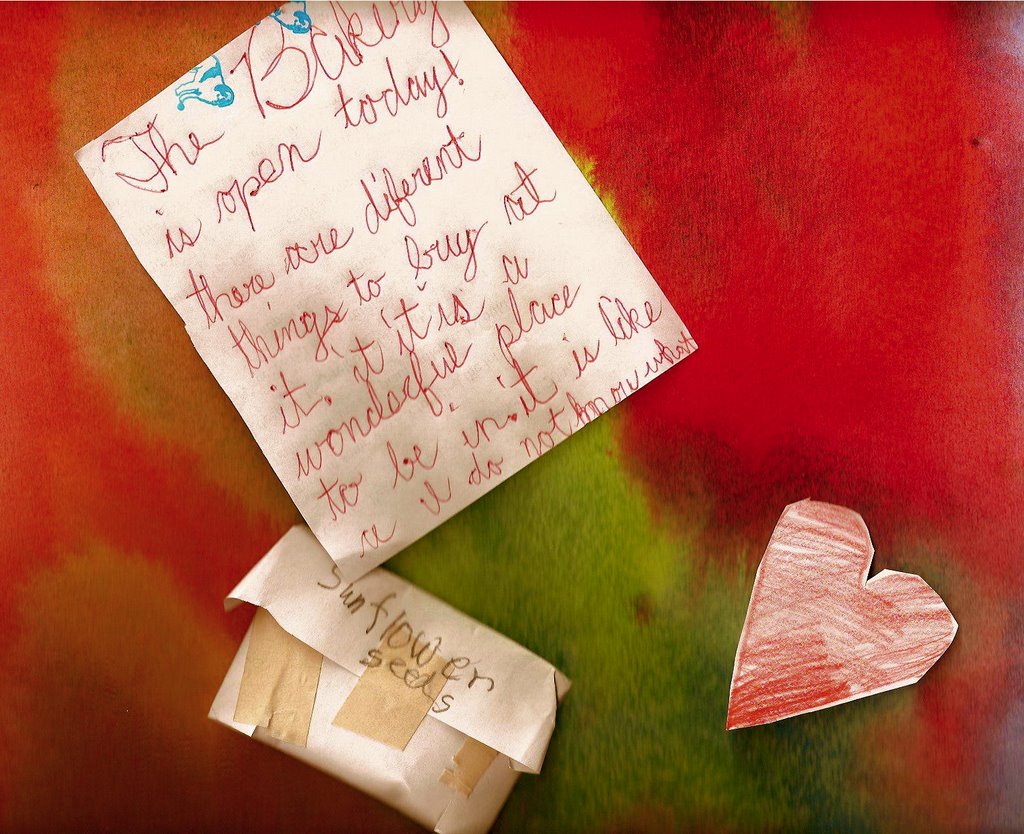
As you see, I am not the only writer of the family. This reminds me to find last summer's saga, "The Gost and the Gril," a short story about a playful ghost and a fearful girl-- all written in multicolor pencil.
Oh, and the seed project: my children collected seeds from the pods of flowers of neighbors, constructed and labeled illustrated envelopes for the seeds, then proceded to sell the seeds back to the exact same neighbors. So far they have collected $4.80 and penciled in a few dozen meetings of The Seed Store onto their busy calendar. I got a complementary pack of sunflowers, after showing them how to rinse and dry tomato seeds.
autumn girls, bluebird and picnic quilt
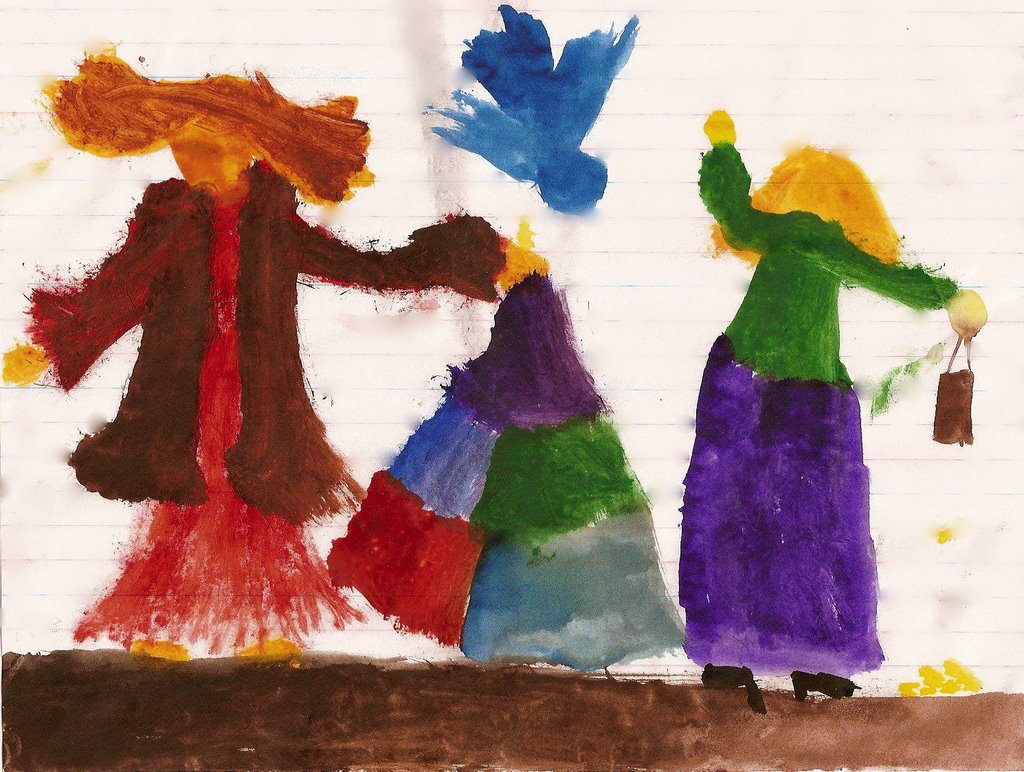
I believe this is Madeleine, on the right, and her friend Lila on the left. I will see if there is more of a story-- found this in the big bin of collected paper productions.
Thursday, October 19, 2006
weather report: soccer and violin
I don’t know how it happened. One day I was cradling the newborns with my friends Tad and Dianna, reliving the glories of spit-up and burping and footie-pajamas, soft round heads and necks to be supported. Mothering floods back, the curve of a baby against the neck, tiny fingers arching and gripping. I love the way time stops and the baby and I test one another’s long gaze.
And days later I am attending my first soccer practice with my nearly-seven-year-old Brendan, watching him fly at the ball with no concern that he knows nothing, has not even seen a soccer game. I ask Madeleine, nearly nine, each day if she needs to remember her violin, the love of her life. Soccer. Violin. He crafts things with great precision. She reads, with a strand of hair stuck in her mouth. Each night I ask Madeleine to find a good place to stop in her reading of The Voyage of the Dawn Treader. Sometimes she is kind enough to read Winnie the Pooh stories for Brendan, and sometimes she agrees to give him a violin lesson. I watch her just now, practicing after her bath, kneeling in her nightgown and damp hair dripping as she concentrates on “Old MacDonald” and a French carol. She begins a new piece that turns out to be our favorite lullaby, Ode to Joy, and hears me gasp in recognition. “I thought I’d surprise you, Mama!” she laughs.
“Oh, play it all! Play for me!” I continue typing at the keyboard, while Brendan sews buttons and Madeleine finds the notes. She’s been playing for three weeks, and while expertise is somewhere in the distant future, she uses her bow with great love and great long strokes, while Brendan and I sing.
Brendan’s imagination soars to all kinds of things he can do. Projects are hard for him to let go for another day. He is so much like me in this respect: when he likes a task, he likes it in great detail. He’d been bugging me to find him a sewing project for a week or so when Scott lost a button from a dress shirt. Brendan ran to find the sewing kit while Scott and I shared a knowing “aha.” Mending? We have an ongoing supply of mending. Where to find buttons? The boy knows the location of twenty odd buttons, in drawers and treasure baskets and piggy banks. I show him the matching replacement buttons which are sewn to the bottom of the button placket of dress shirts, and he runs to show the me similar replacement buttons sewn inside polo shirts and trousers.
“Yes,” I say, “the people who make clothes know that buttons sometimes fall off. This one just needs a grown up to snip it free, and then I will show you a few things to look for. See how this button is sewn with two bars of threads? See how that one is sewn with an ‘x’? See how that other button’s hole is in the back?” He sees. He has an eye for detail. I demonstrate one time how the knot needs to be underneath the shirt, how to wrap the stitches for strength, and he is off, searching for more buttons to replace. There are many. The urge to find and replace buttons may not last more than a few hours, or it may last a month, and I want to catch it while it lasts.
Both Madeleine and Brendan are tempests, but different kinds of tempests. Brendan’s fury is a full-body freight train of strength—but he can suddenly drop the fury for a good distraction. Madeleine’s fury starts small and escalates step by step to high drama, and at times it seems that “there is no going back” from very early in a strategically-planned parent-disassembling tantrum. I think back, each time, to her first tantrum at age 18 months, how I was so mystified that I grabbed the camera and made a photo essay of each of the stages, right up until she was her laughing self again.
I miss the newborn days, and I don’t miss them. I miss the days before “no,” the days when food and sleep and warmth were all the worries, days of sitting in long stretches, waiting for the baby to nod off or settle down. But that violin charms me, and my son’s thrilled description of team practice warms my heart. He sleeps well, with all the buttons in the house sewn in place. She dreams of string ensemble, begging for one more Mozart song on the CD player before bedtime. I’m glad for how they are unfolding, just now. I wouldn’t trade mine for the cuddly ones. We’re just getting started.
And days later I am attending my first soccer practice with my nearly-seven-year-old Brendan, watching him fly at the ball with no concern that he knows nothing, has not even seen a soccer game. I ask Madeleine, nearly nine, each day if she needs to remember her violin, the love of her life. Soccer. Violin. He crafts things with great precision. She reads, with a strand of hair stuck in her mouth. Each night I ask Madeleine to find a good place to stop in her reading of The Voyage of the Dawn Treader. Sometimes she is kind enough to read Winnie the Pooh stories for Brendan, and sometimes she agrees to give him a violin lesson. I watch her just now, practicing after her bath, kneeling in her nightgown and damp hair dripping as she concentrates on “Old MacDonald” and a French carol. She begins a new piece that turns out to be our favorite lullaby, Ode to Joy, and hears me gasp in recognition. “I thought I’d surprise you, Mama!” she laughs.
“Oh, play it all! Play for me!” I continue typing at the keyboard, while Brendan sews buttons and Madeleine finds the notes. She’s been playing for three weeks, and while expertise is somewhere in the distant future, she uses her bow with great love and great long strokes, while Brendan and I sing.
Brendan’s imagination soars to all kinds of things he can do. Projects are hard for him to let go for another day. He is so much like me in this respect: when he likes a task, he likes it in great detail. He’d been bugging me to find him a sewing project for a week or so when Scott lost a button from a dress shirt. Brendan ran to find the sewing kit while Scott and I shared a knowing “aha.” Mending? We have an ongoing supply of mending. Where to find buttons? The boy knows the location of twenty odd buttons, in drawers and treasure baskets and piggy banks. I show him the matching replacement buttons which are sewn to the bottom of the button placket of dress shirts, and he runs to show the me similar replacement buttons sewn inside polo shirts and trousers.
“Yes,” I say, “the people who make clothes know that buttons sometimes fall off. This one just needs a grown up to snip it free, and then I will show you a few things to look for. See how this button is sewn with two bars of threads? See how that one is sewn with an ‘x’? See how that other button’s hole is in the back?” He sees. He has an eye for detail. I demonstrate one time how the knot needs to be underneath the shirt, how to wrap the stitches for strength, and he is off, searching for more buttons to replace. There are many. The urge to find and replace buttons may not last more than a few hours, or it may last a month, and I want to catch it while it lasts.
Both Madeleine and Brendan are tempests, but different kinds of tempests. Brendan’s fury is a full-body freight train of strength—but he can suddenly drop the fury for a good distraction. Madeleine’s fury starts small and escalates step by step to high drama, and at times it seems that “there is no going back” from very early in a strategically-planned parent-disassembling tantrum. I think back, each time, to her first tantrum at age 18 months, how I was so mystified that I grabbed the camera and made a photo essay of each of the stages, right up until she was her laughing self again.
I miss the newborn days, and I don’t miss them. I miss the days before “no,” the days when food and sleep and warmth were all the worries, days of sitting in long stretches, waiting for the baby to nod off or settle down. But that violin charms me, and my son’s thrilled description of team practice warms my heart. He sleeps well, with all the buttons in the house sewn in place. She dreams of string ensemble, begging for one more Mozart song on the CD player before bedtime. I’m glad for how they are unfolding, just now. I wouldn’t trade mine for the cuddly ones. We’re just getting started.
Tuesday, October 10, 2006
three a.m. wooly-headed report
Just off of a searing headache—at some point, I become the kind of hostage that bargains, with Advil Migraine, one, then two, with Claritin, with caffeine, anything to make the buzzing/burning stop. It seems that whatever makes the pain so miserable releases at ten p.m., almost every time. What is that? The headache has been building for nearly a week, hanging around the edges with a little burning in my head, some sinus stuffiness related to allergies. Last time I had one this bad was in early May, six months ago.
The headache subsides, but my muscles are so tensed, and the caffeine still kicking—thus I am writing at three a.m. I will try horizontal again, soon.
I remember, a few hours ago, the feeling that the world was tipping with this pain, and then my ears would latch onto something like the train whistle, a mile away, or the gull cries, or my sense of smell would grab the scent of those fresh green beans I was preparing for dinner, or the salt air. Each of these markers of some good, real joy roots my feet back to the ground and spurs me to simple endurance.
Sometimes I grab my drop spindle and spin yarn, mustering focus from the sickening swirl. The spindle is how I distracted myself from headaches for nearly six months last year. Today’s yarn is a sea green, varied with specks of blue and spring green. I have no idea what this yarn will become, or if it will become anything at all—I just know the concentration pulls me away from the pain.
I was in the middle of “felting” several sweaters, i.e. recycling and re-fashioning the pieces into other creations, when the headache expanded to something difficult to manage. While the pain was in full force, a rich fuzzy brown wool and a patterned blue and pink fair isle emerged from the dryer, plus a sweet girl-sized boiled wool cardigan shrunken from an extra large cardigan with embroidered flowers. A too-bright Bolivian wool sweater will get a good look tomorrow, to assess its good qualities. Will it become mittens? A hat? I sewed two charcoal ribbed sleeves from a ruined sweater into very warm black mittens with long cuffs, and they shrunk to just the right size. Yesterday I asked children to help me scrub and shrink two pair of mittens for the school store—and somehow, though I intended to sell these three pair of mittens, one adult and two children’s pairs, there is one pair of just-right mittens for each of us, and I’m not certain I can part with them.
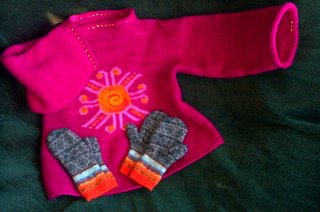
The day before yesterday, I dipped into my recycled sweater stash to find a formerly huge pink sweater with a hideous Aztec sun design on the front and back. It’s Madeleine’s size, after half a dozen washes, and the scratchy homespun yarn changed to a soft, thick wool. Hot water, agitation, and an alkaline soap make the fibers shrink, and the “split ends” create a beautiful fuzzy haze or “halo” over the sweater. I “needle felted” a swirling sun of gold and orange into the center of the Aztec design, cut and rolled the cuffs and collar with bright yellow wool whipstitching. She wore it to church yesterday, shining like the sun, herself. I’m eager to re-fashion the other sweaters, as well. Imagine, gorgeous one-of-a-kind garments from the “buck-a-pound” thrift shop. I’m working to re-fashion something specifically for Brendan, next. I have a matching Aztec sun blue sweater, which I whacked the sleeves off in haste to make mittens—I may need to re-knit sleeves for the damn thing!
And on the very bottom of my recycled sweater stash is the little hat Brendan wore until he was three, the dancing people hat. Suzanne tells me the hat is Peruvian, and that she bought it as an adult hat, but the combination of damp snow and body heat has shrunken it to toddler size. I took a scanned image of the hat, with hopes of recreating the knitted pattern in an adult size again—but this time in washable wool, for my friend! All that is for later, though. First a hat for Sasha, made from handspun wool from her sheep. Or perhaps sleeves for a blue Aztec sun sweater. (Let me just say it here: I can’t really believe I’m going to put sleeves back on that sweater. Grrrr.) All knitting projects are for days without headaches, not today, not the middle of the night.
Horizontal. Will try horizontal again, and hope for the best.
Woke in time to make breakfast and pack lunches—head is okay enough, this morning.
The headache subsides, but my muscles are so tensed, and the caffeine still kicking—thus I am writing at three a.m. I will try horizontal again, soon.
I remember, a few hours ago, the feeling that the world was tipping with this pain, and then my ears would latch onto something like the train whistle, a mile away, or the gull cries, or my sense of smell would grab the scent of those fresh green beans I was preparing for dinner, or the salt air. Each of these markers of some good, real joy roots my feet back to the ground and spurs me to simple endurance.
Sometimes I grab my drop spindle and spin yarn, mustering focus from the sickening swirl. The spindle is how I distracted myself from headaches for nearly six months last year. Today’s yarn is a sea green, varied with specks of blue and spring green. I have no idea what this yarn will become, or if it will become anything at all—I just know the concentration pulls me away from the pain.
I was in the middle of “felting” several sweaters, i.e. recycling and re-fashioning the pieces into other creations, when the headache expanded to something difficult to manage. While the pain was in full force, a rich fuzzy brown wool and a patterned blue and pink fair isle emerged from the dryer, plus a sweet girl-sized boiled wool cardigan shrunken from an extra large cardigan with embroidered flowers. A too-bright Bolivian wool sweater will get a good look tomorrow, to assess its good qualities. Will it become mittens? A hat? I sewed two charcoal ribbed sleeves from a ruined sweater into very warm black mittens with long cuffs, and they shrunk to just the right size. Yesterday I asked children to help me scrub and shrink two pair of mittens for the school store—and somehow, though I intended to sell these three pair of mittens, one adult and two children’s pairs, there is one pair of just-right mittens for each of us, and I’m not certain I can part with them.
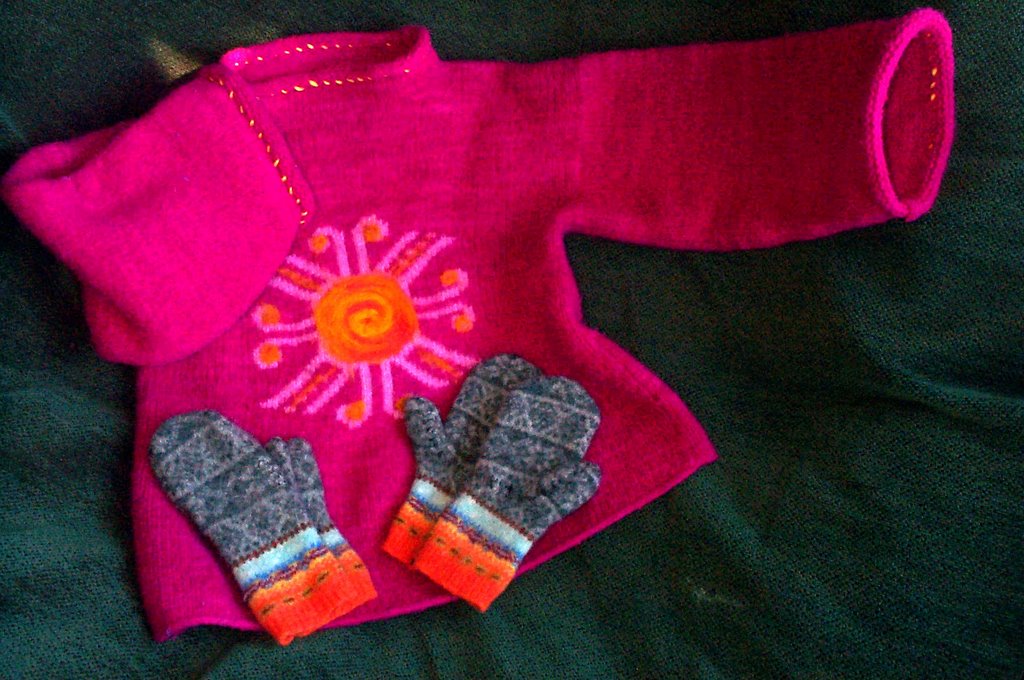
The day before yesterday, I dipped into my recycled sweater stash to find a formerly huge pink sweater with a hideous Aztec sun design on the front and back. It’s Madeleine’s size, after half a dozen washes, and the scratchy homespun yarn changed to a soft, thick wool. Hot water, agitation, and an alkaline soap make the fibers shrink, and the “split ends” create a beautiful fuzzy haze or “halo” over the sweater. I “needle felted” a swirling sun of gold and orange into the center of the Aztec design, cut and rolled the cuffs and collar with bright yellow wool whipstitching. She wore it to church yesterday, shining like the sun, herself. I’m eager to re-fashion the other sweaters, as well. Imagine, gorgeous one-of-a-kind garments from the “buck-a-pound” thrift shop. I’m working to re-fashion something specifically for Brendan, next. I have a matching Aztec sun blue sweater, which I whacked the sleeves off in haste to make mittens—I may need to re-knit sleeves for the damn thing!

And on the very bottom of my recycled sweater stash is the little hat Brendan wore until he was three, the dancing people hat. Suzanne tells me the hat is Peruvian, and that she bought it as an adult hat, but the combination of damp snow and body heat has shrunken it to toddler size. I took a scanned image of the hat, with hopes of recreating the knitted pattern in an adult size again—but this time in washable wool, for my friend! All that is for later, though. First a hat for Sasha, made from handspun wool from her sheep. Or perhaps sleeves for a blue Aztec sun sweater. (Let me just say it here: I can’t really believe I’m going to put sleeves back on that sweater. Grrrr.) All knitting projects are for days without headaches, not today, not the middle of the night.
Horizontal. Will try horizontal again, and hope for the best.
Woke in time to make breakfast and pack lunches—head is okay enough, this morning.
Subscribe to:
Posts (Atom)