I pull my minivan into the school parking lot with five extra minutes—a good boundary for a phone call. The ruffled pages of my journal to leaf through, and find the hospital number.
The ringing ends with a click, then a fumbling sound, then voices discussing what is apparently a news story. After a few moments confusion, I shout her name into the phone, “KAREN? KAREN ARE YOU THERE?” A fumbling sound again and I hear her “hello?” back, as she locates the phone, somewhere near the television speaker I’d wager.
“Hello?” Karen finally answers, out of breath. I wonder if she is figuring how to hold the phone, struggling to find a comfortable position after all that.
“Karen? It’s me, Denise.”
“Hi honey. How are you?” Her breathing is labored.
“I’m good, Karen. Things are fine, here. You’re in the hospital. I’m so glad you made it through surgery okay. How are you?” I don’t add the usual “and what do you need?” I can offer nothing but this phone call.
“I’m okay.” The end of her sentence trails off, not nearly okay. She asks about my children, about my writing, and then talks about the next place she will live, after the rehab hospital, after the burn unit. She thinks she will have work for me, she says.
I am quiet. Her family hasn’t spoken to her yet, then, about the shape of the future. Her sedation is heavy, with the recovery from the skin grafts. She knows she will not be moving to her home again, but she’s planning for a next place, a next independent place. I don’t allow myself to argue with her hope. That’s not my job.
I ask when she might be ready for a visitor, and she says not this week, “I’m so tired, honey, so awfully tired. It’s so much work being in the hospital.” She tells me she can barely stay awake for this phone call, and I hear that it’s true, she is struggling. We spoke for ninety seconds or so.
“You will call me again soon, won’t you? Next week, maybe? I miss talking with you. It’s been a long week," she says.
I smile at the understatement, a long week since your house burned down, long week since you lost what precious little you had left. “Yes, it has been a long week, hasn’t it? I miss you, too, Karen. Rest up and we will talk again soon.” We say our goodbyes.
The children sing their way down the school steps and out into the pickup area. I fold up the phone and pull my shoulders back in a stretch, undo the seatbelt and open the door into the sunny afternoon.
Showing posts with label yearning. Show all posts
Showing posts with label yearning. Show all posts
Thursday, June 07, 2007


Friday, April 20, 2007
a different start to the same story
Months ago, I posted A Fluke Within a Mistake, an essay for a scholarship. Though I finished the essay, the different starts and pieces are still around, waiting find new homes. This is one.
The reading was about heartburn. I was a terrible cook, then, but a good eater, and I felt a keen urge to bake cookies, and to read that cookbook from cover to cover. Both urges were fulfilled in short order. I wonder how many of life’s best moments happen through mistakes and miscalculations, and the tiny seeds sown in strange places, in good faith.
So many events change us so profoundly, and the first that came to mind is the image of a snake, shedding its skin, coupled with the experience of leaving home. Then I listed all the leavings of home, and there were so many: leaving my small town for college, leaving the Midwest for so many places, each time shedding a skin but looking not terribly different from the person I was before. The adult leavings, too: leaving a profession I loved, leaving the easy ways of singlehood for marriage, leaving a good job to be closer to family, and the remarkable shedding of skin involved in childbirth and what follows. Shedding that skin left me so exposed I’m just beginning to recover after ten years.
The better question, for me, is to ask not about the myriad of leavings, but to ask when I began to come home—to come home to myself, and make a home in this world, for me and for others. This reading of a cookbook, in this odd lecture, begins that story.
The moment someone introduced me to the God who delights in the creation like a chef cooking for her best friends, I recognized that God immediately. There is a place for theology, but there is a richer and wiser place for loving the entirety of the created order, lock stock and barrel, with a touch of rosemary and finished off with butter. That’s the same place where composting turns vegetable scraps into the most delicious-smelling black gold, and also the place where color combinations raise the spirit of the handspinner of wool to new heights. There is a place to sing along with Aretha Franklin. The world—this world is full to brimming with entrancing joys.
The reading was about heartburn. I was a terrible cook, then, but a good eater, and I felt a keen urge to bake cookies, and to read that cookbook from cover to cover. Both urges were fulfilled in short order. I wonder how many of life’s best moments happen through mistakes and miscalculations, and the tiny seeds sown in strange places, in good faith.
So many events change us so profoundly, and the first that came to mind is the image of a snake, shedding its skin, coupled with the experience of leaving home. Then I listed all the leavings of home, and there were so many: leaving my small town for college, leaving the Midwest for so many places, each time shedding a skin but looking not terribly different from the person I was before. The adult leavings, too: leaving a profession I loved, leaving the easy ways of singlehood for marriage, leaving a good job to be closer to family, and the remarkable shedding of skin involved in childbirth and what follows. Shedding that skin left me so exposed I’m just beginning to recover after ten years.
The better question, for me, is to ask not about the myriad of leavings, but to ask when I began to come home—to come home to myself, and make a home in this world, for me and for others. This reading of a cookbook, in this odd lecture, begins that story.
The moment someone introduced me to the God who delights in the creation like a chef cooking for her best friends, I recognized that God immediately. There is a place for theology, but there is a richer and wiser place for loving the entirety of the created order, lock stock and barrel, with a touch of rosemary and finished off with butter. That’s the same place where composting turns vegetable scraps into the most delicious-smelling black gold, and also the place where color combinations raise the spirit of the handspinner of wool to new heights. There is a place to sing along with Aretha Franklin. The world—this world is full to brimming with entrancing joys.
Sunday, March 11, 2007
winter fantasy II: brendan's dream
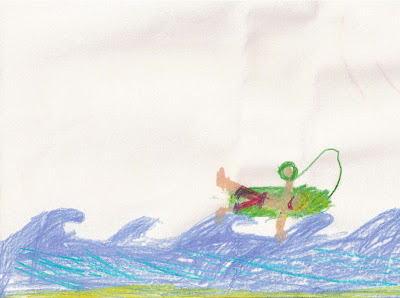
I can't see his eyes, but look at the happy smile... Oh, for the fans back home in Indiana, that's called a "boogie board." It's a shortened, lightweight version of a surfboard-- on a wrist-leash so you don't lose it, as you can see from the picture.
With only the tiniest bit of skill, the average mortal (i.e. even me) can catch a wave and ride all the way to the beach. Children scamper off for the next ride, while adults wonder how to wrench themselves from the wet sand.
Brendan has his dad's natural athleticism and his mom's determination to catch a wave, a good combo for a boy living by the sea. Of course, the ocean won't be warm enough until July, so there's still a few months to wait.

Wednesday, December 27, 2006
exception to the rule
Brendan often chooses particularly challenging projects near bedtime—the Lego car kit that requires tiny pieces placed just right, or braiding, or just the other night he turned over a jigsaw puzzle with a photo of the sun’s surface, then he wept because he just couldn’t make the frustrating pieces fit back together. He didn’t do it to make me mad; he really thought he could do this puzzle, just the same as he could when he is fresh, in the morning. I don’t rescue often—I am the parent who doesn’t give boosts for climbing, doesn’t push swings once children grow capable of pumping their own legs for momentum. “You got the wrong mama!” I laugh when children beg me for things they must do themselves. “If you can’t get yourself up on that high rock, then you don’t need to be on that rock.” Sometimes my children wish they had a nicer mama, but a tough mama comes in handy, too. They are strong climbers, and good on the swings.
But bedtime is a different matter: without that sun picture completed, there will be no sleep. And if tears go on long enough, even if the sun picture is completed, there will be no sleep. “Let’s do it together, B,” I say in what I hope is a soothing tone. It’s late. I hate jigsaw puzzles. “Put all the straight edge pieces in this pile, and then we’ll separate the other pieces by color.” I ask Madeleine to go get my glasses— my eyes show the weariness first.
I place the edge pieces inside the border, and too many pieces are shaped similarly. It’s a 48 piece puzzle designed for eight year olds, and I am swearing at it under my breath, muttering and wanting to pound them with my fist like Brendan does. Fifteen minutes of frustration later, I realize we got two similarly-shaped pieces mixed up, and that’s why the puzzle is not coming together. I pat the sun puzzle with pretend satisfaction, kiss all goodnight and tuck them in, and tuck the puzzle in its case, too. I walk out quietly to my desk, where the urge to type in capital letters I HATE JIGSAW PUZZLES AND I WILL NEVER DO ONE AGAIN IF I CAN HELP IT. But I have other things to write, so I don’t waste my time.
But here I am. Mount Ypsilon, Bear Lake, The Twin Sisters.
My Christmas present from Brendan is a jigsaw puzzle of Rocky Mountain National Park, a topographical map of a landscape I loved intimately twenty summers ago.
The Twin Owls, Sprague Lake. Bridal Veil Falls—there are two different waterfalls sharing the same name, and I used to know which was which, but I don’t now.
I don’t know every single piece. I didn’t own a car when I spent my two college summers working outside of the Park boundaries, so my travels were limited to hikes sponsored by the conference center where I worked, or places I could arrange to hike with friends. My second summer I logged 186 miles over sixteen weeks of summer break, as a slow hiker with a short stride trying real hard. I worked the night shift, then caught the first hiking group available two or three mornings a week, when I wasn’t collapsing due to lack of genuine sleep. Most hikes returned by two p.m. to avoid the afternoon thunder storms so typical in the Rockies. I’d stagger to my little village of staff housing, shower and throw myself into bed, just as the morning kitchen and cleaning staffs arrived home from their shifts to make happy mayhem. Often sleep seemed impossible, so I’d grab my pack and hike to the Big Thompson River, to sleep on my favorite sun-warmed boulder. I had the best tan of my life, joking that my goal was “skinny, tan and godly.” My erratic schedule and my solo work at the conference center’s night switchboard made me half crazy, but “work” constituted stacking the fireplace with wood, playing my guitar and waiting for the phone to ring. And I got to hike more than anyone else but the hikemasters. I invited other staff to come enjoy my fireplace, and the fabulous meals the security guard brought me—steaks and fresh vegetables, delicious strawberries, much better than regular staff rations. With the exception of sleep, it was the perfect job.
I closed my eyes to the cover of the puzzle, so each little piece I turn over from the big box finds me delighted. Keyboard of the Winds, Pagoda, Sunset Lake.
Not much makes me nostalgic. I don’t idealize high school or college—those were lonely years. My first years in the working world were grueling. But I’m nostalgic for landscapes, astounding landscapes like those mountains, the first place I laid eyes on when I left home, the most beautiful place on earth. I long to go back, though I can’t imagine how our lives would need to change to afford such a trip.
Long’s Peak—I don’t think I could train hard enough to climb Long’s easily. It’s a tough, long hike with some very scary precipices. I am not in any kind of condition for it. Altitude sickness occurs in even the fittest of tourists—it would take most of week to acclimate to life two miles above sea level. I am pale and definitively not skinny. Godliness may be different now than it was before, but that spirit-flame is not quite as dependent on circumstances.
I hiked to Eagle’s Cliff at least one afternoon a week, often by myself, to write letters and enjoy a sunset. From there I could see the vast green Moraine Park, which take up half a dozen pieces of this puzzle, with it’s snaking blue river.
Teddy’s Teeth is not a high ridge, but it’s the ridge between Estes Park and Boulder, and the best place to watch fireworks exploding below you, in dozens of cities, for miles and miles of fireworks in bright splashes over the lights of Denver in the distance. Teddy’s is the last peak I climbed, for a picnic lunch with Peter Reigle, 1985, my last day in the Rockies.
I do hate jigsaw puzzles, and I may never do another. But I’ll gladly assemble the Rocky Mountains, each new piece a dream of where I might go someday, if I haven’t seen it already. Five hundred interlocking pieces, some of them falling into place just as I remember them. It’s all I can manage not to obsess over the whole project right now. I will not pound these pieces with my fist or swear at them. Each one is a dear vision. I’ll just go do a few more, just one or two…
But bedtime is a different matter: without that sun picture completed, there will be no sleep. And if tears go on long enough, even if the sun picture is completed, there will be no sleep. “Let’s do it together, B,” I say in what I hope is a soothing tone. It’s late. I hate jigsaw puzzles. “Put all the straight edge pieces in this pile, and then we’ll separate the other pieces by color.” I ask Madeleine to go get my glasses— my eyes show the weariness first.
I place the edge pieces inside the border, and too many pieces are shaped similarly. It’s a 48 piece puzzle designed for eight year olds, and I am swearing at it under my breath, muttering and wanting to pound them with my fist like Brendan does. Fifteen minutes of frustration later, I realize we got two similarly-shaped pieces mixed up, and that’s why the puzzle is not coming together. I pat the sun puzzle with pretend satisfaction, kiss all goodnight and tuck them in, and tuck the puzzle in its case, too. I walk out quietly to my desk, where the urge to type in capital letters I HATE JIGSAW PUZZLES AND I WILL NEVER DO ONE AGAIN IF I CAN HELP IT. But I have other things to write, so I don’t waste my time.
But here I am. Mount Ypsilon, Bear Lake, The Twin Sisters.

My Christmas present from Brendan is a jigsaw puzzle of Rocky Mountain National Park, a topographical map of a landscape I loved intimately twenty summers ago.
The Twin Owls, Sprague Lake. Bridal Veil Falls—there are two different waterfalls sharing the same name, and I used to know which was which, but I don’t now.
I don’t know every single piece. I didn’t own a car when I spent my two college summers working outside of the Park boundaries, so my travels were limited to hikes sponsored by the conference center where I worked, or places I could arrange to hike with friends. My second summer I logged 186 miles over sixteen weeks of summer break, as a slow hiker with a short stride trying real hard. I worked the night shift, then caught the first hiking group available two or three mornings a week, when I wasn’t collapsing due to lack of genuine sleep. Most hikes returned by two p.m. to avoid the afternoon thunder storms so typical in the Rockies. I’d stagger to my little village of staff housing, shower and throw myself into bed, just as the morning kitchen and cleaning staffs arrived home from their shifts to make happy mayhem. Often sleep seemed impossible, so I’d grab my pack and hike to the Big Thompson River, to sleep on my favorite sun-warmed boulder. I had the best tan of my life, joking that my goal was “skinny, tan and godly.” My erratic schedule and my solo work at the conference center’s night switchboard made me half crazy, but “work” constituted stacking the fireplace with wood, playing my guitar and waiting for the phone to ring. And I got to hike more than anyone else but the hikemasters. I invited other staff to come enjoy my fireplace, and the fabulous meals the security guard brought me—steaks and fresh vegetables, delicious strawberries, much better than regular staff rations. With the exception of sleep, it was the perfect job.
I closed my eyes to the cover of the puzzle, so each little piece I turn over from the big box finds me delighted. Keyboard of the Winds, Pagoda, Sunset Lake.
Not much makes me nostalgic. I don’t idealize high school or college—those were lonely years. My first years in the working world were grueling. But I’m nostalgic for landscapes, astounding landscapes like those mountains, the first place I laid eyes on when I left home, the most beautiful place on earth. I long to go back, though I can’t imagine how our lives would need to change to afford such a trip.
Long’s Peak—I don’t think I could train hard enough to climb Long’s easily. It’s a tough, long hike with some very scary precipices. I am not in any kind of condition for it. Altitude sickness occurs in even the fittest of tourists—it would take most of week to acclimate to life two miles above sea level. I am pale and definitively not skinny. Godliness may be different now than it was before, but that spirit-flame is not quite as dependent on circumstances.
I hiked to Eagle’s Cliff at least one afternoon a week, often by myself, to write letters and enjoy a sunset. From there I could see the vast green Moraine Park, which take up half a dozen pieces of this puzzle, with it’s snaking blue river.
Teddy’s Teeth is not a high ridge, but it’s the ridge between Estes Park and Boulder, and the best place to watch fireworks exploding below you, in dozens of cities, for miles and miles of fireworks in bright splashes over the lights of Denver in the distance. Teddy’s is the last peak I climbed, for a picnic lunch with Peter Reigle, 1985, my last day in the Rockies.
I do hate jigsaw puzzles, and I may never do another. But I’ll gladly assemble the Rocky Mountains, each new piece a dream of where I might go someday, if I haven’t seen it already. Five hundred interlocking pieces, some of them falling into place just as I remember them. It’s all I can manage not to obsess over the whole project right now. I will not pound these pieces with my fist or swear at them. Each one is a dear vision. I’ll just go do a few more, just one or two…
Thursday, November 09, 2006
organic fuji
She loves apples. Though other foods come and go from favor, this has not changed over the last year. Organic Fuji apples, Haagen Daz ice cream, and red meat, served as rare as possible. Sometimes she loves whole milk yogurt, drizzled with maple syrup. Last week I enticed her with carrots, sautéed and sauced with ginger plum jam and a squeeze of citrus. But today her stomach is bothering her, and she wants only apples. Fuji. Organic.
I brace myself and phone Karen from the supermarket aisle, to report that there are no Fuji apples today. I hear a long silence and a bit of a whimper like a disappointed child. “I see beautiful Braeburns, Granny Smiths, and translucent yellow ones, let’s see… yes, Golden Delicious.”
“No Fuji. No Ginger Gold? Did you ask?”
“I asked. Braeburns, Grannies, Goldens.”
“Okay,” she says, followed by a long pause. “Four Goldens.”
“The Grannies look good.”
“And two Granny Smiths.”
“Be there soon, Karen. Bye.”
I pull up to Karen’s door to find the bottled water delivery has been abandoned at the base of the stairs. I take the apples to the sink, then make five return trips up the stairs with loads of spring water.
She has just woken, she tells me. The smell of cigarette smoke permeates the bedroom, and she is embarrassed. In warmer months she restricts her smoking to her patio, but today is damp. She keeps the windows open and fans running, so the smoke smell never grows stale.
I rearrange the water supply, then empty first the small dish rack and then the dishwasher. I check the cat’s dishes and the trash cans and the laundry. I carefully wash my hands and wash the apples, start the coffee pot then check the refrigerator. She needs apples, now, and there is only one blue porcelain dish of thin-sliced apples, with a half of a juiced lime stored in the bowl. I pour her a cup of fresh coffee, add a drop of maple syrup, and carry the chilled dish of apples to Karen’s bedroom. “Sustenance!” I announce.
“Such sustenance! I’ll be a few minutes.” She apologizes, a woman recovering from so many things, she still feels responsible to be a good hostess in her own home.
I return and calculate what Karen will need for lunch and dinner. I carefully wash the apples, and set a bin for compost beside the cutting board. I roll the lime on the counter with a bit of pressure to release the juices, cut it in half and squeeze it into the next porcelain dish. Quarter the apples, peel and core the quarters, and slice each quarter into three or four thin slices. I cut them as if I were feeding the apples to toddlers I don’t want to choke. And I roll the slices in lime, just the way she likes them. The Granny Smith apple is pale green on the inside, just as the Golden is a pale yellow. As I peel the Golden Delicious slices, I see one peel go into the compost and then I ask myself what I am thinking! I peel the other slices and stack all the peels on the side of the cutting board. When I’ve rolled the last of the slices in lime and placed the dish in the refrigerator, I toss the lime into my water glass and snack on the delicate peels.
That’s enough apples for overnight.
Karen walks carefully into the kitchen with her empty bowl. I can see that walking is painful for her, and she seems unsteady. Still she is thanking me graciously, and I try to convince her to let me make her breakfast. Nothing tastes good, she says. She wants a shower. As she goes, she turns to say, on second thought, could I make her a hamburger? I am such a mom about these things, so excited to find something Karen will eat.
“How would you like it?”
“If it’s not too much trouble, could you sauté some finely chopped red onion and garlic and mix it with the organic burger? Lots of onions and garlic.”
“Salt? Pepper?”
“Lots of those, too. And rare—bloody rare. Just introduce the burger to the pan and embarrass him a little in front of his friends.”
I love all these little instructions that remind me she used to be a chef. She can coach me through a dish, and the food seems to come out exactly as she wants it. I heat extra virgin olive oil in the cast iron skillet while I slice a red onion paper thin and rough it up a little, then mash the garlic under the flat side of the knife, with the bang of a fist.
“Karen, it’s cooked barely enough to hold the burger together. Is that the way you like it?”
“That sounds perfect. Can we heat up the sweet potato fries?”
“Absolutely!”
I set the table for two and pour myself a cup of coffee. I grab salad fixings for myself, and leave room for a few of the fries on the side of the plate. Floral plates, napkins from India, a little vase of flowers from Karen’s regular assistant.
And we sit, and we talk, and she is so pleased with her hamburger and fries. Her eyes close and she hums a little with contentment.
“Exactly as I wanted it, dear.” And she is just as hungry for my company, for conversation. We linger over our plates.
After lunch she heads for the shower, after all. I begin to tidy up dishes and pans and I glance at the list of chores I saw earlier on the kitchen table, written in very large hand so Karen can check it over. Number 1 read, Slice apples, and she has scrawled something above it with a bold permanent pen. So now it reads “Slice FUJI apples.” I smile and shake my head. Next time, I say to myself, next time I will go to as many stores as it takes, if I have to go to every grocery in town. Organic Fuji apples, peeled and tossed in lime, next time.
I brace myself and phone Karen from the supermarket aisle, to report that there are no Fuji apples today. I hear a long silence and a bit of a whimper like a disappointed child. “I see beautiful Braeburns, Granny Smiths, and translucent yellow ones, let’s see… yes, Golden Delicious.”
“No Fuji. No Ginger Gold? Did you ask?”
“I asked. Braeburns, Grannies, Goldens.”
“Okay,” she says, followed by a long pause. “Four Goldens.”
“The Grannies look good.”
“And two Granny Smiths.”
“Be there soon, Karen. Bye.”
I pull up to Karen’s door to find the bottled water delivery has been abandoned at the base of the stairs. I take the apples to the sink, then make five return trips up the stairs with loads of spring water.
She has just woken, she tells me. The smell of cigarette smoke permeates the bedroom, and she is embarrassed. In warmer months she restricts her smoking to her patio, but today is damp. She keeps the windows open and fans running, so the smoke smell never grows stale.
I rearrange the water supply, then empty first the small dish rack and then the dishwasher. I check the cat’s dishes and the trash cans and the laundry. I carefully wash my hands and wash the apples, start the coffee pot then check the refrigerator. She needs apples, now, and there is only one blue porcelain dish of thin-sliced apples, with a half of a juiced lime stored in the bowl. I pour her a cup of fresh coffee, add a drop of maple syrup, and carry the chilled dish of apples to Karen’s bedroom. “Sustenance!” I announce.
“Such sustenance! I’ll be a few minutes.” She apologizes, a woman recovering from so many things, she still feels responsible to be a good hostess in her own home.
I return and calculate what Karen will need for lunch and dinner. I carefully wash the apples, and set a bin for compost beside the cutting board. I roll the lime on the counter with a bit of pressure to release the juices, cut it in half and squeeze it into the next porcelain dish. Quarter the apples, peel and core the quarters, and slice each quarter into three or four thin slices. I cut them as if I were feeding the apples to toddlers I don’t want to choke. And I roll the slices in lime, just the way she likes them. The Granny Smith apple is pale green on the inside, just as the Golden is a pale yellow. As I peel the Golden Delicious slices, I see one peel go into the compost and then I ask myself what I am thinking! I peel the other slices and stack all the peels on the side of the cutting board. When I’ve rolled the last of the slices in lime and placed the dish in the refrigerator, I toss the lime into my water glass and snack on the delicate peels.
That’s enough apples for overnight.
Karen walks carefully into the kitchen with her empty bowl. I can see that walking is painful for her, and she seems unsteady. Still she is thanking me graciously, and I try to convince her to let me make her breakfast. Nothing tastes good, she says. She wants a shower. As she goes, she turns to say, on second thought, could I make her a hamburger? I am such a mom about these things, so excited to find something Karen will eat.
“How would you like it?”
“If it’s not too much trouble, could you sauté some finely chopped red onion and garlic and mix it with the organic burger? Lots of onions and garlic.”
“Salt? Pepper?”
“Lots of those, too. And rare—bloody rare. Just introduce the burger to the pan and embarrass him a little in front of his friends.”
I love all these little instructions that remind me she used to be a chef. She can coach me through a dish, and the food seems to come out exactly as she wants it. I heat extra virgin olive oil in the cast iron skillet while I slice a red onion paper thin and rough it up a little, then mash the garlic under the flat side of the knife, with the bang of a fist.
“Karen, it’s cooked barely enough to hold the burger together. Is that the way you like it?”
“That sounds perfect. Can we heat up the sweet potato fries?”
“Absolutely!”
I set the table for two and pour myself a cup of coffee. I grab salad fixings for myself, and leave room for a few of the fries on the side of the plate. Floral plates, napkins from India, a little vase of flowers from Karen’s regular assistant.
And we sit, and we talk, and she is so pleased with her hamburger and fries. Her eyes close and she hums a little with contentment.
“Exactly as I wanted it, dear.” And she is just as hungry for my company, for conversation. We linger over our plates.
After lunch she heads for the shower, after all. I begin to tidy up dishes and pans and I glance at the list of chores I saw earlier on the kitchen table, written in very large hand so Karen can check it over. Number 1 read, Slice apples, and she has scrawled something above it with a bold permanent pen. So now it reads “Slice FUJI apples.” I smile and shake my head. Next time, I say to myself, next time I will go to as many stores as it takes, if I have to go to every grocery in town. Organic Fuji apples, peeled and tossed in lime, next time.
Thursday, October 26, 2006
circulation
“When you are depressed,” she said, “and when grieved, take a shower.” I stared at her, dumbfounded. This is the advice people pay for? “I know it sounds silly, but think about it. Don’t you feel, when you are really down sometimes, like you don’t need a shower? But that’s when you need it most. When I’m down, I tend to wear the same thing, tend not to care how I look, to be out of touch with what my body needs. When you feel that way, shower.”
I recall this strange, straightforward advice from my friend the professional herbalist, as I catalog the last few days. Did I shower yesterday? No. But probably the day before. I can’t remember. And if I didn’t shower, I didn’t look at the calendar to see what day to change the patch, and yes, I forgot to replace it yesterday, and no, that’s not good. Missing two days might cause headaches. Writing on next week’s calendar, Friday, patch, don’t forget.
And then I shower.
I toss the favorite turtleneck over my head—not the same favorite turtleneck as yesterday, nor the same favorite jeans, though it’s a temptation, a yearning to wear them for a second day, or maybe a third. Someday I’ll explore where that compulsion comes from. Not today. Today, I simply need to look like “I tried.” I bring down the necklace of Indian corn hanging from my dresser mirror to add just the right touch of whimsy, the sentiment about my children and the colors of nature in autumn. It’s more everyday than dressy. And it reminds me of a dear friend who moved away, after we strung these necklaces for her son’s sixth birthday party. Just a year ago.
I unwrap this week’s patch—it looks exactly like a repair patch for an inflatable children’s pool, or an air mattress. I peel half of the adhesive and press it onto my left hip for the count of ten, then peel the other half, smooth in place and press for another ten. It’s a form of prayer, a no-more-migraines prayer, a thanks-for-no-more-migraines prayer. I am officially repaired for another week.
It’s not, this grief, so much about the loss of my friend Eugene—though that is a loss, a huge loss in the overall fabric of my life. Eug was Ellen’s best friend, and very close to the Schraders. We didn’t have that kind of “always current” friendship; we had instead a we-don’t-need-to-be-current friendship, and I was comfortable with that. The grief is not over the issue of mortality—the shortness of life has been pointed out before.
And it’s not the curve of the widow’s shoulders, the bent arch drawn by her vertebrae in the black dress, though that picture will haunt me, along with the numbness of her hands hanging limply at her sides.
My grief is spurred instead by a moment six weeks before his death. It begins with the way she looked at him as he defied doctor’s orders by trying to stand, in his hospital room. She looked like a woman scolding an angel for flapping its wings, love written all over her at the same time she was exasperated and nearly desperate. “They need your compliance if you want to come home, and you want to come home. Sit. And wait. We all need you to come home.” This grief that breaks my heart is the next moment as he collapsed onto the bed, shaking, grinning and proud of himself for flaunting authority. She lifted his foot and placed it on her lap, exasperation melted, and the cup of her palm slid under the achilles tendon to his heel, removing his running shoes one by one and thus effectively preventing any further foolhardiness—without the stability of those shoes, he would not dare try again. His foot may have been recovering from paralysis, but his eyes looked at the golden crown of her hair. He knew her adoration, spilling out from the cup of her hand. Enough tenderness to create the universe all over again, if she had the power to do so, the power to change anything. His health was already hopeless. He didn’t know it, but she knew.
The grief then? I thought, watching that generous hand cupped, I cannot possibly do what she is doing, live through what she is living through. I can’t even do the simple things my life needs doing, behave lovingly towards the people who need me. I need to be a better person.
Her adoration was so pure, even in the midst of fear and exasperation. I am not selfless, have never been selfless. My caution is that selflessness holds a dangerous edge for women, an edge that leans toward self-erasure, and I’m unwilling to try it on for any longer than necessary. Self-mindfulness, I aspire to, but not selflessness. And adoration? Adoration overflows for my children, unstoppable adoration that surprised me when I first gave birth, because I do love my husband, but I do not adore any adult, not like that. I’m afraid my cupped palm overflows with the exasperation, only, the frustration, irritation, weariness. Rationally, I think my husband probably deserves that rich substance, as much as any good husband, but that impulse reserves itself for my children. I wonder if that’s typical. I wonder if Eugene’s wife’s adoration flowed simply from his nearing death—somehow I doubt that, but perhaps I am giving her the benefit of my self-doubt. Is my love less? Or is their love merely intensified? Perhaps it’s the latter answer, but still I wonder, just as I did when I was an awkward twelve-year-old, if I am simply defective. I give a great deal. My giving is not effortless.
Do I love like that? Do I even have the capacity, beyond those little ones I gave birth to?
I am writing at my kitchen table after my shower. I write through breakfast, over my coffee and I can’t recall what errand pulls me into the bedroom. Earrings, the ones with a touch of orange to match the corn necklace. And there is the mirror—how long since I bothered to wear more than under-eye-concealer? Mascara, then, and a tinted lip balm.
“The shower is not about being clean,” said my herbalist friend. “It’s about circulation, removing the dead skin and dust, helping your skin renew and breathe, the steam releasing the tension in your lungs.”
“I have to adjust to this,” I protested. “I shower like a committed environmentalist, a short shower every other day, unless it’s summer and I’ve sweat a lot. My hair dries out if I wash it too often.”
“That’s what hair conditioner is for. Shower long. Pour a pot of boiling water into the plugged sink first, so there is plenty of steam. Add a few drops of lavender so you breathe more deeply. Your hair holds in the pollen, dust, allergens. It’s not about clean—your scalp needs to breathe. Shed some deadness. Try it and see, first thing when you feel blue. See if it helps.” We discussed a dozen other good options that day, but showering is cheap and easy, requires no expertise and no shopping.
I look in the mirror once again. If I am dressed and accessorized, I might as well circulate right out the door. Maybe I’ll shake off some dead skin. I might well be defective—if so, it’s something to pray about, but I pray best while moving. I grab my bag, my keys, and go.
I recall this strange, straightforward advice from my friend the professional herbalist, as I catalog the last few days. Did I shower yesterday? No. But probably the day before. I can’t remember. And if I didn’t shower, I didn’t look at the calendar to see what day to change the patch, and yes, I forgot to replace it yesterday, and no, that’s not good. Missing two days might cause headaches. Writing on next week’s calendar, Friday, patch, don’t forget.
And then I shower.
I toss the favorite turtleneck over my head—not the same favorite turtleneck as yesterday, nor the same favorite jeans, though it’s a temptation, a yearning to wear them for a second day, or maybe a third. Someday I’ll explore where that compulsion comes from. Not today. Today, I simply need to look like “I tried.” I bring down the necklace of Indian corn hanging from my dresser mirror to add just the right touch of whimsy, the sentiment about my children and the colors of nature in autumn. It’s more everyday than dressy. And it reminds me of a dear friend who moved away, after we strung these necklaces for her son’s sixth birthday party. Just a year ago.
I unwrap this week’s patch—it looks exactly like a repair patch for an inflatable children’s pool, or an air mattress. I peel half of the adhesive and press it onto my left hip for the count of ten, then peel the other half, smooth in place and press for another ten. It’s a form of prayer, a no-more-migraines prayer, a thanks-for-no-more-migraines prayer. I am officially repaired for another week.
It’s not, this grief, so much about the loss of my friend Eugene—though that is a loss, a huge loss in the overall fabric of my life. Eug was Ellen’s best friend, and very close to the Schraders. We didn’t have that kind of “always current” friendship; we had instead a we-don’t-need-to-be-current friendship, and I was comfortable with that. The grief is not over the issue of mortality—the shortness of life has been pointed out before.
And it’s not the curve of the widow’s shoulders, the bent arch drawn by her vertebrae in the black dress, though that picture will haunt me, along with the numbness of her hands hanging limply at her sides.
My grief is spurred instead by a moment six weeks before his death. It begins with the way she looked at him as he defied doctor’s orders by trying to stand, in his hospital room. She looked like a woman scolding an angel for flapping its wings, love written all over her at the same time she was exasperated and nearly desperate. “They need your compliance if you want to come home, and you want to come home. Sit. And wait. We all need you to come home.” This grief that breaks my heart is the next moment as he collapsed onto the bed, shaking, grinning and proud of himself for flaunting authority. She lifted his foot and placed it on her lap, exasperation melted, and the cup of her palm slid under the achilles tendon to his heel, removing his running shoes one by one and thus effectively preventing any further foolhardiness—without the stability of those shoes, he would not dare try again. His foot may have been recovering from paralysis, but his eyes looked at the golden crown of her hair. He knew her adoration, spilling out from the cup of her hand. Enough tenderness to create the universe all over again, if she had the power to do so, the power to change anything. His health was already hopeless. He didn’t know it, but she knew.
The grief then? I thought, watching that generous hand cupped, I cannot possibly do what she is doing, live through what she is living through. I can’t even do the simple things my life needs doing, behave lovingly towards the people who need me. I need to be a better person.
Her adoration was so pure, even in the midst of fear and exasperation. I am not selfless, have never been selfless. My caution is that selflessness holds a dangerous edge for women, an edge that leans toward self-erasure, and I’m unwilling to try it on for any longer than necessary. Self-mindfulness, I aspire to, but not selflessness. And adoration? Adoration overflows for my children, unstoppable adoration that surprised me when I first gave birth, because I do love my husband, but I do not adore any adult, not like that. I’m afraid my cupped palm overflows with the exasperation, only, the frustration, irritation, weariness. Rationally, I think my husband probably deserves that rich substance, as much as any good husband, but that impulse reserves itself for my children. I wonder if that’s typical. I wonder if Eugene’s wife’s adoration flowed simply from his nearing death—somehow I doubt that, but perhaps I am giving her the benefit of my self-doubt. Is my love less? Or is their love merely intensified? Perhaps it’s the latter answer, but still I wonder, just as I did when I was an awkward twelve-year-old, if I am simply defective. I give a great deal. My giving is not effortless.
Do I love like that? Do I even have the capacity, beyond those little ones I gave birth to?
I am writing at my kitchen table after my shower. I write through breakfast, over my coffee and I can’t recall what errand pulls me into the bedroom. Earrings, the ones with a touch of orange to match the corn necklace. And there is the mirror—how long since I bothered to wear more than under-eye-concealer? Mascara, then, and a tinted lip balm.
“The shower is not about being clean,” said my herbalist friend. “It’s about circulation, removing the dead skin and dust, helping your skin renew and breathe, the steam releasing the tension in your lungs.”
“I have to adjust to this,” I protested. “I shower like a committed environmentalist, a short shower every other day, unless it’s summer and I’ve sweat a lot. My hair dries out if I wash it too often.”
“That’s what hair conditioner is for. Shower long. Pour a pot of boiling water into the plugged sink first, so there is plenty of steam. Add a few drops of lavender so you breathe more deeply. Your hair holds in the pollen, dust, allergens. It’s not about clean—your scalp needs to breathe. Shed some deadness. Try it and see, first thing when you feel blue. See if it helps.” We discussed a dozen other good options that day, but showering is cheap and easy, requires no expertise and no shopping.
I look in the mirror once again. If I am dressed and accessorized, I might as well circulate right out the door. Maybe I’ll shake off some dead skin. I might well be defective—if so, it’s something to pray about, but I pray best while moving. I grab my bag, my keys, and go.
Thursday, October 05, 2006
elopement risk
“Elopement Risk”.
My friend Eugene and I contemplated a sign he sees every day, and the mystery of those words together, in this setting, bore into me. Elope, such a merry word in this unmerry place. The sign is posted on a set of double swinging doors—with a lock, evidently.
“Can’t very well have us running off, now, can we? This is a brain injury ward,” my friend jokes from his seat in the wheelchair. “Does wheeling me remind you of your stroller pushing days?”
“Yes, the double-wide jogging stroller felt much like this, and was just as hard to turn.” Another image incongruent with this moment—the handles of my jogging stroller, powering the seats bubbling over with life and giggles, the outside air, little feet bobbing up and down.
But I am pushing Eugene in a wheelchair, in a brain injury ward, because his legs don’t work, currently. And I love this dear man, and some part of me wants to elope right out that door, where the staff are notified to secure the exit behind them. I look down the elopement hall, and it looks no greener nor more promising than this one.
I’d like to run off with my friend to a time in the past. I’m not prone to nostalgia, but health is altogether another kind of nostalgia. I would go back to a time without fear of physical calamity, without the brain tumor. Yes, I’d run away there in a heartbeat. But I speak the opposite.
“I’m not eloping today. I came a long way to be right here, to see you. No escape for me.”
“Me, too. I’m right here.”
And I wish, I wish it were true. He is here, but not fully here. Something of the part I love is missing. The Eugene I know would be depressed out of his mind, wrenched with grief, quick to tears. The Eugene I push in the wheelchair recognizes the change, on an intellectual level, but the tumor is located in the emotional center of his brain—he doesn’t weep, doesn’t keen, speaks in a positive and even tone about the frustrations of hospital life and being removed from his family. The irony of him being “right here” pulls angry tears from me, and I’m glad I am standing behind the wheelchair, where he can’t see. You’re not right here, damn it! If only you, you were right here, we would have a good cry. Eugene, and not Eugene. Do I hope for cure? Do I despair the loss? Is he recovering or dying? No one can say.
My friend Ellen phoned in early July to say, he’s leaving us. I demanded to know how that could be: Eugene! The most “alive” man alive. Brain tumor. The irony, for this brilliant man, that the brain could be the seat of the sickness. I phoned him to ask, “would you like me to come?” and he said yes, he’d like that very much.
After two days by bus, I arrived in white linen to beat the August heat, topped with a bright sarong overlay—he smiled at the brightness and said, “I always think of color when I think of you.” There is not a stitch of nostalgia in him. He barely notices that eighteen years have passed since we shared leadership of a house of twenty college students. He reminds me, as he does each visit, that I saved his life by talking him through a terrible depression the year we worked together. I remind him I was also dealing with a lot that year, and I could say the same of him. How I wish I had any power to save, this visit. I can only be company, diversion from the deadness of this place. Color. And I can push a wheelchair.
When I entered the room, he looked so much like himself—too skinny, but dressed in his running shoes, alert, and ready to get up from his hospital bed, any minute. The whiteboard behind him read “Goals: raise head to midline 80% of the day.” I remembered Ellen saying his head rested on his shoulder in a disconcerting way when she visited, but there was no sign of drooping for my Saturday. He smiled and welcomed me. I scruffed his beard and told him the truth, that he looked good. Relief washed over me—my friend recovers! He is right here. I sat in his wheelchair and pulled it close to the bed, my feet dangling uselessly off the ground. Eugene asked about my travel adventures and I tried to condense a whirlwind into a few sentences. He struggled to follow my conversation, and I thought of the incredible level of medication, and I reined my story in a bit.
“I miss you, Eugene. I’ve been planning to visit when the kids are big enough to see the history in this town—they are not ready to make the most of it. But now I’m sorry I’ve been putting it off. What a gift to visit you all by myself, though. Tell me if I make you tired. I have just one day: I’m staying the whole day, if that’s okay with you.”
I see his gladness. I hear him checking with his wife by phone—she is having a wheelchair ramp built, so he can return home, and it will take all day. She is relieved by my visit. “She knows I do better when I have visitors,” he said. “I wake up each day and ask her who God will bring me next.”
Eugene shows me the gallery of photos in the frames on his windowsill. We begin comparing timelines in our minds, when we shared a house, who we’ve seen last, how we summarize that pivotal year in our own minds. He plays with the button to raise and lower his hospital bed, not to the right height, but compulsively raising and lowering, right in the middle of a somewhat intimate conversation. Eugene would never do that. The new reality knocks me cold: he’s right there in front of me. And he’s altered, all the friend, minus the intuition and attentiveness I expect. It takes every ounce of Eugene’s energy to focus on our conversation, and he seems engaged one moment and mentally shut down the next, fidgeting wildly with his clothes, his nose, his bandages. That’s right, I think. He fights fidgeting on a good day, without medication. Usually he fights it off well. Remember he’s really, really sick.
A nurse arrives to lift Eugene into the wheelchair I’ve been sitting on, and take him to physical therapy. “I was running, six weeks ago,” he reminds me. “I’m stronger every day, and I have more energy every day. All traces of depression are miraculously gone.” I’ve always trusted every word Eugene has said. What do I do with this information? He wheels off to his appointment, and I pull the curtain, lie down in the hospital bed and nap.
Eugene returns to find me asleep in his bed, deeply enough that I wake startled, and I think without thinking, “I am sleeping in a dead man’s bed.” I have no idea if it’s true or not, and I put the thought aside. I rise and sit knee-to-knee with my friend. I read him a story about memories from our year in Erie, Pennsylvania. We talk about more memories, and he asks me to read another. He likes the fact that he can dip in and out of the story, focusing on some images and letting his mind wander in the wash of words when he wishes. I like it, too. He remembers everything, remembers many details I’ve forgotten, cracks a deadpan joke that he still has his memory intact, even though he lives on a brain injury ward.
And so the day winds on, moments I’m simply together with my friend, the same as ever, and moments where the wind is knocked out of me and I gasp, he’s gone, while choosing my words carefully, not disturbing his seeming peace. Reminder, he is not here for my benefit—I am here for his. I owe this friend so much. I decided, the year I worked with Eugene, ate my breakfasts and midnight snacks with him, that I might want to marry someday, encouraged that I could live with someone for a year and not grow weary with his company.
His wife arrives, exhausted, and we walk to get a bite to eat. It’s my first conversation with her since her wedding. It seems unfair that our first friendly conversation is about losing her husband, about whether he will recover and what parts of him may not recover. I’m a distant friend, from a part of her husband’s life she doesn’t know. She is preparing for a future as the single mother of two children not yet in grade school. She is already alone, and she knows it. He’s right there, and he’s not there.
Eugene is tired when we come back, setting up a DVD player to watch The Office as we leave. I stand close but he is lying down, so a goodbye hug is out of reach. On impulse I kiss him on the forehead. “Be well, my friend. Sleep well. And give me a better excuse to visit next time.”
“Thank you for making the long trip to see me. You’ve been a great encouragement. Safe journey, Denise. I can’t thank you enough, for everything.”
I think, the next time I see him he will be sicker, and I want to be ready. But I want to remember how it feels to be in his company, today.
And Eugene’s wife and I are out the door, talking once we are out of earshot. She drives me to my hotel. I travel home. She prepares for Eugene to arrive at home the following week.
A month passes, and my friend Eugene has died, at home, after a dinner with his family. None of us expected his life to end so quickly—by all accounts, he seemed poised for a slow decline as the brain tumor progressed. He’d been working very hard to walk again, and photos show his spirit, still working hard in his final few weeks. Every one of us is miserable not to see him one last time. I wonder if every one of us holds a secret corner of relief that his children will not see him deteriorate inch by inch over the course of long months or years.
I drove, Sunday, hustling my little Jetta down the East Coast for a thousand miles of grief. Mutual friends made a home with me for a few nights, and at some moments our borrowed house provided corners for four women to write pieces for a memorial service.
Eugene has given me everything available in his heart, again and again, and I’m glad to give the same. I wrote a story of one year in our mid-twenties, to tell Christine, his wife, and I read it directly to her during the service. I could not have spoken if I’d not taken time to write it out—that piece of paper anchored me. I’m thankful I packed flat buttery-soled shoes, to feel my feet gripping the floor beneath the podium at the church. Heart stumbling so desperately, it’s a comfort to still be upright, walking steadily to the aisle, the pew, the reception, the car. I drove away thinking I’d spoken too personally—I think that very thought every time I read to someone I know. The stories that interest me are the stories close to my heart, the closer, the truer, the more wrenching to speak, the more necessary. I told a story of Eugene’s generosity and joy, his committed friendship.
Perhaps I will tell that story here, sometime. I arrived home Tuesday afternoon, after four hours sleep and nine hours of driving, the kind of blazing headache one should expect after such a quantity of heavy crying. The whole experience is too raw just now.
And it was too raw to admit to any but my friend Ellen: I woke up the morning after she told me of his death, and my first thought was, he’s eloped. I imagined once again some green rolling hills and the hints of autumn around the edges, hidden on the other side of those ominous swinging doors in the hospital. He’s eloped and he’s free from that damned tumor, and he weeps for awhile to begin with, for the sorrow of his family and friends. And then he runs, because he can. I don’t know the next scene, because he is far in the distance from me, for now.
I’m right here, for now, remembering my friend’s voice and praying for those who love him. I think about the word “parousia,” the Greek word for that time-beyond-time at the end of all things. “We don’t know much about it,” I say to my Sunday school class, “but we know it will be good.” I think also of the longing of the psalmist who says, “If I forget thee, Jerusalem…” If I forget thee, my friend—well, I won’t forget.
My friend Eugene and I contemplated a sign he sees every day, and the mystery of those words together, in this setting, bore into me. Elope, such a merry word in this unmerry place. The sign is posted on a set of double swinging doors—with a lock, evidently.
“Can’t very well have us running off, now, can we? This is a brain injury ward,” my friend jokes from his seat in the wheelchair. “Does wheeling me remind you of your stroller pushing days?”
“Yes, the double-wide jogging stroller felt much like this, and was just as hard to turn.” Another image incongruent with this moment—the handles of my jogging stroller, powering the seats bubbling over with life and giggles, the outside air, little feet bobbing up and down.
But I am pushing Eugene in a wheelchair, in a brain injury ward, because his legs don’t work, currently. And I love this dear man, and some part of me wants to elope right out that door, where the staff are notified to secure the exit behind them. I look down the elopement hall, and it looks no greener nor more promising than this one.
I’d like to run off with my friend to a time in the past. I’m not prone to nostalgia, but health is altogether another kind of nostalgia. I would go back to a time without fear of physical calamity, without the brain tumor. Yes, I’d run away there in a heartbeat. But I speak the opposite.
“I’m not eloping today. I came a long way to be right here, to see you. No escape for me.”
“Me, too. I’m right here.”
And I wish, I wish it were true. He is here, but not fully here. Something of the part I love is missing. The Eugene I know would be depressed out of his mind, wrenched with grief, quick to tears. The Eugene I push in the wheelchair recognizes the change, on an intellectual level, but the tumor is located in the emotional center of his brain—he doesn’t weep, doesn’t keen, speaks in a positive and even tone about the frustrations of hospital life and being removed from his family. The irony of him being “right here” pulls angry tears from me, and I’m glad I am standing behind the wheelchair, where he can’t see. You’re not right here, damn it! If only you, you were right here, we would have a good cry. Eugene, and not Eugene. Do I hope for cure? Do I despair the loss? Is he recovering or dying? No one can say.
My friend Ellen phoned in early July to say, he’s leaving us. I demanded to know how that could be: Eugene! The most “alive” man alive. Brain tumor. The irony, for this brilliant man, that the brain could be the seat of the sickness. I phoned him to ask, “would you like me to come?” and he said yes, he’d like that very much.
After two days by bus, I arrived in white linen to beat the August heat, topped with a bright sarong overlay—he smiled at the brightness and said, “I always think of color when I think of you.” There is not a stitch of nostalgia in him. He barely notices that eighteen years have passed since we shared leadership of a house of twenty college students. He reminds me, as he does each visit, that I saved his life by talking him through a terrible depression the year we worked together. I remind him I was also dealing with a lot that year, and I could say the same of him. How I wish I had any power to save, this visit. I can only be company, diversion from the deadness of this place. Color. And I can push a wheelchair.
When I entered the room, he looked so much like himself—too skinny, but dressed in his running shoes, alert, and ready to get up from his hospital bed, any minute. The whiteboard behind him read “Goals: raise head to midline 80% of the day.” I remembered Ellen saying his head rested on his shoulder in a disconcerting way when she visited, but there was no sign of drooping for my Saturday. He smiled and welcomed me. I scruffed his beard and told him the truth, that he looked good. Relief washed over me—my friend recovers! He is right here. I sat in his wheelchair and pulled it close to the bed, my feet dangling uselessly off the ground. Eugene asked about my travel adventures and I tried to condense a whirlwind into a few sentences. He struggled to follow my conversation, and I thought of the incredible level of medication, and I reined my story in a bit.
“I miss you, Eugene. I’ve been planning to visit when the kids are big enough to see the history in this town—they are not ready to make the most of it. But now I’m sorry I’ve been putting it off. What a gift to visit you all by myself, though. Tell me if I make you tired. I have just one day: I’m staying the whole day, if that’s okay with you.”
I see his gladness. I hear him checking with his wife by phone—she is having a wheelchair ramp built, so he can return home, and it will take all day. She is relieved by my visit. “She knows I do better when I have visitors,” he said. “I wake up each day and ask her who God will bring me next.”
Eugene shows me the gallery of photos in the frames on his windowsill. We begin comparing timelines in our minds, when we shared a house, who we’ve seen last, how we summarize that pivotal year in our own minds. He plays with the button to raise and lower his hospital bed, not to the right height, but compulsively raising and lowering, right in the middle of a somewhat intimate conversation. Eugene would never do that. The new reality knocks me cold: he’s right there in front of me. And he’s altered, all the friend, minus the intuition and attentiveness I expect. It takes every ounce of Eugene’s energy to focus on our conversation, and he seems engaged one moment and mentally shut down the next, fidgeting wildly with his clothes, his nose, his bandages. That’s right, I think. He fights fidgeting on a good day, without medication. Usually he fights it off well. Remember he’s really, really sick.
A nurse arrives to lift Eugene into the wheelchair I’ve been sitting on, and take him to physical therapy. “I was running, six weeks ago,” he reminds me. “I’m stronger every day, and I have more energy every day. All traces of depression are miraculously gone.” I’ve always trusted every word Eugene has said. What do I do with this information? He wheels off to his appointment, and I pull the curtain, lie down in the hospital bed and nap.
Eugene returns to find me asleep in his bed, deeply enough that I wake startled, and I think without thinking, “I am sleeping in a dead man’s bed.” I have no idea if it’s true or not, and I put the thought aside. I rise and sit knee-to-knee with my friend. I read him a story about memories from our year in Erie, Pennsylvania. We talk about more memories, and he asks me to read another. He likes the fact that he can dip in and out of the story, focusing on some images and letting his mind wander in the wash of words when he wishes. I like it, too. He remembers everything, remembers many details I’ve forgotten, cracks a deadpan joke that he still has his memory intact, even though he lives on a brain injury ward.
And so the day winds on, moments I’m simply together with my friend, the same as ever, and moments where the wind is knocked out of me and I gasp, he’s gone, while choosing my words carefully, not disturbing his seeming peace. Reminder, he is not here for my benefit—I am here for his. I owe this friend so much. I decided, the year I worked with Eugene, ate my breakfasts and midnight snacks with him, that I might want to marry someday, encouraged that I could live with someone for a year and not grow weary with his company.
His wife arrives, exhausted, and we walk to get a bite to eat. It’s my first conversation with her since her wedding. It seems unfair that our first friendly conversation is about losing her husband, about whether he will recover and what parts of him may not recover. I’m a distant friend, from a part of her husband’s life she doesn’t know. She is preparing for a future as the single mother of two children not yet in grade school. She is already alone, and she knows it. He’s right there, and he’s not there.
Eugene is tired when we come back, setting up a DVD player to watch The Office as we leave. I stand close but he is lying down, so a goodbye hug is out of reach. On impulse I kiss him on the forehead. “Be well, my friend. Sleep well. And give me a better excuse to visit next time.”
“Thank you for making the long trip to see me. You’ve been a great encouragement. Safe journey, Denise. I can’t thank you enough, for everything.”
I think, the next time I see him he will be sicker, and I want to be ready. But I want to remember how it feels to be in his company, today.
And Eugene’s wife and I are out the door, talking once we are out of earshot. She drives me to my hotel. I travel home. She prepares for Eugene to arrive at home the following week.
A month passes, and my friend Eugene has died, at home, after a dinner with his family. None of us expected his life to end so quickly—by all accounts, he seemed poised for a slow decline as the brain tumor progressed. He’d been working very hard to walk again, and photos show his spirit, still working hard in his final few weeks. Every one of us is miserable not to see him one last time. I wonder if every one of us holds a secret corner of relief that his children will not see him deteriorate inch by inch over the course of long months or years.
I drove, Sunday, hustling my little Jetta down the East Coast for a thousand miles of grief. Mutual friends made a home with me for a few nights, and at some moments our borrowed house provided corners for four women to write pieces for a memorial service.
Eugene has given me everything available in his heart, again and again, and I’m glad to give the same. I wrote a story of one year in our mid-twenties, to tell Christine, his wife, and I read it directly to her during the service. I could not have spoken if I’d not taken time to write it out—that piece of paper anchored me. I’m thankful I packed flat buttery-soled shoes, to feel my feet gripping the floor beneath the podium at the church. Heart stumbling so desperately, it’s a comfort to still be upright, walking steadily to the aisle, the pew, the reception, the car. I drove away thinking I’d spoken too personally—I think that very thought every time I read to someone I know. The stories that interest me are the stories close to my heart, the closer, the truer, the more wrenching to speak, the more necessary. I told a story of Eugene’s generosity and joy, his committed friendship.
Perhaps I will tell that story here, sometime. I arrived home Tuesday afternoon, after four hours sleep and nine hours of driving, the kind of blazing headache one should expect after such a quantity of heavy crying. The whole experience is too raw just now.
And it was too raw to admit to any but my friend Ellen: I woke up the morning after she told me of his death, and my first thought was, he’s eloped. I imagined once again some green rolling hills and the hints of autumn around the edges, hidden on the other side of those ominous swinging doors in the hospital. He’s eloped and he’s free from that damned tumor, and he weeps for awhile to begin with, for the sorrow of his family and friends. And then he runs, because he can. I don’t know the next scene, because he is far in the distance from me, for now.
I’m right here, for now, remembering my friend’s voice and praying for those who love him. I think about the word “parousia,” the Greek word for that time-beyond-time at the end of all things. “We don’t know much about it,” I say to my Sunday school class, “but we know it will be good.” I think also of the longing of the psalmist who says, “If I forget thee, Jerusalem…” If I forget thee, my friend—well, I won’t forget.
Sunday, June 04, 2006
serenade
A year ago, for my birthday, my friend Valerie treated me to a fancy dinner at a wonderful restaurant, and her family made cards for me. Two of her children, Rachel and Josh, are in my Sunday school class, and they passed along “gift certificates”—Josh’s was for “an hour of guitar-playing.” Somehow I never took him up on it, which was a shame. He’s an awfully, awfully good kid, and he lights up when my family appears at his basketball or football games. From time to time, he gets surly with his parents about attending Sunday school, because no other kid he knows is “forced” to attend church, let alone an extra hour of teaching. But he always talks about this openly, apologetically. “No offence to you, Denise. You are great. Really great. I just shouldn’t have to, you know?”
I just look at him and smile, and remind him he has great parents. One day he was offered a chance to get out of church, to provide child care for the service, instead, and he refused. “Why are you refusing? I thought you liked to get out of church?” I asked.
“Not today,” he said. “Today I get to sit with my dad. There is nothing better than sitting with my dad in church.” Other days, Josh has been training his younger brother John to be an acolyte, and the two of them look so proud to be standing together. Josh treats John as though they are in on this grand joke together, and their affection for each other shows. I am not speaking too much about Rachel, here, but she enjoys the sermons and is very much like an adult. We hear she has surly teenage moments, but none of those is apparent in our class or in church—in fact, those reports are just hard to believe.
So yesterday, Valerie and I ate our annual Denise’s Birthday Dinner, always belated enough that I’ve long forgotten I had a birthday. We drank good wine and dined at a little Italian bistro, on a cold rainy night. After a quick dessert at Valerie’s house (homemade fudge sauce on ice cream, yum!), I thought we were winding down, when Josh came through the door.
“Hey, that’s Denise’s fish bag purse! Denise, you here?”
I nodded, and Valerie asked him to bring down the guitars. He shook his head, insisted he was hungry. I talked a little while longer with Valerie and her husband when Josh walked in grinning sheepishly, with two guitars. Eric picked up the acoustic, and Josh the electric, and after a teenage-boy-sized fudgy sundae, the two started noodling their way through their catalog: Chicago tunes, Green Day, Jimi Hendrix, the Stones, and some of their own songs, as well. Josh’s ears turned red when his mom asked him to please sing, but he just couldn’t go that far. Still, an impromptu post-birthday guitar jam is a good enough present for anyone, really. My heart was almost too full to be in a room with a boy whose ears are blushing for him, so I didn’t stare too much at my performers, hoping I wouldn’t get teary.
About eleven-thirty, Josh apologized that he wouldn’t be in Sunday school today—he’d be at his new job at the chowder house. He’s saving money for a new guitar, and he was smart enough to find a job before all the good ones were taken for the summer. I tell him that’s okay, and thanks for telling me. And I tell him I will miss him tomorrow. The next time we talk, I will no longer be his Sunday school teacher, just a friend, and his mom’s friend, though I don’t think he’ll consider it much until fall, when the summer ends. I’ve considered it for months now. I manage well until I get to the car and settle in for the ride home, when no one else will be made to blush, and then just as I suspect, it hits me when I turn on the radio, some nice guitar music, and how I will miss this particular role in this particular boy’s life. There will be another role. But it won’t be this one.
I just look at him and smile, and remind him he has great parents. One day he was offered a chance to get out of church, to provide child care for the service, instead, and he refused. “Why are you refusing? I thought you liked to get out of church?” I asked.
“Not today,” he said. “Today I get to sit with my dad. There is nothing better than sitting with my dad in church.” Other days, Josh has been training his younger brother John to be an acolyte, and the two of them look so proud to be standing together. Josh treats John as though they are in on this grand joke together, and their affection for each other shows. I am not speaking too much about Rachel, here, but she enjoys the sermons and is very much like an adult. We hear she has surly teenage moments, but none of those is apparent in our class or in church—in fact, those reports are just hard to believe.
So yesterday, Valerie and I ate our annual Denise’s Birthday Dinner, always belated enough that I’ve long forgotten I had a birthday. We drank good wine and dined at a little Italian bistro, on a cold rainy night. After a quick dessert at Valerie’s house (homemade fudge sauce on ice cream, yum!), I thought we were winding down, when Josh came through the door.
“Hey, that’s Denise’s fish bag purse! Denise, you here?”
I nodded, and Valerie asked him to bring down the guitars. He shook his head, insisted he was hungry. I talked a little while longer with Valerie and her husband when Josh walked in grinning sheepishly, with two guitars. Eric picked up the acoustic, and Josh the electric, and after a teenage-boy-sized fudgy sundae, the two started noodling their way through their catalog: Chicago tunes, Green Day, Jimi Hendrix, the Stones, and some of their own songs, as well. Josh’s ears turned red when his mom asked him to please sing, but he just couldn’t go that far. Still, an impromptu post-birthday guitar jam is a good enough present for anyone, really. My heart was almost too full to be in a room with a boy whose ears are blushing for him, so I didn’t stare too much at my performers, hoping I wouldn’t get teary.
About eleven-thirty, Josh apologized that he wouldn’t be in Sunday school today—he’d be at his new job at the chowder house. He’s saving money for a new guitar, and he was smart enough to find a job before all the good ones were taken for the summer. I tell him that’s okay, and thanks for telling me. And I tell him I will miss him tomorrow. The next time we talk, I will no longer be his Sunday school teacher, just a friend, and his mom’s friend, though I don’t think he’ll consider it much until fall, when the summer ends. I’ve considered it for months now. I manage well until I get to the car and settle in for the ride home, when no one else will be made to blush, and then just as I suspect, it hits me when I turn on the radio, some nice guitar music, and how I will miss this particular role in this particular boy’s life. There will be another role. But it won’t be this one.
Tuesday, May 16, 2006
amaranth floor
Each Thursday and Friday, I turn the corner onto Elm Street and most days I glimpse Andrew in the store window, stocking the produce section. People of each age have some sort of uniform, and Andrew’s regular daily wear includes a giant black sweatshirt cloaking his rather skinny frame, and those funny kind of jeans that seem to be near falling off, at least to me I should say, twenty years his senior. That long silver chain for keys—I see the practicality of it, as well as the practicality of the giant black hood on his sweatshirt, into which he disappears like a monk when entering the walk-in cooler to unload the lettuce and cilantro. Often he looks up from his apple-stacking and potato-hauling to wave as I slide up Elm Street to park my car. He pushes the door open to welcome me, laughs at me juggling my coffee mug and water bottle and orange hemp apron, my messenger bag and sometimes my toast for breakfast. I enter to some caffeinated music, either Cold Play or a Beatles mix blaring loudly, for Andrew only, until time to open the store for customers.
Andrew carries the heavy sandwich board sign down to Main Street, while I switch on the lovely copper fountain, the Himalayan salt lamps, the lights of the makeup display. I fill my apron pockets with necessities: my glasses case, my hair sticks, a pad of paper and a pen. The cash drawers slide into place with a satisfying jingle. I check the condition of the floor, the counters, the coffee grinder. If the wooden floors were not swept the previous night, I tuck a feather duster into the belt of my apron and go fetch the push broom in the staff room, and say hey while Andrew puts wilty vegetables in the sink to soak.
After a quick hello and “how goes it?” I ask if he needs help.
“Nah. Got it under control,” he answers. We discuss coffee, whether the morning warrants another cup.
And then it’s time: the store is open. Pull every product to the front of the shelves, first in the food aisles, then in the supplement aisles, then in the beauty product aisles. Check the dates of the perishables in the glass-front refrigerators. Look for the dirt and spills that no one else has noticed, the dust bunnies under the bottom shelves, the wayward coffee beans which seem to migrate into the furthest possible locations. Andrew picks up the muffins from the café down the street. I cover them with plastic wrap. I take a minute to catch up with the new produce Andrew has arranged—he has photographer’s eye, making finicky lettuce beautiful.
And this is how it goes, every day. The store owners arrive at nine and Andrew and I look at each other to time how long Pat will wait until she changes Andrew’s morning music—usually less than one minute, and we smile and nod to each other, going about our business. It’s mostly not exciting. It’s a good little life. We find jokes.
A month ago, a warm stretch of days found me in a flowing pair of dressy pants, covered with my usual orange hemp apron, feather duster parked in the back waistband of my apron tie. I’d been gone for a week, caring for my daughter’s flu. I was removing the eight-foot long kickplate of the bulk bin shelves, dumping the trays that collect spills of amaranth grains and popcorn. I was deep in a knee-bend, my broom fishing out the stuff underneath, my head turned sideways and my tongue probably poking out of my mouth in concentration, when Andrew appeared around the corner of the aisle. He placed his hands on his hips in amusement.
“What?” I said, as if I am always squatting in flowery pants, with a feather duster tail, cleaning under something.
“I miss you!” he laughed.
“Are you admiring my brute determination?” I asked.
“Yeah, something like that.” He shook his head and moved on to his work, and me to mine.
A few minutes later, we were standing behind the counter for a moment, and Andrew told me his plan to take two weeks off, to see if he likes being an electrician for his stepfather, someplace in Maryland.
“Oh,” was my response, tears welling in my eyes before I could prevent them. “You might not come back,” I nodded. In the past, in another life, I would have said, enthusiastically, “Well, then, we’ll have to get together when you are back in town!” But I know better. He will have skateboarding friends and family and his girlfriend when he visits. I barely have time for my forty-year old friends, who have children and playdates in common. I have no excuse to hang out with Andrew at length, outside of work.
I looked at my shoes, and back at him. I’m the last person on earth to be uncomfortable with strong emotions, but this was different, somehow. “Andrew, figure out if it will make you happy, okay? You’ve never lived away from the ocean. I know you’ll make a lot of money. But you need to be happy, remember. Wait, what I mean to say, is that I will miss working with you. I will miss you. Contrary to popular belief, I don’t like just everybody, but I really like you, Andrew. It will be different without you.”
What must it feel like, as a young man, to have a forty-four year old woman cry over losing you?
“I know, Denise. I like working with you, too. I look forward to the mornings we open the store together. I’ll miss you, too.” We broke the moment, as it was just too goofy to be standing teary-eyed behind a cash register. He’s my buddy, but I’m old enough to be his mother, and a hug would seem entirely out-of-place. I shook it off. There was work to do.
Another few weeks passed, and my job at the organic grocery has ended, as well. “Staffing crisis,” simple words. It barely matters why. Those tears seem like a pre-cursor to these tears, now. I will miss the store, with all its good smells and good customers. I will miss being downtown. I will shop at the organic grocery from time to time, in the morning before the crowds hit. I will not look under the bulk bins—if amaranth grains have piled up, there, I don’t want to know.
Andrew carries the heavy sandwich board sign down to Main Street, while I switch on the lovely copper fountain, the Himalayan salt lamps, the lights of the makeup display. I fill my apron pockets with necessities: my glasses case, my hair sticks, a pad of paper and a pen. The cash drawers slide into place with a satisfying jingle. I check the condition of the floor, the counters, the coffee grinder. If the wooden floors were not swept the previous night, I tuck a feather duster into the belt of my apron and go fetch the push broom in the staff room, and say hey while Andrew puts wilty vegetables in the sink to soak.
After a quick hello and “how goes it?” I ask if he needs help.
“Nah. Got it under control,” he answers. We discuss coffee, whether the morning warrants another cup.
And then it’s time: the store is open. Pull every product to the front of the shelves, first in the food aisles, then in the supplement aisles, then in the beauty product aisles. Check the dates of the perishables in the glass-front refrigerators. Look for the dirt and spills that no one else has noticed, the dust bunnies under the bottom shelves, the wayward coffee beans which seem to migrate into the furthest possible locations. Andrew picks up the muffins from the café down the street. I cover them with plastic wrap. I take a minute to catch up with the new produce Andrew has arranged—he has photographer’s eye, making finicky lettuce beautiful.
And this is how it goes, every day. The store owners arrive at nine and Andrew and I look at each other to time how long Pat will wait until she changes Andrew’s morning music—usually less than one minute, and we smile and nod to each other, going about our business. It’s mostly not exciting. It’s a good little life. We find jokes.
A month ago, a warm stretch of days found me in a flowing pair of dressy pants, covered with my usual orange hemp apron, feather duster parked in the back waistband of my apron tie. I’d been gone for a week, caring for my daughter’s flu. I was removing the eight-foot long kickplate of the bulk bin shelves, dumping the trays that collect spills of amaranth grains and popcorn. I was deep in a knee-bend, my broom fishing out the stuff underneath, my head turned sideways and my tongue probably poking out of my mouth in concentration, when Andrew appeared around the corner of the aisle. He placed his hands on his hips in amusement.
“What?” I said, as if I am always squatting in flowery pants, with a feather duster tail, cleaning under something.
“I miss you!” he laughed.
“Are you admiring my brute determination?” I asked.
“Yeah, something like that.” He shook his head and moved on to his work, and me to mine.
A few minutes later, we were standing behind the counter for a moment, and Andrew told me his plan to take two weeks off, to see if he likes being an electrician for his stepfather, someplace in Maryland.
“Oh,” was my response, tears welling in my eyes before I could prevent them. “You might not come back,” I nodded. In the past, in another life, I would have said, enthusiastically, “Well, then, we’ll have to get together when you are back in town!” But I know better. He will have skateboarding friends and family and his girlfriend when he visits. I barely have time for my forty-year old friends, who have children and playdates in common. I have no excuse to hang out with Andrew at length, outside of work.
I looked at my shoes, and back at him. I’m the last person on earth to be uncomfortable with strong emotions, but this was different, somehow. “Andrew, figure out if it will make you happy, okay? You’ve never lived away from the ocean. I know you’ll make a lot of money. But you need to be happy, remember. Wait, what I mean to say, is that I will miss working with you. I will miss you. Contrary to popular belief, I don’t like just everybody, but I really like you, Andrew. It will be different without you.”
What must it feel like, as a young man, to have a forty-four year old woman cry over losing you?
“I know, Denise. I like working with you, too. I look forward to the mornings we open the store together. I’ll miss you, too.” We broke the moment, as it was just too goofy to be standing teary-eyed behind a cash register. He’s my buddy, but I’m old enough to be his mother, and a hug would seem entirely out-of-place. I shook it off. There was work to do.
Another few weeks passed, and my job at the organic grocery has ended, as well. “Staffing crisis,” simple words. It barely matters why. Those tears seem like a pre-cursor to these tears, now. I will miss the store, with all its good smells and good customers. I will miss being downtown. I will shop at the organic grocery from time to time, in the morning before the crowds hit. I will not look under the bulk bins—if amaranth grains have piled up, there, I don’t want to know.
Subscribe to:
Posts (Atom)